MCQ
Two waves each of amplitude a and have a phase difference $\frac{\pi}{2}$. The amplitude and frequency of a resultant wave due to their superposition will be
  • A
    2a, $\frac{f}{2}$
  • B
    $\sqrt{2} a , f$
  • C
    $\frac{a}{\sqrt{2}}, \frac{f}{2}$
  • D
    $\frac{a}{\sqrt{2}}, f$

Need a full question paper?

Generate a complete, print-ready paper with questions like this in minutes — across 16+ boards, with answer keys.

Start Generating Free

Similar questions

In a thermodynamics process, pressure of a fixed mass of a gas is changed in such a manner that the gas releases $20 J$ of heat and $8J$ of work is done on the gas. If the initial internal energy of the gas was $30J.$ The final internal energy will be ...... $J$
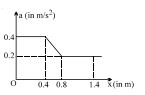
The acceleration of a particle which moves along the positive $x-$axis varies with its position as shown. If the velocity of the particle is $0.8 m/s$ at $x = 0$ , the velocity of the particle at $x = 1.4$ is(in $m/s$)
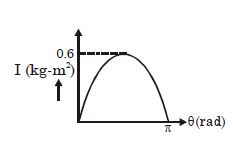
Figure shows the variation of the moment of inertia of a uniform rod, about an axis passing through its centre and inclined at an angle $\theta$ to the length. The moment of inertia of the rod about an axis passing through one of its ends and making an angle $\theta  = \frac{\pi }{3}$ will be ........ $ kg-m^2$.
Two springs $A$ and $B$ having spring constant $K_{A}$ and $K_{B}\left(K_{A}=2 K_{B}\right)$ are stretched by applying force of equal magnitude. If energy stored in spring $A$ is $E_{A}$ then energy stored in $B$ will be
A body is sliding down an inclined plane (angle of inclination $45^o$). If the coefficient of friction is $0.5$ and $g = 9.8\, m/s^2$. then the acceleration of the body downwards in $m/s^2$ is
The specific heat capacity of solids is given by:
A small steel ball is dropped into a long cylinder containing glycerine. Which one of the following is the correct representation of the velocity time graph for the transit of the ball?
$Assertion$ : Moment of inertia depends on the axis of rotation and the nature of distribution of the mass of the body.
$Reason$ : Moment of inertia is the rotational inertia of the body
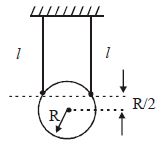
A disc of mass $m$ and radius $R$ is attached to celling with the help of ropes of length $l$. Find the time period of small oscillation of disc in the plane of disc.
A ball $P$ is dropped vertically and another ball Q is thrown horizontally with the same velocities from the same height and at the same time. If air resistance is neglected, then