Two wires are producing fundamental notes of the same frequency. Change in which of the following factors of one wire will not produce beats between them
Easy


Download our appand get started for free
Experience the future of education. Simply download our apps or reach out to us for more information. Let's shape the future of learning together!No signup needed.*
Similar Questions
- 1Two uniform strings $A$ and $B$ made of steel are made to vibrate under the same tension. if the first overtone of $ A$ is equal to the second overtone of $B$ and if the radius of $A$ is twice that of $B,$ the ratio of the lengths of the strings isView Solution
- 2A person driving car at a constant speed of $15\,m / s$ is approaching a vertical wall. The person notices a change of $40\,Hz$ in the frequency of his car's horn upon reflection from the wall. The frequency of horn is ............ $Hz$. (Given : Speed of sound : $330\,m / s$ )View Solution
- 3View SolutionA pulse or a wave train travels along a stretched string and reaches the fixed end of the string. It will be reflected back with
- 4The figure represents the instantaneous picture of a longitudinal harmonic wave travelling along the negative $x$-axis. Identify the correct statement $(s)$ related to the movement of the points shown in the figure. The stationary points areView Solution
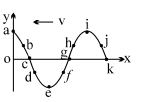
- 5A source of sound emits waves with frequency $f \,Hz$ and speed $V\, m/sec$. Two observers move away from this source in opposite directions each with a speed $0.2\, V$ relative to the source. The ratio of frequencies heard by the two observers will beView Solution
- 6View SolutionThe loudness and pitch of a sound depends on
- 7The equation of progressive wave is $y = a\sin (200\,t - x)$. where $x$ is in meter and $t$ is in second. The velocity of wave is ..... $m/sec$View Solution
- 8The $(x, y)$ coordinates of the corners of a square plate are $(0, 0), (L, 0), (L, L)$ and $(0, L).$ The edges of the plate are clamped and transverse standing waves are set up in it. If $u(x, y)$ denotes the displacement of the plate at the point $(x, y)$ at some instant of time, the possible expression(s) for $u$ is(are) ($a =$ positive constant)View Solution
- 9In an experiment to study standing waves, you use a string whose mass per length is $μ$ = $(1.0 ± 0.1) × 10^{-4}\ kg/m$ . You look at the fundamental mode, whose frequency $f$ is related to the length $L$ and tension $T$ of the string by the following equation $L$ = $\frac{1}{{2f}}\sqrt {\frac{T}{\mu }} $ You make a plot with $L$ on the $y-$ axis and $\sqrt T$ on the $x-$ axis, and find that the best fitting line is $y$ = $(8.0 ± 0.3) × 10^{-3}x + (0.2 ± 0.04)$ in $SI\ units$ . What is the value of the frequency of the wave (including the error)? Express your result in $SI\ unit\ (Hz)$View Solution
- 10If $l_1$ and $l_2$ are the lengths of air column for the first and second resonance when a tuning fork of frequency $n$ is sounded on a resonance tube, then the distance of the displacement antinode from the top end of the resonance tube is:View Solution