Question
Two wires carrying equal currents i each, are placed perpendicular to each other, just avoiding a contact. If one wire is held fixed and the other is free to move under magnetic forces, what kind of motion will result?

Answer

The magnetic force on a wire carrying an electric current i is $\overrightarrow{\text{F}}=\text{i}.\big(\overrightarrow{\text{l}}\times\overrightarrow{\text{B}}\big),$ where l is the length of the wire and B is the magnetic field acting on it. Suppose we have one wire in the horizontal direction (fixed) and other wire in the vertical direction (free to move). If the horizontal wire is carrying current from right to left is held fixed perpendicular to the vertical wire, which is free to move, the upper portion of the free wire will tend to move in the left direction and the lower portion of the wire will tend to move in the right direction, according to Fleming's left hand rule, as the magnetic field acting on the wire due to the fixed wire will point into the plane of paper above the wire and come out of the paper below the horizontal wire and the current will flow in upward direction in the free wire. Thus, the free wire will tend to become parallel to the fixed wire so as to experience maximum attractive force.

Need a full question paper?

Generate a complete, print-ready paper with questions like this in minutes — across 16+ boards, with answer keys.
Start Generating Free

Similar questions

Two tiny spheres carrying charges 1.5 µC and 2.5 µC are located 30 cm apart. Find the potential and electric field:
  1. At the mid-point of the line joining the two charges, and
  2. At a point 10 cm from this midpoint in a plane normal to the line and passing through the mid-point.
Two spherical bodies, each of mass 50kg, are placed at a separation of 20cm. Equal charges are placed on the bodies and it is found that the force of Coulomb repulsion equals the gravitational attraction in magnitude. Find the magnitude of the charge placed on either body.
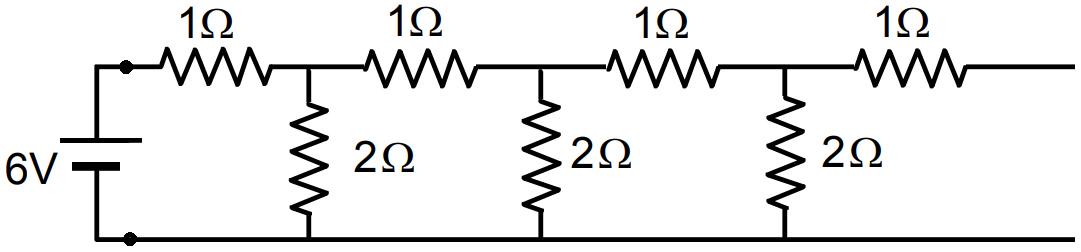
An infinite ladder is constructed with $1\Omega$ and $2\Omega$ resistors, as shown in the figure.

(a) Find the effective resistance between the points A and B. (b) Find the current that passes through the $2\Omega$ resistor nearest to the battery.

A hollow tube has a length l1 inner radius R1 and outer radius R2. The material has a thermal conductivity K. Find the heat flowing through the walls of the tube if.
  1. The flat ends are maintained at temperatures T1 and T2(T2 > T1)
  2. The inside of the tube is maintained at temperature T1 and the outside is maintained at T2.
Suppose India had a target of producing by 2020 AD, 200,000 MW of electric power, ten percent of which was to be obtained from nuclear power plants. Suppose we are given that, on an average, the efficiency of utilization (i.e. conversion to electric energy) of thermal energy produced in a reactor was 25%. How much amount of fissionable uranium would our country need per year by 2020? Take the heat energy per fission of $^{235}\text{U}$ to be about 200MeV.
Solve the previous problem if the pulley has a moment of inertia I about its axis and the string does not slip over it.
What is Gauss theorem? With its help, obtain an expression for the electric field intensity at any point near a uniformly charged linear conductor of infinite length.###Make the necessary diagram and with the help of Gauss law, calculate the electric field intensity at any point due to a charged wire of infinite length. Plot the change in intensity with distance.###Define Gauss' law. With its help, find the value of electric field intensity at a distance from a uniformly charged linear conductor of infinite extension. Make the necessary diagram and also make a graph of the change of electric field with distance.
A radio can tune in to any station in the 7.5 MHz to 12 MHz band. What is the corresponding wavelength band?
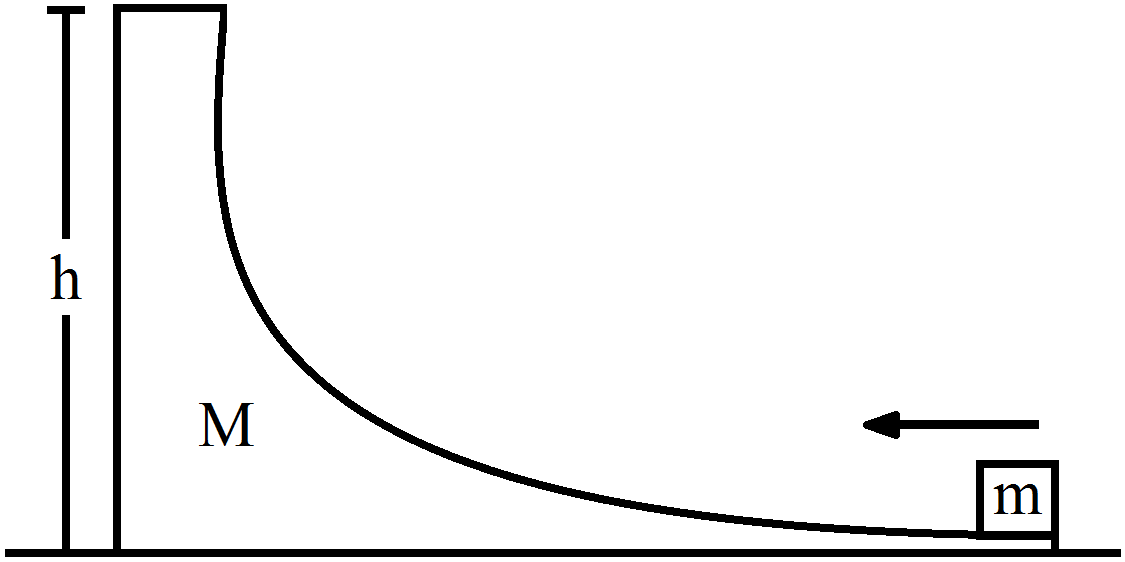
Figure shows a small body of mass m placed over a larger mass M whose surface is horizontal near the smaller mass and gradually curves to become vertical. The smaller mass is pushed on the longer one at a speed v and the system is left to itself. Assume that all the surfaces are frictionless.
  1. Find the speed of the larger block when the smaller block is sliding on the vertical part.
  2. Find the speed of the smaller mass when it breaks off the larger mass at height h.
  3. Find the maximum height (from the ground) that the smaller mass ascends.
  4. Show that the smaller mass will again land on the bigger one. Find the distance traversed by the bigger block during the time when the smaller block was in its flight under gravity.
​​​​​​​
An electron emitted by a heated cathode and accelerated through a potential difference of 2.0 kV, enters a region with uniform magnetic field of 0.15 T. Determine the trajectory of the electron if the field,
  1. is transverse to its initial velocity,
  2. makes an angle of 30º with the initial velocity.