Question
Two wires carrying equal currents i each, are placed perpendicular to each other, just avoiding a contact. If one wire is held fixed and the other is free to move under magnetic forces, what kind of motion will result?

Answer

The magnetic force on a wire carrying an electric current i is $\overrightarrow{\text{F}}=\text{i}.\big(\overrightarrow{\text{l}}\times\overrightarrow{\text{B}}\big),$ where l is the length of the wire and B is the magnetic field acting on it. Suppose we have one wire in the horizontal direction (fixed) and other wire in the vertical direction (free to move). If the horizontal wire is carrying current from right to left is held fixed perpendicular to the vertical wire, which is free to move, the upper portion of the free wire will tend to move in the left direction and the lower portion of the wire will tend to move in the right direction, according to Fleming's left hand rule, as the magnetic field acting on the wire due to the fixed wire will point into the plane of paper above the wire and come out of the paper below the horizontal wire and the current will flow in upward direction in the free wire. Thus, the free wire will tend to become parallel to the fixed wire so as to experience maximum attractive force.

Need a full question paper?

Generate a complete, print-ready paper with questions like this in minutes — across 16+ boards, with answer keys.
Start Generating Free

Similar questions

A source of frequency 250Hz produces sound waves of wavelength 1.32m in a gas at STP. Calculate the change in the wavelength, when temperature of the gas is 40°C.
The edge of an aluminium cube is 10cm long. One face of the cube is firmly fixed to a vertical wall. A mass of 100kg is then attached to the opposite face of the cube. The shear modulus of aluminium is 25G Pa. What is the vertical deflection of this face?
Prove that the total speed of a particle in simple harmonic motion energy is directly proportional to the square of the particle's amplitude and the square of its frequency.
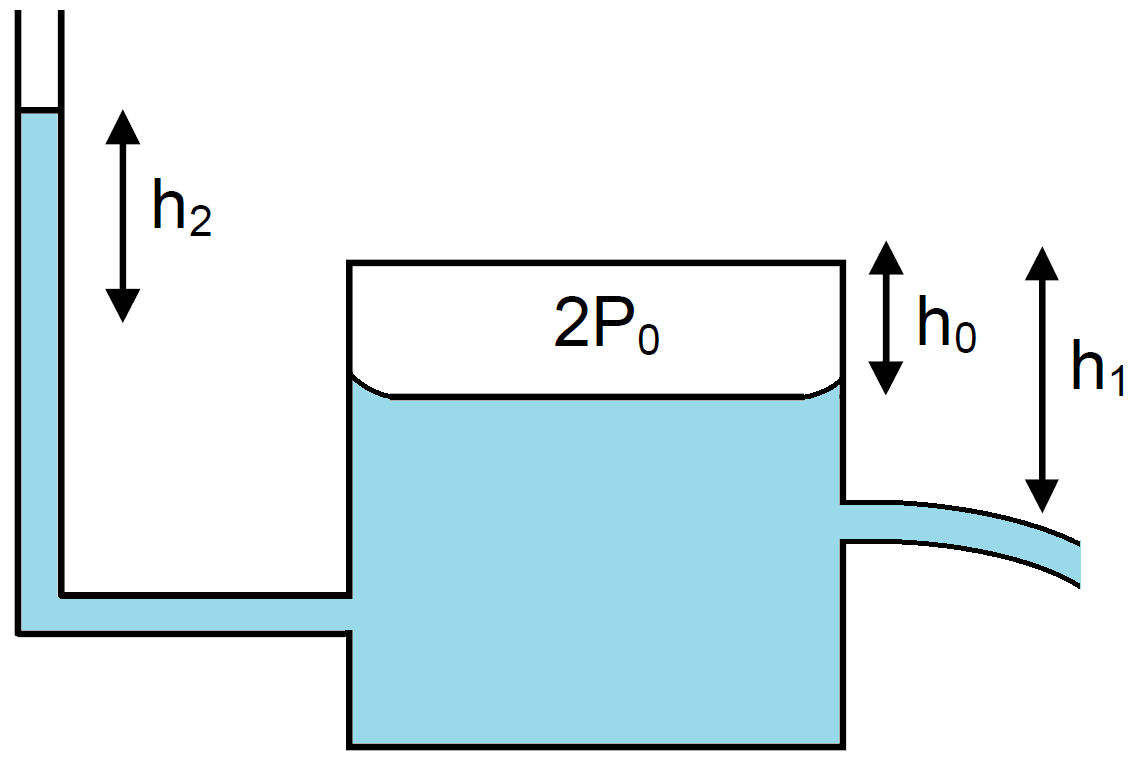
Figure. shows a large closed cylindrical tank containing water. Initially the air trapped above the water surface has a height h0 and pressure 2p0 where p0 is the atmospheric pressure. There is a hole in the wall of the tank at a depth h1 below the top from which water comes out. A long vertical tube is connected as shown.
  1. Find the height h2 of the water in the long tube above the top initially.
  2. Find the speed with which water comes out of the hole.
  3. Find the height of the water in the long tube above the top when the water stops coming out of the hole.

A disc of radius R is rotating with an angular speed $\omega_\text{o}$ about a horizontal axis. It is placed on a horizontal table. The coefficient of kinetic friction is $\mu_\text{k}{:}$
  1. What was the velocity of its centre of mass before being brought in contact with the table?
  2. What happens to the linear velocity of a point on its rim when placed in contact with the table?
  3. What happens to the linear speed of the centre of mass when disc is placed in contact with the table?
  4. Which force is responsible for the effects in (b) and (c).
  5. What condition should be satisfied for rolling to begin?
  6. Calculate the time taken for the rolling to begin.
Air is streaming past a horizontal air plane wing such that its speed is 120ms-1 over the upper surface and 90ms-1 at the lower surface. If the density of air is 1.3kg m-3, find the difference in pressure between the top and bottom of the wing. If wing is 10m long and has an average width of 2m, calculate the gross lift of the wing.
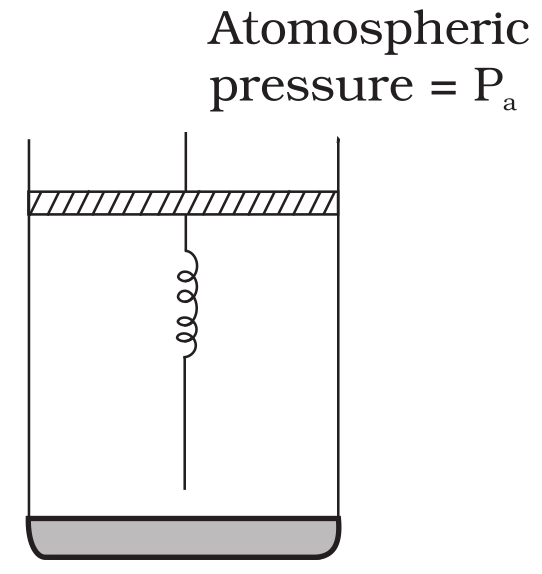
Consider one mole of perfect gas in a cylinder of unit cross section with a piston attached (Fig.) A spring (spring constant k) is attached (unstretched length L) to the piston and to the bottom of the cylinder. Initially the spring is unstretched and the gas is in equilibrium. A certain amount of heat Q is supplied to the gas causing an increase of volume from Vo to V1.

  1. What is the initial pressure of the system.
  2. What is the final pressure of the system.
  3. Uing the first law of thermodynamics, write down a relation between Q, Pa, V, Vo and k.
Find the centre of mass of a uniform:
  1. Half-disc.
  2. Quarter-disc.
Explain the difference between static friction, kinetic friction and rolling friction.
Explain the motion of a boat floating in water. Find the expression of its period.