MCQ
Two wires of the same material and equal length are joined in parallel combination.  If one of them has half the thickness of the other and the thinner wire has a resistance of 8 ohms, the resistance of the combination is equal to
  • A
    $\frac 58\ ohms$
  • $\frac 85\ ohms$
  • C
    $\frac 38\ ohms$
  • D
    $\frac 83\ ohms$

Answer

Correct option: B.
$\frac 85\ ohms$
$\frac 85\ ohms$

Need a full question paper?

Generate a complete, print-ready paper with questions like this in minutes — across 16+ boards, with answer keys.

Start Generating Free

Similar questions

Find the value of $x$ in the following nuclear reaction. $_7​N^{14 }+ _2​He^{4 }\rightarrow _x​O^{17 }+ _{1}H^1$
A proton and an alpha particle are separately projected in a region where a uniform magnetic field exists. Their initial velocities are perpendicular to direction of magnetic field. If both the particles move around magnetic field in circles of equal radii, the ratio of momentum of proton to alpha particle $\left(\frac{p_{p}}{p_\alpha}\right)$ is
An AC source is rated 220V, 50Hz. The average voltage is calculated in a time interval of 0.01s, It:
The phenomenon of radioactivity is(a) Exothermic change which increases or decreases with temperature(b) Increases on applied pressure(c) Nuclear process does not depend on external factors (d) None of the above


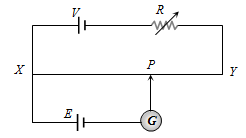
A potentiometer circuit shown in the figure is set up to measure e.m.f. of a cell $E.$ As the point $P$ moves from $X$ to $Y$ the galvanometer $G$ shows deflection always in one direction, but the deflection decreases continuously until $Y$ is reached. In order to obtain balance point between $X$ and $Y$ it is necessary to
The reactance of a circuit is zero. It is possible that the circuit contains:
  1. An inductor and a capacitor.
  2. An inductor but no capacitor.
  3. A capacitor but no inductor.
  4. Neither an inductor nor a capacitor.
An electromagnetic wave going through vacuum is described by $\text{E}=\text{E}_0\sin(\text{kx}-\omega\text{t}),\text{ B}=\text{B}_0\sin(\text{kx}-\omega\text{t})$ Then:
Dielectric constant for metal is (a) Zero  (b) Infinite(c) 1  (d) Greater than 1
       
The magnetic field due to the earth is closely equivalent to that due to(a) A large magnet of length equal to the diameter of the earth(b) A magnetic dipole placed at the centre of the earth(c) A large coil carrying current(d) Neither of the above


In an inelastic collision:
  1. The initial kinetic energy is equal to the final kinetic energy.
  2. The final kinetic energy is less than the initial kinetic energy.
  3. The kinetic energy remains constant.
  4. The kinetic energy first increases then decreases.