Question
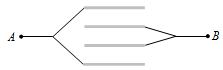
Two wires of the same material are given. The first wire is twice as long as the second and has twice the diameter of the second. The resistance of the first will be(a) Twice of the second(b) Half of the second(c) Equal to the second(d) Four times of the second


Answer

(b) Half of the second

Need a full question paper?

Generate a complete, print-ready paper with questions like this in minutes — across 16+ boards, with answer keys.

Start Generating Free

Similar questions

Three identical capacitors are combined differently. For the same voltage to each combination, the one that stores the greatest energy is(a) Two in parallel and the third in series with it(b) Three in series(c) Three in parallel(d) Two in series and third in parallel with it
   
   
The self-inductance of a solenoid is L. Keeping the length and area same, the number of turns in the coil is increased to two times. The self-inductance of the solenoid will now be-
State the rule that is used to find the direction of field acting at a point near a current-carrying straight conductor.
If ionisation energy of hydrogen atom in ground state is 13.6 eV , then ionisation energy of first excited state will be :
A straight wire carrying a current $i _1 \ \ce{amp}$ runs along the axis of a circular current $i _2 \ \ce{amp} - I$ hen the force of interaction between the two current carrying conductors is
Two condensers of capacities $2C$ and $C$ are joined in parallel and charged upto potential $V$. The battery is removed and the condenser of capacity $C$ is filled completely with a medium of dielectric constant $K$. The $p.d.$ across the capacitors will now be
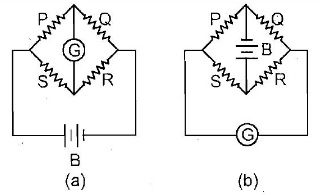
Figure (a) below shows a Wheatstone bridge in which P, Q, R, S are fixed resistances, G is a galvanometer and B is a battery. For this particular case the galvanometer shows zero deflection. Now, only the positions of B and G are interchanged,. as shown in figure (b). The new deflection of the galvanometer.
The energy of characteristic X-ray is a consequence of which of the following?
Four plates of equal area $A$ are separated by equal distances $d$ and are arranged as shown in the figure. The equivalent capacity is
Of the following properties, the photon does not possess: