Two wires of the same material have lengths in the ratio 1 : 2 and their radii are in the ratio $1:\sqrt 2 $. If they are stretched by applying equal forces, the increase in their lengths will be in the ratio
Medium


Download our appand get started for free
Experience the future of education. Simply download our apps or reach out to us for more information. Let's shape the future of learning together!No signup needed.*
Similar Questions
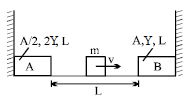
- 1In the given figure, two elastic rods $A$ & $B$ are rigidly joined to end supports. $A$ small mass $‘m’$ is moving with velocity $v$ between the rods. All collisions are assumed to be elastic & the surface is given to be frictionless. The time period of small mass $‘m’$ will be : [$A=$ area of cross section, $Y =$ Young’s modulus, $L=$ length of each rod ; here, an elastic rod may be treated as a spring of spring constant $\frac{{YA}}{L}$ ]View Solution
- 2A spherical ball contracts in volume by $0.02 \%$, when subjected to a normal uniform pressure of $50$ atmosphere. The Bulk modulus of its material is ............... $N / m ^2$View Solution
- 3View SolutionAccording to Hook’s law of elasticity, if stress is increased, the ratio of stress to strain
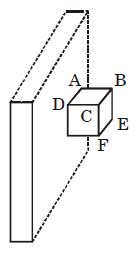
- 4A steel rod is projecting out of rigid wall. The shearing strength of steel is $345 \,\,MN/m^2.$ The dimensions $AB = 5\,\, cm,\,BC = BE = 2\,\, cm.$ The maximum load that can be put on the face $ABCD$ is .......... $kg$ (neglect bending of the rod) $(g = 10\,\, m/s^2)$View Solution
- 5The length of metallic wire is $\ell_{1}$ when tension in it is $T _{1}$. It is $\ell_{2}$ when the tension is $T _{2}$. The original length of the wire will be ...... .View Solution
- 6When a block of mass $M$ is suspended by a long wire of length $L$, the length of the wire become $(L+l) .$ The elastic potential energy stoped in the extended wire is :View Solution
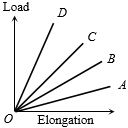
- 7View SolutionThe load versus elongation graph for four wires of the same material is shown in the figure. The thickest wire is represented by the line
- 8A solid sphere of radius $r$ made of a soft material of bulk modulus $K$ is surrounded by a liquid in a cylindrical container. A massless piston of area $a$ floats on the surface of the liquid, covering entire crosssection of cylindrical container. When a mass $m$ is placed on the surface of the piston to compress the liquid, the fractional decrement in the radius of the sphere, $\left( {\frac{{dr}}{r}} \right)$ isView Solution
- 9The stress-strain curves are drawn for two different materials $X$ and $Y$. It is observed that the ultimate strength point and the fracture point are close to each other for material $X$ but are far apart for material $Y$. We can say that materials $X$ and $Y$ are likely to be (respectively)View Solution
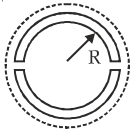
- 10A wooden wheel of radius $R$ is made of two semicircular part (see figure). The two parts are held together by a ring made of a metal strip of cross section area $S$ and length $L$. $L$ is slighly less than $2\pi R$. To fit the ring on the wheel, it is heated so that its temperature rises by $\Delta T$ and it just steps over the wheel.As it cools down to surronding temperature, it presses the semicircular parts together. If the coefficint of linear expansion of the metal is $\alpha$, and its young's modulus is $Y$, the force that one part of wheel applies on the other part isView Solution