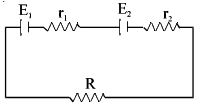
Under what condition current passing through the resistance $R$ can be increased by short circuiting the battery of emf $E_2$. The internal resistances of the two batteries are $r_1$ and $r_2$ respectively.
Medium
Download our app for free and get started
$\frac{E_{1}}{r_{1}+R}>\frac{E_{2}+E_{1}}{r_{1}+r_{2}+R}$
$E_{1} r_{1}+E_{1} r_{2}+E_{1} R>E_{2} r_{1}+E_{2} R+E_{1} r_{1}+E_{1} R$
$E_{1} r_2 >E_{2}\left(r_{1}+R\right)$

Download our appand get started for free
Experience the future of education. Simply download our apps or reach out to us for more information. Let's shape the future of learning together!No signup needed.*
Similar Questions
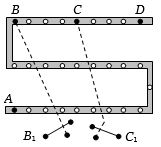
- 1View SolutionFor the post office box arrangement to determine the value of unknown resistance the unknown resistance should be connected between
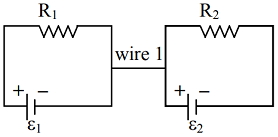
- 2In the circuit, wire $1$ is of negligible resistance. Then,View Solution
- 3Two resistors of resistance $R_1$ and $R_2$ having $R_1 > R_2$ are connected in parallel. For equivalent resistance $R$, the correct statements isView Solution
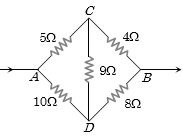
- 4Five resistors are connected as shown in the diagram. The equivalent resistance between $A$ and $B$ is .............. $ohm$View Solution
- 5There are a large number of cells available, each marked $(6 \,V , 0.5 \,\Omega)$ to be used to supply current to a device of resistance $0.75 \,\Omega$, requiring $24 \,A$ current. How should the cells be arranged, so that power is transmitted to the load using minimum number of cells?View Solution
- 6When two identical batteries of internal resistance $1 \Omega$ each are connected in series across a resistor $\mathrm{R}$, the rate of heat produced in $R$ is $J_1$. When the same batteries are connected in parallel across $R$, the rate is $\mathrm{J}_2$. If $\mathrm{J}_1=2.25 \mathrm{~J}_2$ then the value of $\mathrm{R}$ in $\Omega$ isView Solution
- 7View SolutionKirchhoff's second law is based on the law of conservation of
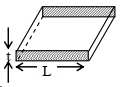
- 8Consider a thin square sheet of side $\mathrm{L}$ and thickness $\mathrm{t}$, made of a material of resistivity $\rho$. The resistance between two opposite faces, shown by the shaded areas in the figure isView Solution
- 9There are two wires of the same length and of the same material and radii $r$ and $2r$ . The ratio of their specific resistance isView Solution
- 10A $4\,\mu F$ conductor is charged to $400\, volts$ and then its plates are joined through a resistance of $1\,k\Omega $. The heat produced in the resistance is ............... $J$View Solution