Question
Under what condition increase in demand would not make any effect $N$ on equilibrium price?

Answer

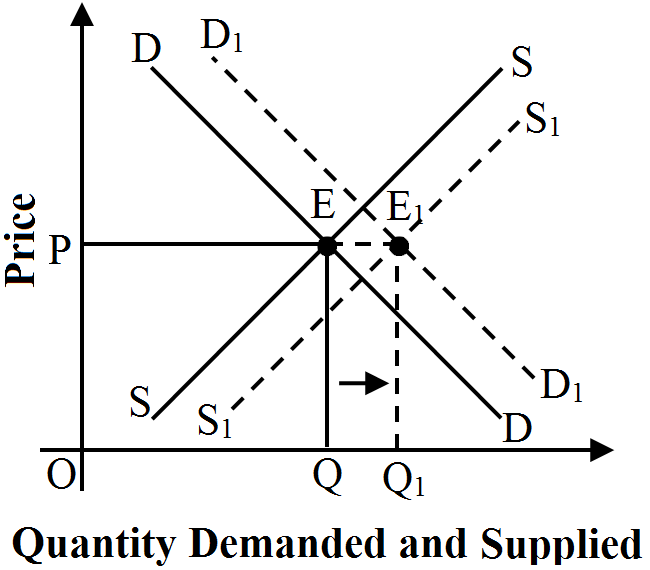
Case I: When supply also increase at the same rate as the demand increases: In the given diagram price is measured on vertical axis and quantity demanded and supplied is measured on horizontal axis. Initially, the equilibrium price is $OP$ and equilibrium quantity is $OQ$. But when "demand and supply both increase at the same rate" then,
  1. Equilibrium price remains constant at $OP$.
  2. Equilibrium quantity rises from $OQ$ to $OQ_1$.

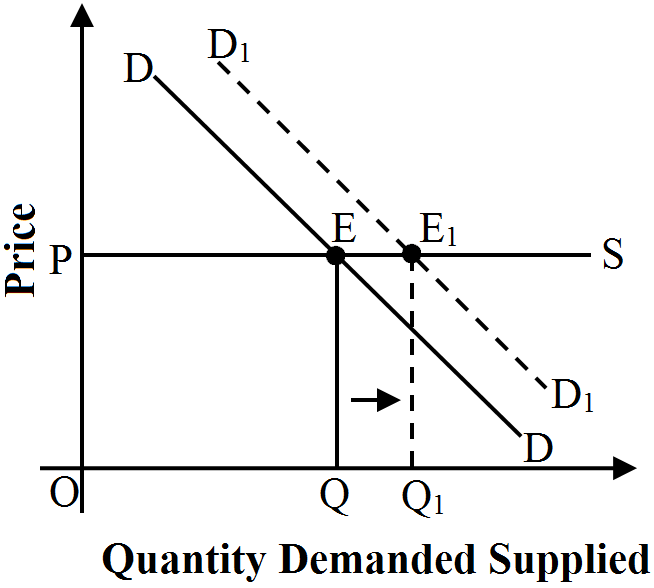
Case II: When supply becomes perfectly elastic: In the given diagram price is measured on vertical axis and quantity demanded and supplied is measured on horizontal axis. Initially, the equilibrium price is $OP$ and equilibrium quantity is $OQ$. But when "supply becomes perfectly elastic and demand increases then.
  1. Equilibrium price remains constant at $OP$.
  2. Equilibrium quantity rises from $OQ$ to $OQ_1$.

Need a full question paper?

Generate a complete, print-ready paper with questions like this in minutes — across 16+ boards, with answer keys.
Start Generating Free

Similar questions

Explain law of statistical regularity and law of inertia of large numbers in short.
Explain how a fall in the price of related goods affect the demand for a given good. Give examples.
OR
A consumer consumes good X. Explain the effect of fall in the price of related goods on the demand of X. Use diagrams.
Distinguish between individual’s demand and market demand. Name the factors affecting demand for a good by an individual.
The price elasticity of supply of a commodity is 2. When its price falls from Rs. 10 to Rs. 8 per unit, its quantity supplied falls by 500 units. Calculate the quantity supplied at the reduced price.
Equilibrium price of an essential medicine is too high. Explain what possible steps can be taken to bring down the equilibrium price, but only through the market forces. Also explain the series of changes that will occur in the market.
Explain the problem of ‘what to produce’ with the help of an example.
A consumer buys $20$ units of a good at ₹ $10$ per unit. The price elasticity of demand of this good is $(-)1$. Calculate quantity demanded by the consumer when price falls to ₹ $8$ per unit.
At the market price of Rs. $10$, a firm supplies $4$ units of output. The market price increases to Rs. $30$. The price elasticity of the firm’s supply is $1.25$. What quantity will the firm supply at the new price?
Commodities X and Y have equal price elasticity of supply. The supply of X rises from 400 units to 500 units due to a 20 percent rise in its price. Calculate the percentage fall in supply of Y if its price falls by 8 percent.
Production in an economy is below its potential due to unemployment. Government starts employment generation schemes. Explain its effect using production possibilities curve.