Question
Under what conditions is total internal reflection possible? Explain it with a suitable example. Define critical angle of incidence and obtain an expression for it.
Answer

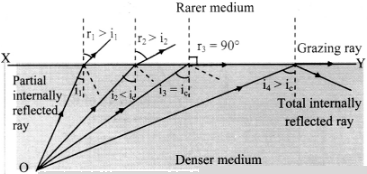
Conditions for total internal reflection:
i. The light ray must travel from denser medium to rarer medium.ii. The angle of incidence in the denser medium must be greater than critical angle for the given pair of media.
Total internal reflection in optical fibre:
iii. Consider an optical fibre made up of core of refractive index $n_1$ and cladding of refractive index $n_2$ such that, $n_1 > n_2$.
iv. When a ray of light is incident from a core (denser medium), the refracted ray is bent away from the normal.
v. At a particular angle of incidence $i_c​​​​​​​$​​​​​​​ in the denser medium, the corresponding angle of refraction in the rarer medium is $90^\circ $.
vi. For angles of incidence greater than $ic$, the angle of refraction become larger than $90^\circ $ and the ray does not enter into rarer medium at all but is reflected totally into the denser medium as shown in figure.
Image
critical angle of incidence and obtain an expression:
i. Critical angle for a pair of refracting media can be defined as that angle of incidence in the denser medium for which the angle of refraction in the rarer medium is 90°.
ii. Let n be the relative refractive index of denser medium with respect to the rarer.
iii. Then, according to Snell’s law,
$n=\frac{n_{\text {denser }}}{n_{\text {raner }}}=\frac{\sin r}{\sin i_c}=\frac{\sin 90^{\circ}}{\sin i_c}$
$\therefore \sin \left(i_c\right)=\frac{1}{n}$

Need a full question paper?

Generate a complete, print-ready paper with questions like this in minutes — across 16+ boards, with answer keys.
Start Generating Free

Similar questions

Two galaxies of masses $9$ billion solar mass and $4$ billion solar mass are $5$ million light years apart. If, the Sun has to cross the line joining them, without being attracted by either of them, through what point it should pass? [Ans: $3$ million light years from the $9$ billion solar mass]
Suppose that the electric field amplitude of an electromagnetic wave is $E_0=120 N / C$ and that its frequency is $v=50.0 MHz. (i)$ Determine, $B_0, \omega, k$, and $\lambda. (ii)$ Find expressions for $\vec{E}$ and $\vec{B}$.
Derive expression for electric field intensity due to a point charge in a material medium.
A $20 g$ bullet leaves a machine gun with a velocity of $200 \ m/s.$ If the mass of the gun is $20 \ kg,$ find its recoil velocity. If the gun fires $20$ bullets per second, what force is to be applied to the gun to prevent recoil?
Discuss the following as special cases of elastic collisions and obtain their exact or approximate final velocities in terms
of their initial velocities.
(i) Colliding bodies are identical.
(ii) A very heavy object collides on a lighter object, initially at rest.
(iii) A very light object collides on a comparatively much massive object, initially at rest.
The figure below shows three situations of a ball at rest under the action of balanced forces. Is the bail in mechanical equilibrium? Explain how the three situations differ.
Image
Derive the expression for average acceleration and instantaneous acceleration for the motion of an object in $x-y$ plane.
Explain the graph showing variation of acceleration due to gravity with altitude and depth.
State the main characteristics of EM waves.
Two small and similar bar magnets have magnetic dipole moment of 1.0 Am² each. They are kept in a plane in such a way that their axes are perpendicular to each other. A line drawn through the axis of one magnet passes through the centre of other magnet. If the distance between their centres is 2 m, find the magnitude of magnetic field at the midpoint of the line joining their centres.