MCQ
Unit of power is
  • Kilowatt
  • B
    Kilowatt-hour
  • C
    Dyne
  • D
    Joule

Answer

Correct option: A.
Kilowatt
a
(a)

Need a full question paper?

Generate a complete, print-ready paper with questions like this in minutes — across 16+ boards, with answer keys.
Start Generating Free

Similar questions

When the adhesive force in the case of liquid and glass is greater than the cohesive forces between the liquid molecules, the shape of the meniscus of liquid in a capillary tube is?
A Merry-go-round, made of a ring-like platform of radius $R$ and mass $M$, is revolving with angular speed $\omega$. A person of mass M is standing on it. At one instant, the person jumps off the round, radially away from the centre of the round (as seen from the round). The speed of the round afterwards is
At the top of the trajectory of a projectile, the directions of its velocity and acceleration are
Gravels are dropped on a conveyor belt at the rate of $0.5\, kg/sec$. The extra force required in newtons to keep the belt moving at $2 \,m/sec$ is
Which of the following will change the time period as they are taken to moon?
  1. A simple pendulum.
  2. A physical pendulum.
  3. A torsional pendulum.
  4. A spring-mass system.
A bullet from a gun is fired on a rectangular wooden block with velocity $u$.When bullet travels $24\,cm$ through the block along its length horizontally, velocity of bullet becomes $\frac{u}{3}$. Then it further penetrates into the block in the same direction before coming to rest exactly at the other end of the block. The total length of the block is $........\,cm$
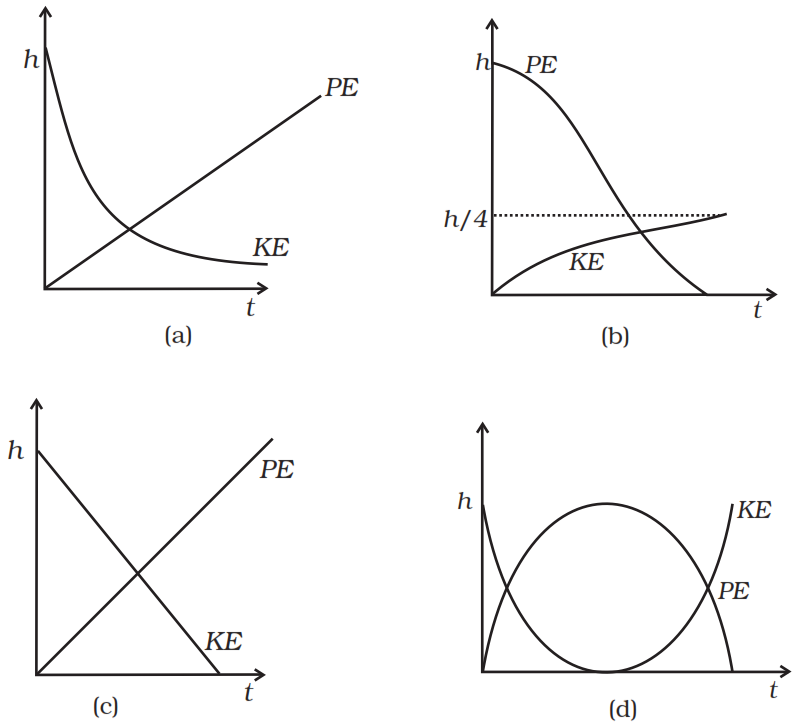
A raindrop falling from a height h above ground, attains a near terminal velocity when it has fallen through a height (3/4)h. Which of the diagrams shown in correctly shows the change in kinetic and potential energy of the drop during its fall up to the ground?
In a standing wave, all particles of the medium cross the mean position with
A rod of length is $3 \;m$ and its mass acting per unit length is directly proportional to distance $x$ from one of its end then its centre of gravity from that end will be at
A soap bubble, blown by a mechanical pump at the mouth of a tube, increases in volume, with time, at a constant rate. The graph that correctly depicts the time dependence of pressure inside the bubble is given by