MCQ
Unit of stress is
  • A
    $N / m$
  • B
    $N-m$
  • $N / m ^2$
  • D
    $N \rightarrow m^2$

Answer

Correct option: C.
$N / m ^2$
(c) Stress $=\frac{\text { Force }}{\text { Area }}=\frac{N}{m^2}$

Need a full question paper?

Generate a complete, print-ready paper with questions like this in minutes — across 16+ boards, with answer keys.
Start Generating Free

Similar questions

If $\vec{A} \quad 3 \hat{i} \quad \hat{j} \quad 2 \hat{k}$ and $\vec{B} \quad 2 \hat{i} \quad 2 \hat{j} \quad 4 \hat{k}$ then value of $\mid \vec{A} u B$ will be
A conductor of $3 \mathrm{~m}$ in length is moving perpendicularly to magnetic field of $10^{-3}$ tesla with the speed of $10^2 \mathrm{~m} / \mathrm{s}$, then the e.m.f. produced across the ends of conductor will be
If the work function of a photometal is $6.825 \mathrm{eV}$. Its threshold wavelength will be $\left(c=3 \times 10^8 \mathrm{~m} / \mathrm{s}\right)$
In a transformer, number of turns in the primary are $140$ and that in the secondary are $280.$ If current in primary is $4\ A$ then that in the secondary is
A travelling wave passes a point of observation. At this point, the time interval between successive crests is 0.2 seconds and
One mole of a perfect gas in a cylinder fitted with a piston has a pressure $P$, volume $V$ and temperature $T$. If the temperature is increased by $1 K$ keeping pressure constant, the increase in volume is
The source producing sound and an observer both are moving along the direction of propagation of sound waves. If the respective velocities of sound, source and an observer are $v, v_s$ and $v_o$, then the apparent frequency heard by the observer will be ( $n=$ frequency of sound)
In thermodynamic process, 200 Joules of heat is given to a gas and 100 Joules of work is also done on it. The change in internal energy of the gas is
The magnetic moment of an electron $(e)$ revolving in an orbit around nucleus with an orbital angular momentum is given by :
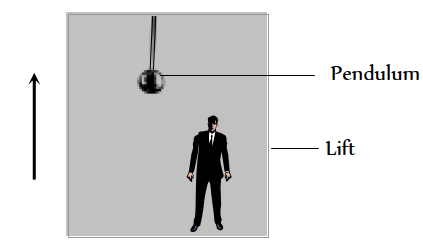
A man measures the period of a simple pendulum inside a stationary lift and finds it to be $T$ sec. If the lift accelerates upwards with an acceleration $g / 4$, then the period of the pendulum will be
Image