MCQ
Unit vector does not have any .......
  • A
    Direction
  • B
    Magnitude
  • Unit
  • D
    All of these

Answer

Correct option: C.
Unit
c
(c)

Unit vector does not have any unit.

Need a full question paper?

Generate a complete, print-ready paper with questions like this in minutes — across 16+ boards, with answer keys.
Start Generating Free

Similar questions

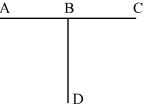
Three conducting rods of same material and cross-section are shown in figure. Temperatures of$ A, D$ and $C$ are maintained at $20^o C, 90^o C$ and $0^o C$. The ratio of lengths of $BD$ and $BC$ if there is no heat flow in $AB$ is:
A ball is dropped from a high rise platform at  $t=0$ starting from rest. After $6$ seconds another ball is thrown downwards from the same platform with a speed $v$. The tow ball meet at $t=18\,s$ . What is the value of $v$ ?..........$m/s$ (Take $g= 10 ms^{-2}$ )
In an experiment of determine the Young's modulus of wire of a length exactly $1\; m$, the extension in the length of the wire is measured as $0.4\,mm$ with an uncertainty of $\pm 0.02\,mm$ when a load of $1\,kg$ is applied. The diameter of the wire is measured as $0.4\,mm$ with an uncertainty of $\pm 0.01\,mm$. The error in the measurement of Young's modulus $(\Delta Y)$ is found to be $x \times 10^{10}\,Nm ^{-2}$. The value of $x$ is

$\left[\right.$ Take $\left.g =10\,m / s ^{2}\right]$
A block of mass m, attached to a spring of spring constant $k$, oscillates on a smooth horizontal table. The other end of the spring is fixed to a wall. The block has a speed $v$ when the spring is at its natural length. Before coming to an instantaneous rest, if the block moves a distance $x$ from the mean position, then
The resistance $R =\frac{ V }{ I },$ where $V =(50 \pm 2) \;V$ and $I=(20 \pm 0.2)\;A.$ The percentage error in $R$ is $x\%$. The value of $x$ to the nearest integer is .........
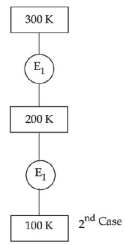
In $1^{\text {st }}$ case, Carnot engine operates between temperatures $300\,K$ and $100\,K$. In $2^{\text {nd }}$ case, as shown in the figure, a combination of two engines is used. The efficiency of this combination (in $2^{\text {ad }}$ case) will be.
A body is started from rest with acceleration 2m/ s2 till it attains the maximum velocity then retards to rest with 3m/ s2. If total time taken is 10 second then maximum speed attained is:
When two progressive waves $\mathrm{y}_1=4 \sin (2 \mathrm{x}-6 \mathrm{t})$ and $\mathrm{y}_2=3 \sin \left(2 \mathrm{x}-6 \mathrm{t}-\frac{\pi}{2}\right)$ are superimposed, the amplitude of the resultant wave is
The average translational energy and the $r.m.s.$ speed of molecules in a sample of oxygen gas at $300 K$ are $6.21 \times {10^{ - 21}}\,J$ and $484\, m/s$ respectively. The corresponding values at $600 K$ are nearly (assuming ideal gas behaviour)
A chef, on finding his stove out of order, decides to boil the water for his wife's coffee by shaking it in a thermos flask. Suppose that he uses tap water at $15^{\circ} C$ and that the water falls 30 cm each shake, the chef makes 30 shakes each minute. Neglecting any loss of thermal energy by the flask, how long must he shake the flask until the water reaches $100^{\circ} C$ ?