MCQ
Universal time is based on
  • A
    Rotation of the earth on its axis
  • B
    Earth's orbital motion around the earth
  • Vibrations of cesium atom
  • D
    Oscillations of quartz crystal

Answer

Correct option: C.
Vibrations of cesium atom
(c) According to the definition.

Need a full question paper?

Generate a complete, print-ready paper with questions like this in minutes — across 16+ boards, with answer keys.
Start Generating Free

Similar questions

The kinetic energy acquired by a mass $m$ in travelling a certain distance $d$ starting from rest under the action of a constant force is directly proportional to
A galvanometer can be used as a voltmeter by connecting a
Find the maximum velocity for skidding for a car moved on a circular track of radius $100 m$. The coefficient of friction between the road and tyre is 0.2
The energy of a photon of light of wavelength $450 \mathrm{~nm}$ is
The plane faces of two identical plano-convex lenses each having focal length of $40 \mathrm{~cm}$ are pressed against each other to form a usual convex lens. The distance from this lens, at which an object must be placed to obtain a real, inverted image with magnification one is
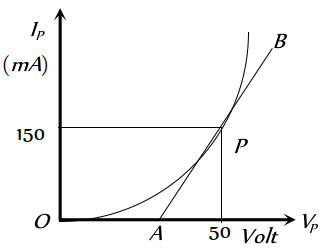
The plate characteristic curve of a diode in space charge limited region is as shown in the figure. The slope of curve at point $P$ is $5.0 m A / V$. The static plate resistance of diode will be
Image
The equation of progressive wave is $y=a \sin (200 t-x)$. where $x$ is in meter and $t$ is in second. The velocity of wave is
If time of flight of a projectile is 10 seconds. Range is 500 meters. The maximum height attained by it will be
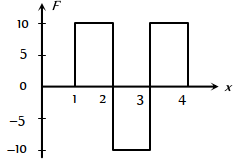
Figure shows the $F_{-x}$ graph. Where $F$ is the force applied and $x$ is the distance covered by the body along a straight line path. Given that $F$ is in newton and $x$ in metre, what is the work done?
Image
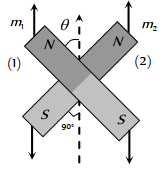
Two magnets of equal mass are joined at right angles to each other as shown the magnet $1$ has a magnetic moment $3$ times that of magnet $2.$ This arrangement is pivoted so that it is free to rotate in the horizontal plane. In equilibrium what angle will the magnet $1$ subtend with the magnetic meridian
Image