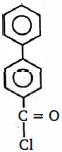
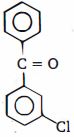
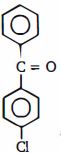
MCQ
Unknown $(A)$ is
  • A

  • B


  • D
    $\begin{matrix}
       O  \\
       ||  \\
       Ph-C-Ph  \\
    \end{matrix}$

Answer

Correct option: C.

c
$(c)$ Friedel-Craft reaction, Acylation is more favourable because of resonance  stabilization.

Need a full question paper?

Generate a complete, print-ready paper with questions like this in minutes — across 16+ boards, with answer keys.
Start Generating Free

Similar questions

Electromagnetic waves travel in a medium which has relative permeability $1.3$ and relative permittivity $2.14$. Then the speed of the electromagnetic wave in the medium will be
Consider a solid sphere of radius $\mathrm{R}$ and mass density $\rho(\mathrm{r})=\rho_{0}\left(1-\frac{\mathrm{r}^{2}}{\mathrm{R}^{2}}\right),  0<\mathrm{r} \leq \mathrm{R} .$ The minimum density of a liquid in which it will float is
The current through choke coil increases form zero to $6A$ in $0.3$ $seconds$ and an induced $e.m.f$. of $30\, V$ is produced. The inductance of the coil of choke is.......$H$
A cylinder of capacity $20$ litres is filled with ${H_2}$ gas. The total average kinetic energy of translatory motion of its molecules is $1.5 \times {10^5}\,J$. The pressure of hydrogen in the cylinder is
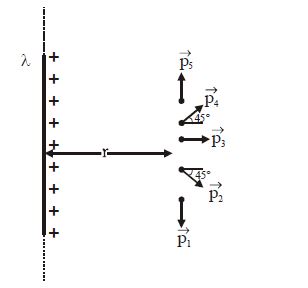
Five identical small electric dipoles are placed at a distance $r$ from an infinitely long straight wire carrying a uniform charge density $\lambda$.If they experience force of magnitude $F_1$, $F_2$, $F_3$, $F_4$ and $F_5$ respectively then
In photo electric effect

$A.$ The photocurrent is proportional to the intensity of the incident radiation.

$B.$ Maximum Kinetic energy with which photoelectrons are emitted depends on the intensity of incident light.

$C.$ Max. $K.E$ with which photoelectrons are emitted depends on the frequency of incident light.

$D.$ The emission of photoelectrons require a minimum threshold intensity of incident radiation.

$E.$ Max. K.E of the photoelectrons is independent of the frequency of the incident light.

Choose the correct answer from the options given below:
Photon and electron are given same energy $({10^{ - 20}}J)$. Wavelength associated with photon and electron are ${\lambda _{Ph}}$ and ${\lambda _{el}}$ then correct statement will be
A simple pendulum with a metallic bob has a time period $T$. The bob is now immersed in a non-viscous liquid and oscillated. If the density of the liquid is $1 / 4$ that of metal, the time period of the same pendulum will be ...........
If a bimetallic strip is heated, it will
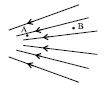
Which of the following is true for the figure showing electric lines of force? ($E$ is electrical field, $V$ is potential)