Question
‘Until the 1800s, the world’s population grew steadily but slowly.’ Why?

Answer

For an extremely long period of human history, until the 1800s, the world’s population grew steadily but slowly. Large numbers of babies were born, but they died early too. This was as there were no proper health facilities. Sufficient food was not available for all the people. Farmers were not able to produce enough to meet the food requirements of all the people. As a result the total increase in population was very low.

Need a full question paper?

Generate a complete, print-ready paper with questions like this in minutes — across 16+ boards, with answer keys.
Start Generating Free

Similar questions

How can the government meet the challenges where everyone can benefit from the clean environment?
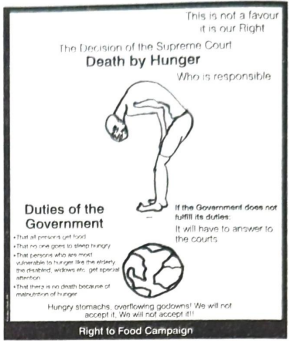
The following is a poster made by the Right to Food campaign.
Read this poster and list the duties of the government to uphold the Right to Food.
How does the phrase "Hungry stomachs, overflowing godowns! We will not accept it!!" used in the poster relate to the photo essay on the Right to Food on.
Image
What simple Do-s and Don't-s can you list in case of a biological disaster?
After Independence, why was there a reluctance to divide the country on linguistic lines?
Imagine that you are watching the Republic Day parade on TV with a friend and she remarks, “Look at these tribals. They look so exotic. And they seem to be dancing all the time”. List three things that you would tell her about the lives of Adivasis in India.
What are population pyramids? How do they help in understanding about the population of a country?
Take some of the public facilities in your area, such as water, electricity, etc. Is there scope to improve these? What in your opinion should be done? Complete the table.
  Is it available? How can it be improved?
Water    
Electricity    
Roads    
Public Transport    
What were the different reasons people had for not sending girls to school?
Read the following extract and answer the questions that follow:
"Not fit for human consumption"
Newspaper provide accounts of the movements in different parts of the country. Here is a report of a police strike in 1946. More than 2000 policemen in Delhi refused to take their food on Thursday morning as a protest against their low salaries and the bad quality of food supplied to them from the Police Lines kitchen. As the news spread to the other police stations, the men there also refused to take food… One of the strikers said: "The food supplied to us from the Police Lines kitchen is not fit for human consumption. Even cattle would not eat the chappattis and dal which we have to eat".
Hindustan Times,
22 March, 1946
  1. What is newspaper clipping all about?
  2. Why did the policeman refuse to take their food on Thursday morning?
  3. What was the remark of one of the strikers on the food supplied to them?
  4. What was the reaction of policemen at other police stations?
Describe the Indian National Movement.