Question
  1. Urea forms an ideal solution in water. Determine the vapour pressure of anaqueous solution containing 10% by mass of urea at 40°C. (Vapour pressure of water at 40°C = 55.3 mm of Hg)
  2. Why is freezing point depression of 0.1 M sodium chloride solution nearly twice that of 0.1 M glucose solution?
Answer

  1. $\frac{\text{P}^{\circ}_{A}-\text{P}_{A}}{\text{P}^{\circ}_{A}}=\frac{\text{Moles of Solvent}}{\text{Moles solute + Moles of solvent}}$
$\text{P}^{\circ}_{\text{A}}=55.3\text{ mm of Hg, P}_{\text{A}}=?$

Mass of Solvent = (100 - 10)g = 90g,

No. of Moles of solvent =$\frac{\text{90g}}{\text{18g mol}^{-1}}=\text{5 mol} $

No. of Moles of solute$\frac{\text{10}}{\text{60}}=\frac{\text{1}}{\text{6}}\text{ mol}$

$\frac{\text{55.3 - P}_{A}}{\text{55.3}}=\frac{\frac{1}{6}}{\frac{1}{6}+5}=\frac{\text{1}}{\text{31}}$

$\text{P}_{A}\text{=53.52 mm Hg}.$
  1. Sodium chloride dissolves in water to form two ions whereas glucose is non–electrolyte and remains in molecular form only.

Need a full question paper?

Generate a complete, print-ready paper with questions like this in minutes — across 16+ boards, with answer keys.

Start Generating Free

Similar questions

Complete the following reactions :
  1. $\text{C}_6\text{H}_5-\text{COO}^-\text{NH}^+_4\xrightarrow{\text{ }\text{ }\text{ }\text{ }\text{ }\text{ }\text{ }\text{ }\triangle\text{ }\text{ }\text{ }\text{ }\text{ }\text{ }\text{ }\text{ }\text{ }}\text{A}\xrightarrow{\text{ }\text{ }\text{ }\text{ }\text{Br}_2/\text{KOH}\text{ }\text{ }\text{ }\text{ }}\text{B}\xrightarrow{\text{ }\text{ }\text{ }\text{ }\text{CH}_3\text{COC}l_3/\text{pyridine}\text{ }\text{ }\text{ }\text{ }}\text{C}$
  2. $\text{C}_6\text{H}_5\text{N}^+_2\text{BF}^-_4\xrightarrow[\triangle]{\text{ }\text{ }\text{ }\text{ }\text{ }\text{ }\text{ }\text{ }\text{NaNO}_2/\text{Cu}\text{ }\text{ }\text{ }\text{ }\text{ }\text{ }\text{ }\text{ }\text{ }}\text{A}\xrightarrow{\text{ }\text{ }\text{ }\text{ }\text{Sn}/\text{HC}l\text{ }\text{ }\text{ }\text{ }}\text{B}\xrightarrow[\triangle]{\text{ }\text{ }\text{ }\text{ }\text{CHC}l_3+\text{alc. KOH}\text{ }\text{ }\text{ }\text{ }}\text{C}$
Differentiate between the following:
  1. Amylose and Amylopectin.
  2. Peptide linkage and Glycosidic linkage.
  3. Fibrous proteins and Globular proteins.
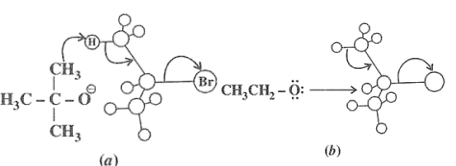
One of the two figures given below represents substitution and the other represents elimination. Indicate which is substitution and which is elimination.
Image
Various isomeric haloalkanes with the general formula $C_4H_9CI$ undergo hydrolysis reaction. Among them, compound $"A\ "$ is the most reactive through $S_N^1 $ mechanism. Identify $"A\ "$ citing the reason for your choice. Write the mechanism for the reaction.
Although $+3$ oxidation states is the characteristic oxidation state of lanthanoids but cerium shows $+4$ oxidation state also. Why?
Why is an external emf of more than $2.2V$ required for the extraction of $Cl_2$ from brine?
The chemistry of the actinoid elements is not so smooth as that of the lanthanoids. Justify this statement by giving some examples from the oxidation state of these elements.
What is the role of flux in metallurgical processes?
How would you account for the following:
  1. $H_2S$ is more acidic than $H_2O.$
  2. The $N–O$ bond in ${NO_2}^-$ is shorter than the $N–O$ bond in ${NO_3}^-.$
  3. Both $O_2$ and $F_2$ stabilise high oxidation states but the ability of oxygen to stabilize the higher oxidation state exceeds that of fluorine.
How do you convert the following:
  1. Prop-1-ene to Propan-2-ol
  2. Bromobenzene to 2-bromoacetophenone
  3. 2-bromobutane to But-2-ene