Question
Use a graph paper for this question (take 10 small divisions = 1 unit on both axis).
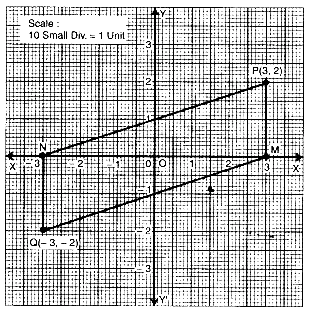
Plot the points P (3, 2) and Q (-3, -2), from P and Q draw perpendicular PM and QN on the X- axis.
(i) Name the image of P on reflection at the origin.
(ii) Assign, the. special name to the geometrical figure. PMQN and find its area.
(iii) Write the co-ordinates of the point to which M is mapped on reflection in (i) X- axis,
(ii) Y-axis, (iii) origin.
Answer


In the graph paper
(i) Q (-3, -2)
(ii) Parallelgoram;
Area of ΔPMN
$=\frac{1}{2} PM \times MN$
$=\frac{1}{2} \times 2 \times 63$
∴ Area of PMQN
= 2 x ΔPMN
= 2 x 6
= 12 square unit
(iii) Co-ordinates of M(3, 0)
(i) (3, 0), (ii) (-3, 0), (iii) (-3, 0).

Need a full question paper?

Generate a complete, print-ready paper with questions like this in minutes — across 16+ boards, with answer keys.

Start Generating Free

Similar questions

If $A=\left[\begin{array}{cc}0 & 2 \\ 5 & -2\end{array}\right], B=\left[\begin{array}{cc}1 & -1 \\ 3 & 2\end{array}\right]$ and $I$ is unit matrix of order $2 \times 2$ find $B^2 A$
Prove that the following set of point is collinear :
$(5 , 1),(3 , 2),(1 , 3)$
Prove the following identitie:$\operatorname{cosec} A-\cot A=\frac{\sin A}{1+\cos A}$
 $(x-2)$ is a factor of the expression $x^3+a x^2+b x+6$. When this expression is divided by $(x-3)$, it leaves the remainder 3 . Find the values of $a$ and $b$.
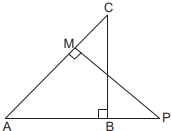
In the given figure $\triangle A B C$ and $\triangle A M P$ are right angled at $B$ and $M$ respectively.
Given $\mathrm{AC}=10 \mathrm{~cm}, \mathrm{AP}=15 \mathrm{~cm}$ and $\mathrm{PM}=12 \mathrm{~cm}$.
(a) Prove $\triangle \mathrm{ABC} \sim \triangle \mathrm{AMP}$
(b) Find AB and BC .
Image
Find the fourth proportion to the following :
$(x^2 - y^2),(x^3 + y^3)$ and $(x^3 - xy^2 + x^2y- y^3)$
Find the value of $m$ if the distance between the points $(m,-4)$ and $(3,2)$ is $3 \sqrt{5}$ units.
The boundary of the shaded region in the given diagram consists of three semicircular areas, the smaller ones being equal and it’s diameter $5$ cm, if the diameter of the larger one is $10$ cm,
calculate:
(i) The length of the boundary,
(ii) The area of the shaded region. (Take $\pi = 3.14$)
From a well shuffled deck of 52 cards, one card is drawn. Find the probability that the card drawn will:   be a face card.
A pair of dice is thrown. Find the probability of getting a sum of 10 or more, if 5 appears on the first die.