Question
Use a pair of compasses and construct the following angles:$135^\circ $
Answer


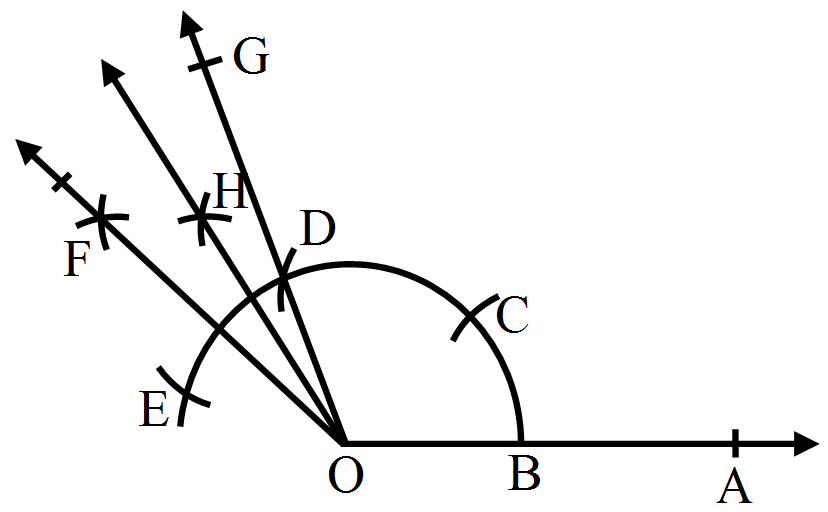
Steps of Construction:
$1.$Draw a ray $OA.$
$2.$With $O$ as centre and any suitable radius draw an arc above $OA,$ cutting it at $B.$
$3.$With $B$ as centre and same radius as before draw another arc to cut the previous arc at $C.$ With $C$ as centre and same radius draw the arc to cut it at $D.$ Again with $D$ as centre and same radius cut the arc at $E.$
$4.$Join $OD$ and produce it to $G.$ Then $\angle\text{AOG}=120^\circ.$
$5.$With $D$ as centre and radius more than half $DE$ draw an arc.
$6.$With $E$ as centre and same radius draw another arc to cut the previous arc at $F$ Join $OF.$
$7.$Draw the bisector $OH$ of $\angle\text{GOF}.$
Then, $\angle\text{AOH}=135^\circ$ is the required angle.

Need a full question paper?

Generate a complete, print-ready paper with questions like this in minutes — across 16+ boards, with answer keys.

Start Generating Free

Similar questions

Find the greatest number that will divide $445, 572$ and $699,$ leaving remainders $4, 5, 6$ respectively.
The following table shows the interest paid by a company (in lakhs):
Year
$1995-96$
$1996-97$
$1997-98$
$1998-99$
$1999-2000$
Interest (in lakhs of rupees)
$20$
$25$
$15$
$18$
$30$
Draw the bar graph to represent the above information.
A rectangular piece of land measure 0.7 km by 0.5 km. Each side is to be fenced with four rows of wires. What length of the wire is needed?
Using ruler and compasses only, draw a right angle.
Solve the following equation and verify the answer: $3(2 - 5x) - 2(1 - 6x) = 1$
Match the equivalent fractions and write another $2$ for each:
$(i)$ $\frac{250}{400}$ $(a)$ $\frac{2}{3}$
$(ii)$ $\frac{180}{200}$ $(b)$ $\frac{2}{5}$
$(iii)$ $\frac{660}{990}$ $(c)$ $\frac{1}{2}$
$(iv)$ $\frac{180}{360}$ $(d)$ $\frac{5}{8}$
$(v)$ $\frac{220}{550}$ $(e)$ $\frac{9}{10}$
Draw an angle and label it as $\angle\text{BAC}.$ Draw its bisector ray $AX$ and take a point $P$ on it. From $P$ draw line segments $PM$ and $PN,$ such that $\text{PM}\perp\text{AB}$ and $\text{PN}\perp\text{AC},$ where $M$ and $N$ are respectively points on rays $AB$ and $AC$. Measure $PM$ and $PN.$ Are the two lengths equal$?$
Solve the following equation and verify the answer: $\text{2x}-\frac{1}{2}=3$
The following data gives the production of food grains (in thousand tones) for some years:
Years
$1995$
$1996$
$1997$
$1998$
$1999$
$2000$
Production (in thousand tonnes)
$120$
$150$
$140$
$180$
$170$
$190$
Represent the above data with the help of a bar graph.