Question
Use Huygens's principle to explain the formation of diffraction pattern due to a single slit illuminated by a monochromatic source of light.
When the width of the slit is made double the original width, how would this affect the size and intensity of the central diffraction band?
Answer

Explanation:
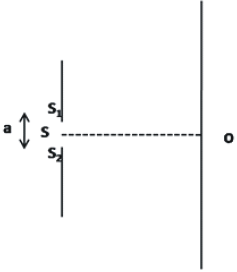
As per Huygen's Principle
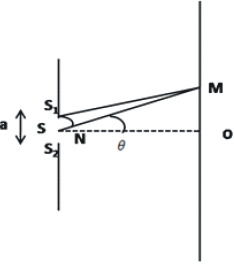
Net effect at any point = sum total of contribution of all wavelets with proper phase difference At the central Point (O) Contribution from each half in $SS_1$ is in phase with that from the corresponding
part in $SS_2.$ Hence, O is a maxima

At the point M where $\mathrm{SM}-\mathrm{SM}_1=\lambda / 2$ Phase difference between each wavelet from $\mathrm{SS}_1$ and corresponding wavelet from $\mathrm{SS}_2=\lambda / 2$ Hence, M would be a minima. All such points (path difference $=\mathrm{n} \lambda / 2$ ) are also minima. Similarly, all points, for which path difference $=(2 n+1) \lambda / 2$, are maxima but with decreasing intensity. From the figure

Half angular width of central maxima= $\lambda$/a $\therefore$, Size of central maxima will be reduced to half and intensity of central maxima will be four times.

Need a full question paper?

Generate a complete, print-ready paper with questions like this in minutes — across 16+ boards, with answer keys.

Start Generating Free

Similar questions

Suppose we have 12 protons and 12 neutrons. We can assemble them to form either a :uMg nucleus or two 12C nuclei. In which of the two cases more energy will be liberated?
The specific heat capacities of hydrogen at constant volume and at constant pressure are ${2.4cal-g^{-1} }{^\circ C^{−1}}$ and ${3.4cal-g^{-1} }{^\circ C^{-1}}$ respectively. The molecular weight of hydrogen is $2g-mol^{-1}$ and the gas constant, $R = 8.3 \times 10^7$ erg$^\circ C^{-1}$ mol$^{-1}$. Calculate the value of J.
A constant force of 2.50N accelerates a stationary particle of mass 15g through a displacement of 2.50m. Find the work done and the average power delivered.
There are two sources of light A and B. The wavelength of light emitted from A is from $8000\mathring{\text{A}}$ to $11000\mathring{\text{A}},$ while that from B is from $3000\mathring{\text{A}}$ to $6000\mathring{\text{A}}.$ The intensity of A is 4 times that of B. But when light of A falls on metal, photoelectrons are not emitted whereas light of B can eject photoelectrons from the same metal. Explain its reason.
A uniform rod of mass 300g and length 50cm rotates at a uniform angular speed of 2rad/s about an axis perpendicular to the rod through an end. Calculate:
  1. The angular momentum of the rod about the axis of rotation.
  2. The speed of the centre of the rod.
  3. Its kinetic energy.
Find the time required for a 50Hz alternating current to change its value from zero to the rms value.
The magnetic field in a plane electromagnetic wave is given by $\text{B}=(200\mu\text{T})\sin\Big[\big(4.0\times10^{15}\text{s}^{-1}\big)\Big(\text{t}-\frac{\text{x}}{\text{c}}\Big)\Big]$ Find the maximum electric field and the average energy density corresponding to the electric field.
On the basis of the charging of capacitor, clarify that there is something missing in the Ampere circuital law.
A giant refracting telescope at an observatory has an objective lens of focal length 15 m. If an eyepiece lens of focal length 1.0 cm is used, find the angular magnification of the telescope.
If this telescope is used to view the moon, what is the diameter of the image of the moon formed by the objective lens? The diameter of the moon is $3.42 \times 10^6\ m$ and the radius of the lunar orbit is $3.8 \times 10^6\ m.$
The band gap between the valence and the conduction bands in zinc oxide (ZnO) is 3.2eV. Suppose an electron in the conduction band combines with a hole in the valence band and the excess energy is released in the form of electromagnetic radiation. Find the maximum wavelength that can be emitted in this process.