Question
Using a flow chart explain the process of decomposition. List the factors which affect this process.

Answer

Ecomposition It is the process of breaking down of complex organic matter into inorganic substances like water, carbon dioxide and nutrients by decomposers. Detritus is the raw material for decomposition. It includes dead remains of plants (leaves, bark and flowers) and animals including faecal matter.

Different steps involved in the process of decomposition are:
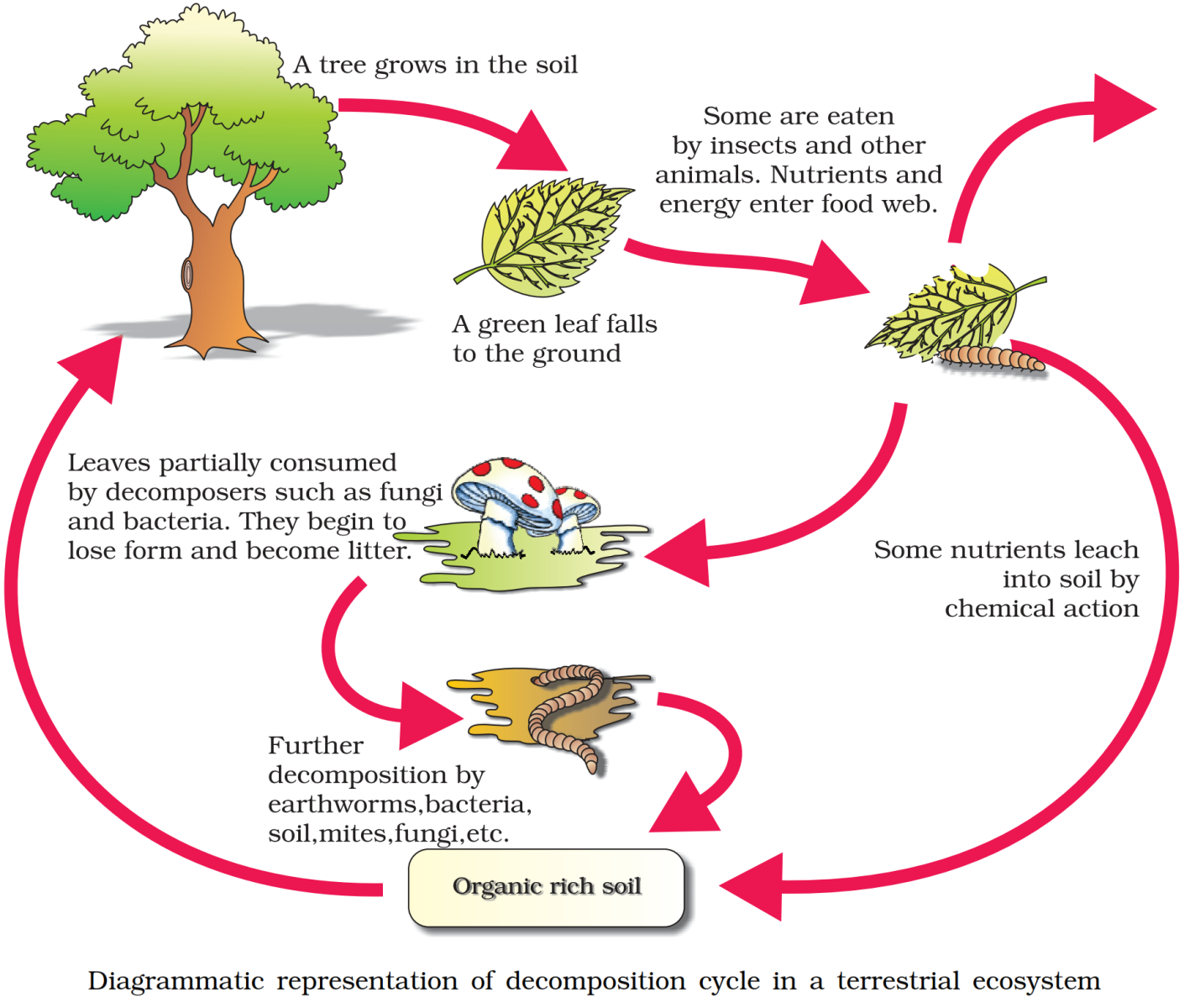
  1. Fragmentation: It is process of breakdown of detritus into smaller particles by detritivores (e.g. earthworm).

  2. Leaching: It is the process by which water-soluble inorganic nutrients go down into the soil horizon and get precipitated as unavailable salts.

  3. Catabolism: It is the process of degradation of detritus into simple organic material by the action of bacterial and fungal enzymes and then their further conversion into simpler inorganic compounds.

  1. Humification: It is a process that leads to accumulation of a dark coloured amorphous and colloidal substance called humus, which is highly resistant to microbial action and undergoes decomposition at a very slow rate. Being colloidal in nature, it serves as a reservoir of nutrients.

  2. Mineralisation: It is process of degradation of humus by microbial action and release of inorganic nutrients

Need a full question paper?

Generate a complete, print-ready paper with questions like this in minutes — across 16+ boards, with answer keys.

Start Generating Free

Similar questions

Draw a diagrammatic sketch of biogas plant, and label its various components given below: Gas Holder, Sludge Chamber, Digester, Dung + water chamber.
Discuss the role of microbes as biofertilisers in detail.
Prashant's mother is suffering from a disorder for which doctor suggests her to take insulin injections. But his mother declines as she presumes injections are prepared by slaughtering of animals. Doctor smiled and explained him about the genetically engineered human insulin produced these days. He also convinced her to take injections.
  1. Name the bacterium that is used to produce human insulin.
  2. Name the company that first produced human insulin.
  3. Name the disease that is treated by using human insulin.
  4. What values are shown by the doctor?
(i) Write the name of the disease occurring as a result of point mutation.
(ii) Explain the lac operon.
(iii) Draw a labelled diagram of the lac operon.
  1. Mention the contributions of the following scientists:
  1. Maurice Wilkins and Rosalind Franklin.
  2. Erwin Chargaff.
  1. Draw a double-stranded dinucleotide chain with all the four nitrogen bases. Label the polarity and the components of the dinucleotide.
  1. Work out a cross upto F, generation between two pure-bred pea plants, one bearing violet flowers and the other white flowers.
  2.  
  1. Name this type of cross.
  2. State the different laws of Mendel that can be derived from such a cross.
Match the items in Column I with those in Column II.
S.No.
Column I
S.No.
Column II
(A)
Pyramid of energy
(i)
Phytoplanktons
(B)
Pyramid of biomass
(ii)
Mesic forest
(C)
Climax community
(iii)
Upright/ inverted
(D)
Hydrarch succession
(iv)
Alwayes upright
 
 
(v)
Pioneer species
Describe briefly about embryonic stages in human being.
i. Describe the phenomenon of adaptive radiation as explained by Darwin.
ii. Is human evolution an example of adaptive radiation? Give reason in support of your answer.
Name the functions of the following:
  1. Corpus luteum.
  2. Endometrium.
  3. Acrosome.
  4. Sperm tail.
  5. Fimbriae.