Question
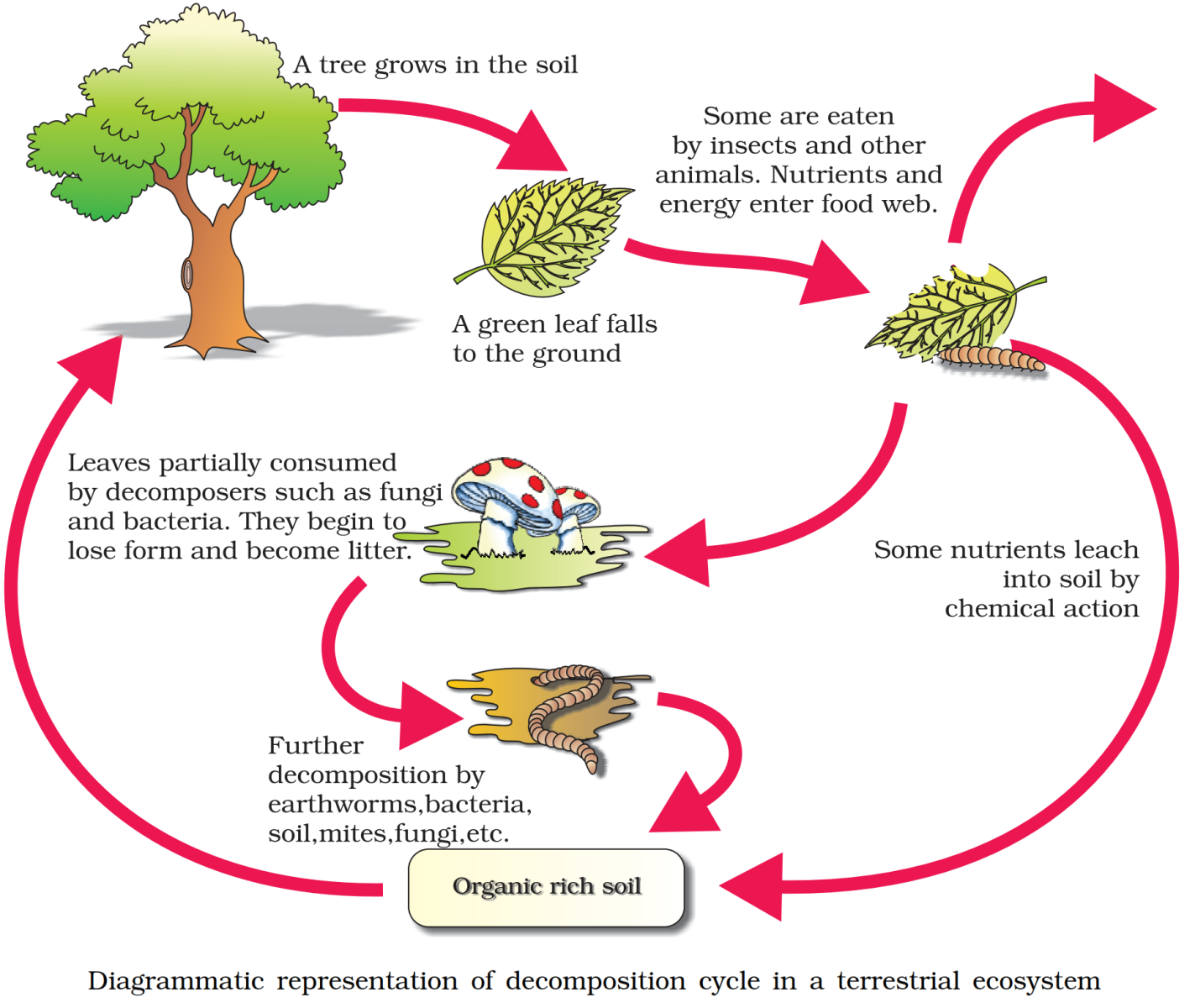
Using a flow chart explain the process of decomposition. List the factors which affect this process.
Answer

Ecomposition It is the process of breaking down of complex organic matter into inorganic substances like water, carbon dioxide and nutrients by decomposers. Detritus is the raw material for decomposition. It includes dead remains of plants (leaves, bark and flowers) and animals including faecal matter.Different steps involved in the process of decomposition are:
  1. Fragmentation: It is process of breakdown of detritus into smaller particles by detritivores (e.g. earthworm).
  2. Leaching: It is the process by which water-soluble inorganic nutrients go down into the soil horizon and get precipitated as unavailable salts.
  3. Catabolism: It is the process of degradation of detritus into simple organic material by the action of bacterial and fungal enzymes and then their further conversion into simpler inorganic compounds.
  1. Humification: It is a process that leads to accumulation of a dark coloured amorphous and colloidal substance called humus, which is highly resistant to microbial action and undergoes decomposition at a very slow rate. Being colloidal in nature, it serves as a reservoir of nutrients.
  2. Mineralisation: It is process of degradation of humus by microbial action and release of inorganic nutrients

Need a full question paper?

Generate a complete, print-ready paper with questions like this in minutes — across 16+ boards, with answer keys.

Start Generating Free

Similar questions

By talking industrial melanism as one example, explain the concept of natural selection.
OR
Explain natural selection in action by quoting the example of industrial melanism.
Following is the sequence of nucleotide in two strands of DNA. Observe the strands and answer the preceding questions.
5' - GAATTC - 3'
3' - CTTAAG - 5'
  1. Name the special term used for such an arrangement of nucleotide.
  2. Name the special type of enzymes which work/ function at this specific points.
  3. Name the enzyme, that cut DNA between GA sequence.
  4. Name the single strands produced after the action of the enzyme.
Natality and Mortality.
Types of traits: [Sickle-cell anaemia, Flower colour of Mirabelis jalapa, Coat colour of cattle, Human blood groups, Widow’s peak, Height in human beings.]
Column AColumn B
(1) Co-dominance—————–
(2) Incomplete dominance—————–
(3) Multiple allelism—————-
(4) Pleiotropy—————–
(5) Polygenes—————-
(6) Autosomal dominance——————
For selection of recombinants, insertional inactivation of antibiotic marker has been superceded by insertional inactivation of a marker gene coding for a chormogenic substrate. Give reasons.
A homozygous tall pea plant with green seeds is crossed with a dwarf pea plant with yellow seeds:
  1. What would be the phenotype and genotype of $F_1$?
  2. Work out the phenotypic ratio of $F_2$ generation with the help of a Punnett square.
Write two differences between spermatogenesis and oogenesis.
Answer the following questions:
How is ‘oogenesis’ markedly different from ‘spermatogenesis’ with respect to the growth till puberty in the humans?
What will be the effect of increasing global temperatures on the different habitats and the organisms found in those habitats?
Write types of neuroglial cells of CNS and PNS in tabular form.