Question
Using a protractor, draw an angle of measure $72^\circ .$ With this angle as given, draw angles of measure $36^\circ $ and $54^\circ .$

Answer

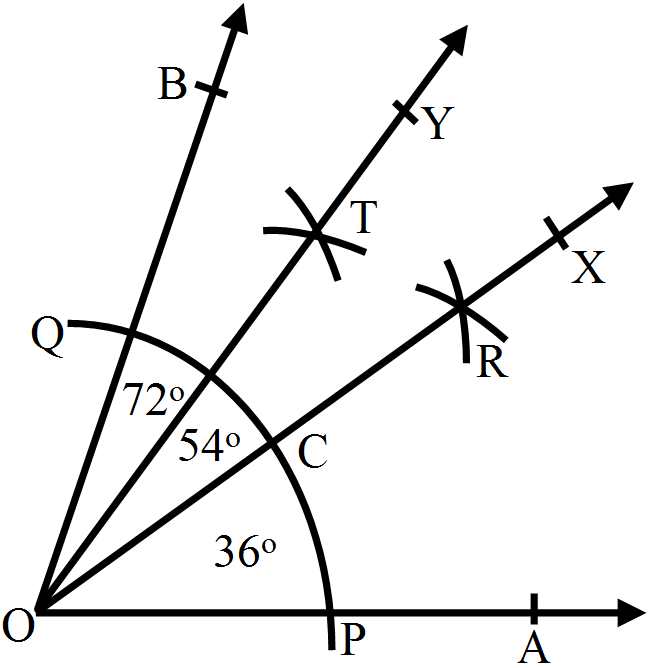
Draw a ray $OA$.
With the help of a protractor, draw an angle $\angle\text{AOB}$ of $72^\circ $.
With a convenient radius and centre at $O,$ draw an arc cutting sides $OA $ and $OB$ at $P$ and $Q,$ respectively.
With $P$ and $Q$ as centres and radius more than half of $PQ,$ draw two arcs cutting each other at $R.$
Join $O$ and $R$ and extend it to $X.$
$ OR$ intersects arc $PQ$ at $C. $
With $C$ and $Q$ as centres and radius more than half of $CQ,$ draw two arcs cutting each other at $T.$
Join $O$ and $T$ and extend it to $Y.$
Now, $OX$ bisects $\angle\text{AOB}$
Therefore, $\angle\text{AOX}=\angle\text{BOX}=\frac{72}{2}=36^{\circ}$
Again, $OY$ bisects $\angle\text{BOX}$
Therefore, $\angle\text{XOY}=\angle\text{BOY}=\frac{36}{2}=18^{\circ}$
Therefore, $\angle\text{AOX}$ is the required angle of $36^\circ $ and $\angle\text{AOY}=\angle\text{AOX}+\angle\text{XOY}=36^{\circ}+18^{\circ}=54^{\circ}$
Therefore, $\angle\text{AOY}$ is the required angle of $54^\circ .$

Need a full question paper?

Generate a complete, print-ready paper with questions like this in minutes — across 16+ boards, with answer keys.

Start Generating Free

Similar questions

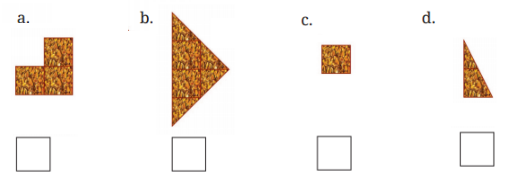
The figure below shows different fractional units of a whole chikki. How much of a whole chikki is each piece?
Image
Arrange the following numbers in ascending order: $1020304, 893245, 980134, 1021403, 893425, 1020216$
Draw a line segment $AB$ and bisect it. Bisect one of the equal parts to obtain a line segment of length $\frac{1}{2}(\text{AB}).$
Give three examples of line segments from your environment.
Draw a rectangle whose two adjacent sides are $5\ cm$ and $3.5\ cm$. Make use of a pair of compasses and a ruler only.
Using number line write the integer which is $3$ more than $5.$
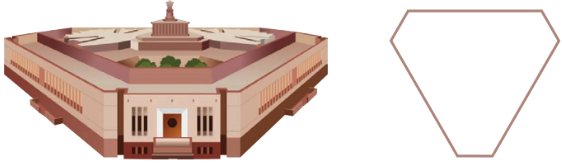
This is a picture of the new Parliament Building in Delhi.
Image
(a) Does the outer boundary of the picture have reflection symmetry? If so, draw the lines of symmetries. How many are they?
(b) Does it have rotational symmetry around its centre?
If so, find the angles of rotational symmetry.
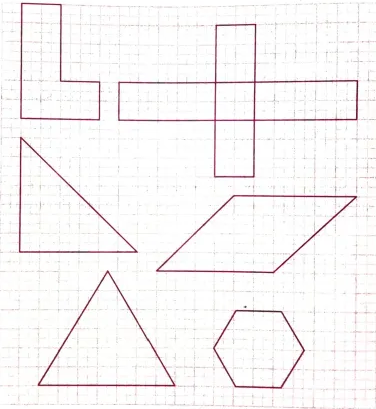
On a squared grid paper (1 square = 1 square unit), make as many rectangles as you can whose lengths and widths are a whole number of units such that the area of the rectangle is 12 square units.
(a) Which rectangle has the greatest perimeter?
(b) Which rectangle has the least perimeter?
(c) If you take a rectangle of area 32 sq cm, what will your answers be? Given any area, is it possible to predict the shape of the rectangle with the greatest perimeter as well as the least perimeter? Give examples and reasons for your answer.
See the figure and find the ratio of number of squares to all the figures inside the rectangle.