Question
Using Ampere's Law, derive an expression for the magnetic induction inside an ideal solenoid carrying a steady current.

Answer

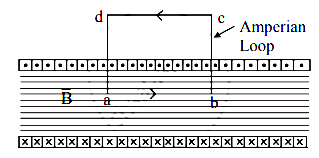
i. Consider an ideal solenoid as shown in the figure below.

Ampere's law applied to a part of a long ideal solenoid
ii. The dots (.) show that the current is coming out of the plane of the paper and the crosses $(x)$ show that the current is going into the plane of the paper, both in the coil of square cross-section wire.
iii. For the application of Ampere's law, an Amperian loop is drawn as shown in the figure and box.
iv. Using Ampere's law,
$\oint \overrightarrow{ B } \cdot \overrightarrow{ d } l =\mu_0 I$
Over the rectangular loop abcd, the above integral takes the form
$\int_{ a }^{ b } \overrightarrow{ B } \cdot \overrightarrow{ d } l +\int_{ b }^{ c } \overrightarrow{ B } \cdot \overrightarrow{ d l}+\int_{ c }^{ d } \overrightarrow{ B } \cdot \overrightarrow{ d l}+\int_{ d }^{ a } \overrightarrow{ B } \cdot \overrightarrow{ d } l =\mu_0 I$
where, $I$ is the net current encircled by the loop.
$\therefore BL +0+0+0=\mu_0 I \ldots \text {...(1) }$
Here, the second and fourth integrals are zero because $\overrightarrow{ B }$ and $\overrightarrow{ d }$ are perpendicular to each other.
The third integral is zero because outside the solenoid, $B=0$.
v. If the number of turns is $n$ per unit length of the solenoid and the current flowing through the wire is $i$, then the net current coming out of the plane of the paper is
$I = nLi$
$\therefore$ Using equation (1)
$ BL =\mu_0 nLi$
$\therefore B =\mu_0 ni . . .(2) $
Equation (2) is the required expression.

Need a full question paper?

Generate a complete, print-ready paper with questions like this in minutes — across 16+ boards, with answer keys.
Start Generating Free

Similar questions

What is a cyclotron? State its principle of working.
An electron in an atom revolves around the nucleus in an orbit of radius $0.53 \mathring A $. If the frequency of revolution of an electron is $9 \times 10^9 MHz$, calculate the equivalent magnetic moment. $\left[e=1.6 \times 10^{-19} C \right]$
A torque of $100 \mathrm{~N} . \mathrm{m}$ is applied to a body capable of rotating about a given axis. If the body starts from rest and acquires kinetic energy of $10000 \mathrm{~J}$ in 10 seconds, find
(i) its moment of inertia about the given axis
(ii) its angular momentum at the end of 10 seconds.
A pipe open at both the ends has a fundamental frequency of \(600 Hz\). The first overtone of a pipe closed at one end has the same frequency as the first overtone of the open pipe. How long are the two pipes? [Velocity of sound in air \(=330 m / s\) |
Calculate the current flowing through two long parallel wires carrying equal currents and separated by a distance of \(1.35 cm\) experiencing a force per unit length of \(4.76 \times 10^{-2} N / m\).
A gas with adiabatic constant $\gamma=1.4$, expands adiabatically so that the final pressure becomes half the initial pressure. If the initial volume of the gas $1 \times 10^{-2} m ^3$, find the final volume.
Derive an expression for orbital magnetic moment of an electron revolving around the nucleus in an atom. State the formula for the Bohr magneton.
If the refractive index of glass is $3 / 2$ and that of water is $4 / 3$ respectively, find the speed of light in glass and in water.
The speed limit for a vehicle on road is \(120 km / hr\). A policeman detects a drop of \(10 \%\) in the pitch of horn of a car as it passes him. Is the policeman justified in punishing the car driver for crossing the speed limit?(Given : Velocity of sound \(=340 m / s\) )
Find the principal specific heats of helium and hence the universal gas constant. Given : $C_p=$ $20.81 \mathrm{~J} / \mathrm{mol} . \mathrm{K}, \mathrm{C}_{\mathrm{V}}=12.5 \mathrm{~J} / \mathrm{mol} . \mathrm{K} . \mathrm{M}_0(\mathrm{He})=4 \times 10^{-3} \mathrm{~kg} / \mathrm{mol}$.