Question
Using Bohr’s postulates of the atomic model, derive the expression for radius of nth electron orbit. Hence obtain the expression for Bohr’s radius.

Answer

For the electron, we have
Bohr’s Postulate $(\text{mvr} = \frac{\text{nh}}{2\pi})$
$\frac{\text{mv}^{2}}{\text{r}} = \frac{1}{4\pi\in_{o}}\frac{\text{ze}^{2}}{\text{r}^{2}}$
and mvr $ = \frac{\text{nh}}{2\pi}$
$\therefore\text{m}^{2}\text{v}^{2}\text{r}^{2} = \frac{\text{n}^{2}\text{h}^{2}}{4\pi^{2}}$
and mv2$ = \frac{1}{4\pi\in_{o}}\text{ze}^{2}$
$\therefore\text{r} = \frac{\in_{o}\text{n}^{2}\text{h}^{2}}{\pi\text{ze}^{2}\text{m}}$
Bohr’s radius (for n = 1) = $\in_{o } \text{h}^{2}/\pi\text{ze}^{2}\text{m}.$

Need a full question paper?

Generate a complete, print-ready paper with questions like this in minutes — across 16+ boards, with answer keys.
Start Generating Free

Similar questions

Give the characteristics of magnetic field lines.
Name two substances out of which magnetic susceptibility of one is positive and of other negative. What does negative magnetic susceptibility represent?
Write any four characteristics of electromagnetic wave.
The speed of the yellow light in a certain liquid is 2.4 × 10⁸m/s. Find the refractive index of the liquid.
Define electric flux. Write its S.I. unit.
A charge q is enclosed by a spherical surface of radius R. If the radius is reduced to half, how would the electric flux through the surface change?
A transformer is designed to convert an AC voltage of 220V to an AC voltage of 12V. If the input terminals are connected to a DC voltage of 220V, the transformer usually burns. Explain.
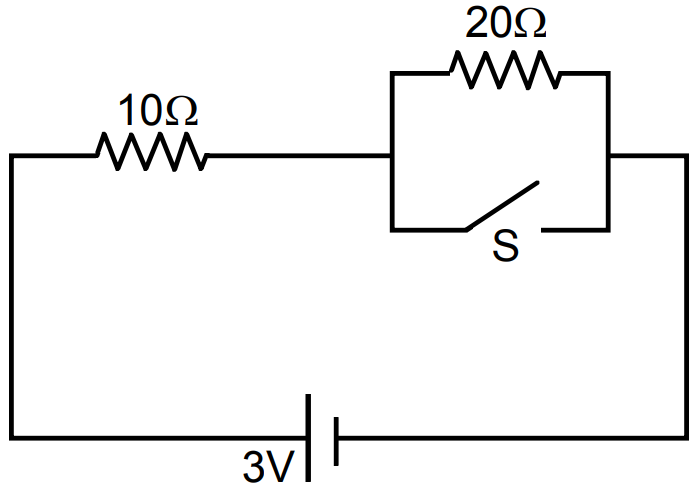
Consider the circuit shown in figure. Find the current through the $10\Omega$ resistor when the switch S is (a) Open (b) Closed.

Show that if the room temperature changes by a small amount from T to $\text{T}+\triangle\text{T},$ the fundamental frequency of an organ pipe changes from v to $\text{v}+\triangle\text{v},$ where-

$\frac{\triangle\text{v}}{\text{v}}=\frac{1}{2}\frac{\triangle\text{T}}{\text{T}}.$
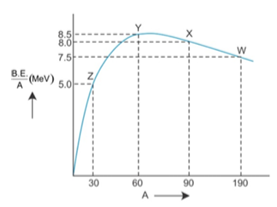
Binding energy per nucleon vs mass number curve for nuclei is shown in the figure. W, X, Y and Z are four nuclei indicated on the curve. Identify which of the following nuclei is most likely to undergo
(i) Nuclear Fission
(ii) Nuclear Fusion.
Justify your answer.

Image