Question
  1. Using Bohr's second postulate of quantization of orbital angular momentum show that the circumference of the electron in the $n^{th}$ orbital state in hydrogen atom is n times the de Broglie wavelength associated with it.
  2. The electron in hydrogen atom is initially in the third excited state.What is the maximum number of spectral lines which can be emitted when it finally moves to the ground state?
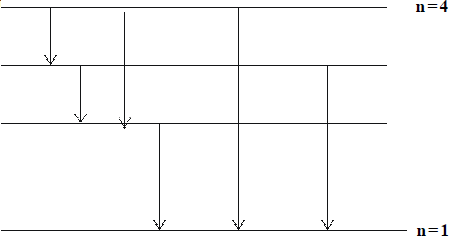
Answer

  1. According to Bohr's second postulate
  2. $\text{mvr}_{n} =\frac{\text{nh}}{2\pi}$
    $\Rightarrow2\pi\text{r}_{n} = \frac{\text{nh}}{\text{mv}}$
    But $\frac{\text{h}}{\text{mv}} =\frac{\text{h}}{\text{p}} =\lambda$
    $\therefore2\pi\text{r}_{n} = \text{n}\lambda$
  3. For third excited state $n = 4$
  4. for ground state $n = 1$
    Hence possible transitions are
    $n_1 = 4$ to $n_1 = 3, 2, 1$
    $n_1 = 3$ to $n_1 = 2, 1$
    $n_1 = 2$ to$ n_1 = 1$
    Total number of transitions $= 6$
    Alternate Answer

Need a full question paper?

Generate a complete, print-ready paper with questions like this in minutes — across 16+ boards, with answer keys.

Start Generating Free

Similar questions

A certain material has refractive indices 1.56, 1.60 and 1.68 for red, yellow and violet light respectively.
  1. Calculate the dispersive power.
  2. Find the angular dispersion produced by a thin prism of angle 6° made of this material.
The final volume of a system is equal to the initial volume in a certain process. Is the work done by the system necessarily zero? Is it necessarily non$-$zero.
Two charges $3 \times 10^{-8} C$ and $-2 \times 10^{-8} C$ are located $15 cm$ apart. At what point on the line joining the two charges is the electric potential zero? Take the potential at infinity to be zero.
Calculate the binding energy per $^{40}_{20}\text{CA}$ nucleon nucleus.
$[$Given: $m \big(^{40}_{20}\text{Ca}\big)=39.962589\text{u}]$
$m_n($mass od a neutron$) = 1.008665u$
$m_p($mass of a proton$) =1.007825u$
$1u = 931\ MeV/c^2]$
Can we find the mass of a photon by the definition p = mv?
An equiconvex lens of focal length $'f\ '$ is cut into two identical plane convex lenses. How will the power of each part be related to the focal length of the original lens? A double convex lens of $+5D$ is made of glass of refractive index $1.55$ with both faces of equal radii of curvature. Find the value of its radius of curvature.
State Brewster's law. Value of Brewster's angle for light of different colours is different for a transparent medium. Give reasons.
In Young’s double slit experiment, the two slits are separated by a distance of $1·5 \ mm$ and the screen is placed $1 m$ away from the plane of the slits. A beam of light consisting of two wavelengths $650 \ nm$ and $520 \ nm$ is used to obtain interference fringes. Find.
  1. The distance of the third bright fringe for $\lambda = 520$ nm on the screen from the central maximum.
  2. The least distance from the central maximum where the bright fringes due to both the wavelengths coincide.
Find the moment of inertia of a uniform square plate of mass m and edge a about one of its diagonals.
What are the dimensions of$:$
  1. Volume of $A$ cube of edge $A.$
  2. Volume of $A$ sphere of radius $A.$
  3. The ratio of the volume of $A$ cube of edge $A$ to the volume of $A$ sphere of radius $A$?