Question
Using crystal field theory, draw energy level diagram, write the electronic configuration of the central metal atom/ion and determine the magnetic moment value in the following:
i. $\left[ CoF _6\right]^{3-},\left[ Co \left( H _2 O \right)_6\right]^{2+},\left[ Co ( CN )_6\right]^{3-}$
ii. $\left[ FeF _6\right]^{3-},\left[ Fe \left( H _2 O \right)_6\right]^{2+},\left[ Fe ( CN )_6\right]^{4-}$
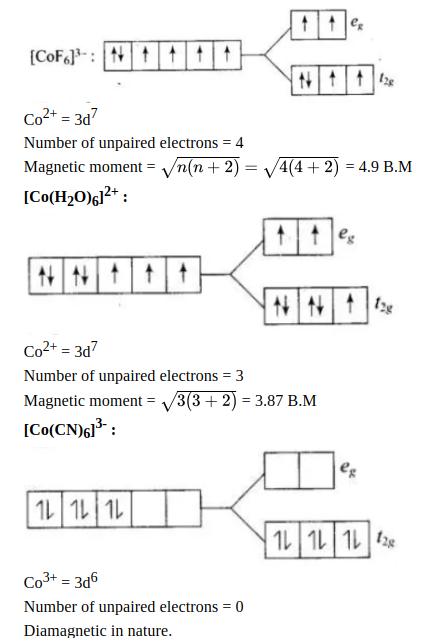
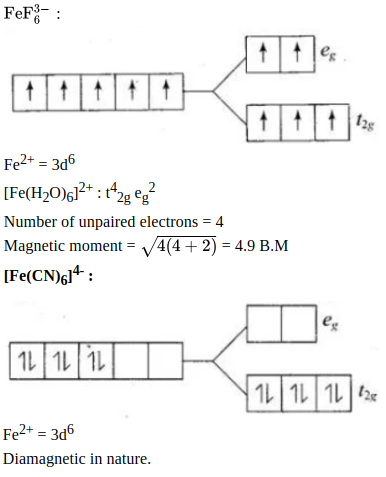
Answer

(1)
Image
(2)
Image

Need a full question paper?

Generate a complete, print-ready paper with questions like this in minutes — across 16+ boards, with answer keys.

Start Generating Free

Similar questions

(i) Define molecularity of a reaction.
(ii) Explain the effect of presence of catalyst on the rate of reaction.
(iii) In a first order reaction at 300 K , the initial concentration of the reactant was $1.0 \times 10^{-2} mol L ^{-1}$, which decreased to $0.5 \times 10^{-2} molL ^{-1}$ after 30 minutes at 300 K . Calculate the rate constant of the reactant at 300 K. $[\log 2=0.3010] \quad$
Using IUPAC norms write the formulas for the following:
a. Tetrahydroxozincate(II)
b. Potassium tetrachloridopalladate(II)
c. Diamminedichloridoplatinum(II)
d. Potassium tetracyanonickelate(II)
e. Pentaamminenitrito-O-cobalt(III)
f. Hexaamminecobalt (III) sulphate
g. Potassium tri(oxalato) chromate(III)
h. Hexaammineplatinum(IV)
i. Tetrabromidocuprate(II)
j. Pentaamminenitrito-N-cobalt(III)
  1. $30 g$ of urea $(M = 60 g mol^{-1})$ is dissolved in 846 g of water. Calculate the vapour pressure of water for this solution if vapour pressure of pure water at $298 K$ is $23.8$ mm Hg.
  2. Write two differences between ideal solutions and non-ideal solutions.
  1. Complete the following chemical equations for reactions:
i. $\text{MnO}_{4(aq)}^{-}+\text{S}_{2}\text{O}_{3(aq)}^{2-}+\text{H}_{2}\text{O}_{(l)}\rightarrow$
ii. $\text{Cr}_{2}\text{O}^{-}_{7(aq)}+\text{H}_{2}\text{S}_{(g)}+\text{H}^{+}_{(aq)}\rightarrow$
  1. Give an explanation for each of the following, observations:
  1. The gradual decrease in size (actinoid contraction) from element to element is greater among the .actinoids than that among the lanthanoids (lanthanoid contraction).
  2. The greatest number of oxidation states are exhibited by the members in the middle of a transition series.
  3. With the same d-orbital configuration $(d^4) Cr^{2+}$ ion is a reducing agent but $Mn^{3+}$ ion is an oxidising agent.
$CoSO_4Cl._5NH_3$ exists in two isomeric forms $'A \ '$ and $'B \ '.$ Isomer $'A \ '$ reacts with $AgNO_3$ to give white precipitate but does not react with $BaCl_2.$ Isomer $ 'B \ '$ gives a white precipitate with $BaCl_2$ but does not react with $AgNO_3.$ Answer the following questions.
$i.$ Identify $'A \ '$ and $'B\ '$ and write their structural formulas.
$ii.$ Name the type of isomerism involved.
$iii.$ Give the $ \text{IUPAC}$ name of $'A\ '$ and $'B \ '.$
a. Amongst the following, the most stable complex is:
i. $\left[ Fe \left( H _2 O \right)_6\right]^{3+}$
ii. $\left[ Fe \left( NH _3\right)_6\right]^{3+}$
iii. $\left[ Fe \left( C _2 O _4\right)_3\right]^{3-}$
iv. $\left[ FeCl _6\right]^{3+}$
b. What will be the correct order for the wavelength of absorption in the visible region for the following:
$
\left[Ni\left(NO_2\right)_6\right]^{4-},\left[Ni\left(NH_3\right)_6\right]^{2+},\left[Ni\left(H_2 O\right)_6\right]^{2+}
$
The experimental data for decomposition of $N_2O_5$
$[2N_2O_5 \rightarrow 4NO_2 + O_2]$
in gas phase at 318K are given below:
$t/s$ $0$ $400$ $800$ $1200$ $1600$ $2000$ $2400$ $2800$ $3200$
$10^2 \times [N_2O_5]/mol L^{-1}$ $1.63$ $1.36$ $1.14$ $0.93$ $0.78$ $0.64$ $0.53$ $0.43$ $0.35$
  1. Plot $[N_2O_5]$ against $t.$
  2. Find the half-life period for the reaction.
  3. Draw a graph between $ \log[N_2O_5]$ and $t.$
  4. What is the rate law?
  5. Calculate the rate constant.
  6. Calculate the half-life period from k and compare it with $(ii).$
Chromium crystallises in bcc structure. If its atomic diameter is $245\ pm$, find its density. Atomic mass of $Cr = 52$ amu and $N_A = 6.02 \times 10^{23}\ mol^{–1}.$
What is the role of adsorption in heterogenous catalysis?
An aromatic compound ‘A’ on treatment with $CHCl_3 / KOH$ gives two compounds ‘B’ and ‘C’. Both B and C give the same product ‘D’ when distilled with zinc dust. Oxidation of D gives E having molecular formula $C_7H_6O_2$. The sodium salt of E on heating with sodalime gives F which may also be obtained by distilling A with zinc dust. Identify A to F.