Question
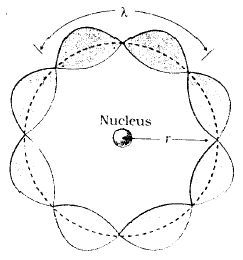
  1. Using de Broglie's hypothesis, explain with the help of a suitable diagram, Bohr's second postulate of quantization of energy levels in a hydrogen atom.
  2. The ground state energy of hydrogen atom is - 13.6 eV. What are the kinetic and potential energies of the electron in this state?
Answer

  1. $\lambda = \frac{\text{h}}{\text{p}} = \frac{\text{h}}{\text{mv}}$

$2\pi\text{r} = \text{n}\lambda$

$ =\text{n}\frac{\text{h}}{\text{mv}}$

$\Rightarrow\text{mvr} = \text{L} = \frac{\text{nh}}{2\pi}$

  1. Kinetic energy=13.6 eV

Potential energy = -27.2 eV.

Need a full question paper?

Generate a complete, print-ready paper with questions like this in minutes — across 16+ boards, with answer keys.

Start Generating Free

Similar questions

Calculate the Q-value of the fusion reaction
4He + 4He = 8Be.
Is such a fusion energetically favourable? Atomic mass of 8Be is 8.0053u and that of 4He is 4.0026u.
A p-n photodiode is fabricated from a semiconductor with band gap of 2.8 eV. Can it detect a wavelength of 6000 nm?
In a typical Indian Bugghi (a luxury cart drawn by horses), a wooden plate is fixed on the rear on which one person can sit. A bugghi of mass 200kg is moving at a speed of 10km/h. As it overtakes a school boy walking at a speed of 4km/h, the boy sits on the wooden plate. If the mass of the boy is 25kg, what will be the new velocity of the bugghi?
Does a nucleus lose mass when it suffers gamma decay?
  1. For a glass prism $(\mu =\sqrt{3} )$ the angle of minimum deviation is equal to the angle of the prism. Calculate the angle of the prism.
  2. Draw ray diagram when incident ray falls normally on one of the two equal sides of a right angled isosceles prism having refractive index $\mu = \sqrt{3} . $
How is the spacing between fringes in a double slit experiment affected if:
a. the slits separation is increased,
b. the colour of light used is changed from red to blue,
c. the whole apparatus is submerged in a oil of refractive index 1.2?
Justify your anwer in each case.
A rod of mass m and length L, lying horizontally, is free to rotate about a vertical axis through its centre. A horizontal force of constant magnitude F acts on the rod at a distance of $\frac{\text{L}}{4}$ from the centre. The force is always perpendicular to the rod. Find the angle rotated by the rod during the time (t) after the motion starts.
Consider two pairs of neutrons. In each pair, the separation between the neutrons is the same. Can the force between the neutrons have different magnitudes for the two pairs?
a. A toroidal solenoid with an air core has an average radius of 0.15 m , area of cross section $12 \times 10^{-4} m^2$ and 1200 turns. Obtain the self inductance of the toroid. Ignore field variation across the cross section of the toroid.
b. A second coil of 300 turns is wound closely on the toroid above. If the current in the primary coil is increased from zero to 2.0 A in 0.05 s, obtain the induced emf in the secondary coil.
Get the electric field due to on infinitely long straight uniformly changed wire.