Question
Using electrostatic analogue, obtain the magnetic field $\vec{B}_{\text {equator }}$ at a distance $d$ on the perpendicular bisector of a magnetic dipole of magnetic length $2 l$ and moment $\vec{M}$. For far field, verify that
$\vec{B}_{\text {equator }}=\left(\frac{\mu_0}{4 \pi}\right) \frac{-\vec{M}}{\left(d^2+l^2\right)^{3 / 2}}$
Answer

The magnitude of the electric intensity at a point at a distance r from an electric charge q in vacuum is given by
$E=\frac{1}{4 \pi \varepsilon_0} \frac{|q|}{r^2}$where $ε_0$ is the permittivity of free space. This intensity is directed away from the charge, if the charge is positive and towards the charge, if the charge is negative.
A magnetic pole is similar to an electric charge. The N-pole is similar to a positive charge and the S-pole is similar to a negative charge. Like an electric charge, a magnetic pole is assumed to produce a magnetic field in the surrounding region. The magnetic field at any point is denoted by a vector quantity called magnetic induction. Thus, by analogy, the magnitude of the magnetic induction at a point at a distance r from a magnetic pole of strength $q_m$ is given by
$B =\frac{\mu_0}{4 \pi} \frac{q_{ m }}{r^2}$
This induction is directed away from the pole if it is an N-pole (strength $+ x)$ and towards the pole if it is an S-pole (strength $-q_m)$.
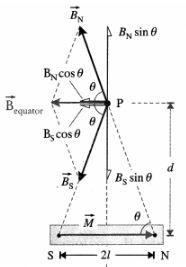
Consider a point P on the equator of a magnetic dipole with pole strengths $+ q_m$ and $– q_m$ and of magnetic length $21$. Let P be at a distance d from the centre of the dipole,


Image
The magnetic induction of a bar magnet at an equatorial point
The magnetic induction at P due to the N-pole is directed along NP (away from the N-pole) while that due to the S-pole is along PS (towards the S-pole), each having a magnitude
$ B _{ N }= B _{ S }=\left(\frac{\mu_0}{4 \pi}\right) \frac{q_{ m }}{\left(d^2+l^2\right)}$
$\left(\because NP = SP =\sqrt{d^2+l^2}\right)$
The inductions due to the two poles are equal in magnitude so that the two, oppositely directed equatorial components, $B_N \sin θ$ and $B_S \sin θ$, cancel each other.
Therefore, the resultant induction is in a direction’ parallel to the axis of the magnetic dipole and has direction opposite to that of the magnetic moment of the magnetic dipole. The component of the induction due to the two poles along the axis is
$\left(\frac{\mu_0}{4 \pi}\right) \frac{q_{ m }}{\left(d^2+l^2\right)} \cos \theta$
where $\theta$ is the angle shown in the diagram. From the diagram,
$\cos \theta=\frac{l}{\left(d^2+l^2\right)^{1 / 2}}$
The total induction at $P$ is then
$ B  =\left(B_{ N }+B_{ S }\right) \cos \theta$
$ =\left(\frac{\mu_0}{4 \pi}\right) \frac{2 q_{ m }}{\left(d^2+l^2\right)} \cos \theta$
$=\left(\frac{\mu_0}{4 \pi}\right) \frac{2 q_{ m }}{\left(d^2+l^2\right)} \cdot \frac{l}{\left(d^2+l^2\right)^{1 / 2}}$
$\therefore B  =\left(\frac{\mu_0}{4 \pi}\right) \frac{M}{\left(d^2+l^2\right)^{3 / 2}} $
where $M=2 q_{ m } l$ is the magnetic moment of the dipole.
$\vec{B}_{\text {equator }}=\left(\frac{\mu_0}{4 \pi}\right) \frac{-\vec{M}}{\left(d^2+l^2\right)^{3 / 2}}$
The minus sign shows that the direction of $\vec{B}_{\text {equator }}$ is opposite to that of $\vec{M}$.
If the dipole is very short, i.e., $l \ll d$, we can ignore $l^2$ in comparison with $d^2$. We then get
$\vec{B}_{\text {equator }}=\left(\frac{\mu_0}{4 \pi}\right) \frac{(-\vec{M})}{d^3}$
Thus, for a short dipole the induction varies in-versely as the cube of the distance from it.

Need a full question paper?

Generate a complete, print-ready paper with questions like this in minutes — across 16+ boards, with answer keys.

Start Generating Free