Question
Using Euler's formula find the unknown:
Faces
$?$
$5$
$20$
Vertices
$6$
$?$
$12$
Edges
$12$
$9$
$?$

Answer

We know that the Euler's formula is: $F + V = E + 2$
$i.$ The number of vertices $V$ is $6$ and the number of edges $E$ is $12$.
Using Euler's formula:
$F + 6 = 12 + 2$
$F + 6 = 14$
$F = 14 - 6$
$F = 8$
So, the number of faces in this polyhedron is 8.
$ii.$ Faces, $F = 5$
Edges, $E = 9$
We have to find the number of vertices.
Putting these values in Euler's formula:
$5 + V = 9+ 25 + V = 11$
$V = 11 - 5$
$V = 6$
So, the number of vertices in this polyhedron is $6$.
$iii.$ Number of faces $F = 20$
Number of vertices $V = 12$
Using Euler's formula:
$20 + 12 = E + 2$
$32 = E + 2$
$E + 2 = 32$
$E = 32 - 2$
$E = 30$
So, the number of edges in this polyhedron is $30$.

Need a full question paper?

Generate a complete, print-ready paper with questions like this in minutes — across 16+ boards, with answer keys.

Start Generating Free

Similar questions

Construct a parallelogram $ABCD$ in which $AB = 4.3\ cm, AD = 4\ cm$ and $BD = 6.8\ cm.$
The four angles of a quadrilateral are as $3 : 5 : 7 : 9$. Find the angles.
Find the volume of a cube, one face of which has an area of $64m^2$.
Complite the following tables given that $x$ varies directly as $y$.
$x$
$4$
$9$
$...$
$...$
$3$
$...$
$y$
$16$
$...$
$48$
$36$
$...$
$4$
Complite the following tables given that $x$ varies directly as $y$.
$x$
$5$
$...$
$10$
$35$
$25$
$...$
$y$
$8$
$12$
$...$
$...$
$...$
$32$
Construct a quadrilateral $BDEF$, where $DE = 4.5\ cm, EF = 3.5\ cm, FB = 6.5\ cm$, $\angle\text{F}=50^\circ$ and $\angle\text{E}=100^\circ.$
Find the product:
$-\frac{8}{27}\text{xyz}\big(\frac{3}{2}\text{xyz}^2-\frac{9}{4}\text{xy}^2\text{z}^2\big)$
Construct a quadrilateral $ABCD$ when $BC = 5.5\ cm, CD = 4.1\ cm$, $\angle\text{A}=70^\circ,\text{AB}=110^\circ$ and $\angle\text{D}=85^\circ.$
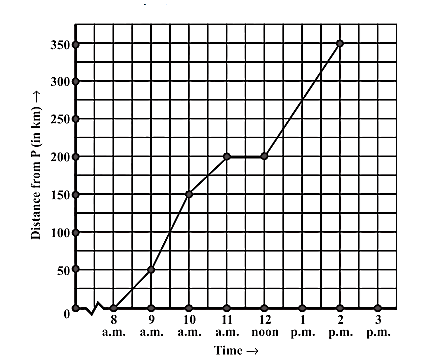
The given graph $($Fig$)$ describes the distances of a car from a city $P$ at different times when it is travelling from City $P$ to City $Q$, which are $350\ km$ apart. Study the graph and answer the following:
$i.$ What information is given on the two axes?
$ii.$ From where and when did the car begin its journey?
$iii.$ How far did the car go in the first hour?
$iv.$ How far did the car go during $(i)$ the $2^{nd}$ hour? $(ii)$ the $3$rd hour?
$v.$ Was the speed same during the first three hours? How do you know it?
$vi.$ Did the car stop for some duration at any place? Justify your answer.
$vii.$ When did the car reach City $Q$?
Solve the following equation and verify your answer: $\frac{6}{2\text{x}-(3-4\text{x})}=\frac{2}{3}$