Question
Using Euler's formula find the unknown:
Faces
?
5
20
Vertices
6
?
12
Edges
12
9
?

Answer

We know that the Euler's formula is: F + V = E + 2
  1. The number of vertices V is 6 and the number of edges E is 12.
Using Euler's formula:

F + 6 = 12 + 2

F + 6 = 14

F = 14 - 6

F = 8

So, the number of faces in this polyhedron is 8.
  1. Faces, F = 5
Edges, E = 9

We have to find the number of vertices.

Putting these values in Euler's formula:

5 + V = 9+ 25 + V = 11

V = 11 - 5

V = 6

So, the number of vertices in this polyhedron is 6.
  1. Number of faces F = 20
Number of vertices V = 12

Using Euler's formula:

20 + 12 = E + 2

32 = E + 2

E + 2 = 32

E = 32 - 2

E = 30

So, the number of edges in this polyhedron is 30.

Need a full question paper?

Generate a complete, print-ready paper with questions like this in minutes — across 16+ boards, with answer keys.

Start Generating Free

Similar questions

Write the following squares of binomials as trinomials:
$\big(\frac{\text{x}}{\text{y}}−\frac{\text{y}}{\text{x}})^2$
Show the number √5 on the number line.
Construct a quadrilateral ABCD in which AB = 3.8cm, BC = 3.4cm, CD = 4.5cm, AD = 5cm and $\angle\text{B}=80^\circ.$
Find the area of a trapezium whose parallel sides are 25cm, 13cm and the other sides are 15cm.
Construct a quadrilateral PQRS, in which $\angle\text{PQR}=45^\circ,$ $\angle\text{QRS}=90^\circ,$ QR = 5cm, PQ = 9cm and Rs = 7cm.
x varies inversely as y, when x = 15 then y = 10, if x = 20, then y = ?
The runs scored by two teams A and B in first 10 overs are given below:
Overs: I II III IV V VI VII VIII IX X
Team A: 2 1 8 9 4 5 6 10 6 2
Team B: 5 6 2 10 5 6 3 4 8 10
Draw a graph depicting the data, making the graphs on the same axes in each case in two different ways as a graph and as a bar chart.
Draw a line. Take a point outside the line. Draw a perpendicular from the point to the line with the help of a set-square
f V is the volume of the cuboid of dimensions a, b, c and S its the surface area then prove that:
$\frac{1}{\text{V}}=\frac{2}{\text{S}}\Big(\frac{1}{\text{a}}+\frac{1}{\text{b}}+\frac{1}{\text{c}}\Big)$
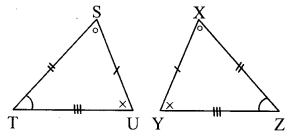
In the given figure, parts of triangles indicated by identical marks are congruent.
a. Identify the one-to-one correspondence of vertices in which the two triangles are congruent and write the congruence.
b. State with reason, whether the statement, ∆XYZ ≅ ∆STU is right or wrong.
Image