Question
Using factor theorem, factorize the following polynomials: $x^3 + 13x^2 + 32x + 20$

Answer

Let $p(x) = x^3 + 13x^2+ 32x + 20$
The factors of 20 are $\pm1,\pm2,\pm4,\pm5\dots$ By hit and trial method $p(-1) = (-1)^3 + 13(-1)^2 + 32(-1) + 20 = -1 + 13 - 32 + 20 = 33 - 33 = 0 As p(-1)$ is zero,
so $x + 1$ is a factor of this polynomial $p(x).$
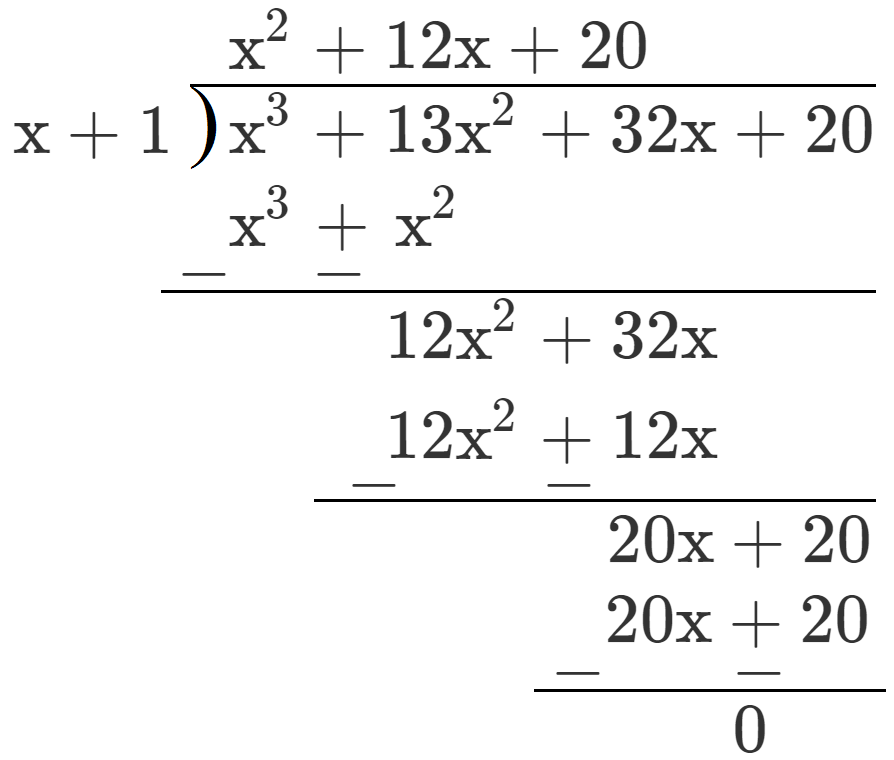
 Let us find the quotient while dividing $x^3 + 13x^2 + 32x + 20 by (x + 1)$ By long division

We know that Dividend = Divisor $\times $ Quotient + Remainder
$x^3 + 13x^2 + 32x + 20 $
$= (x + 1)(x^2 + 12x + 20) + 0 $
$= (x + 1)(x^2 + 10x + 2x + 20) $
$= (x + 1)[x(x + 10) + 2(x + 10)] $
$= (x + 1)(x + 10)(x + 2) $
$= (x + 1)(x + 2)(x + 10)$

Need a full question paper?

Generate a complete, print-ready paper with questions like this in minutes — across 16+ boards, with answer keys.
Start Generating Free

Similar questions

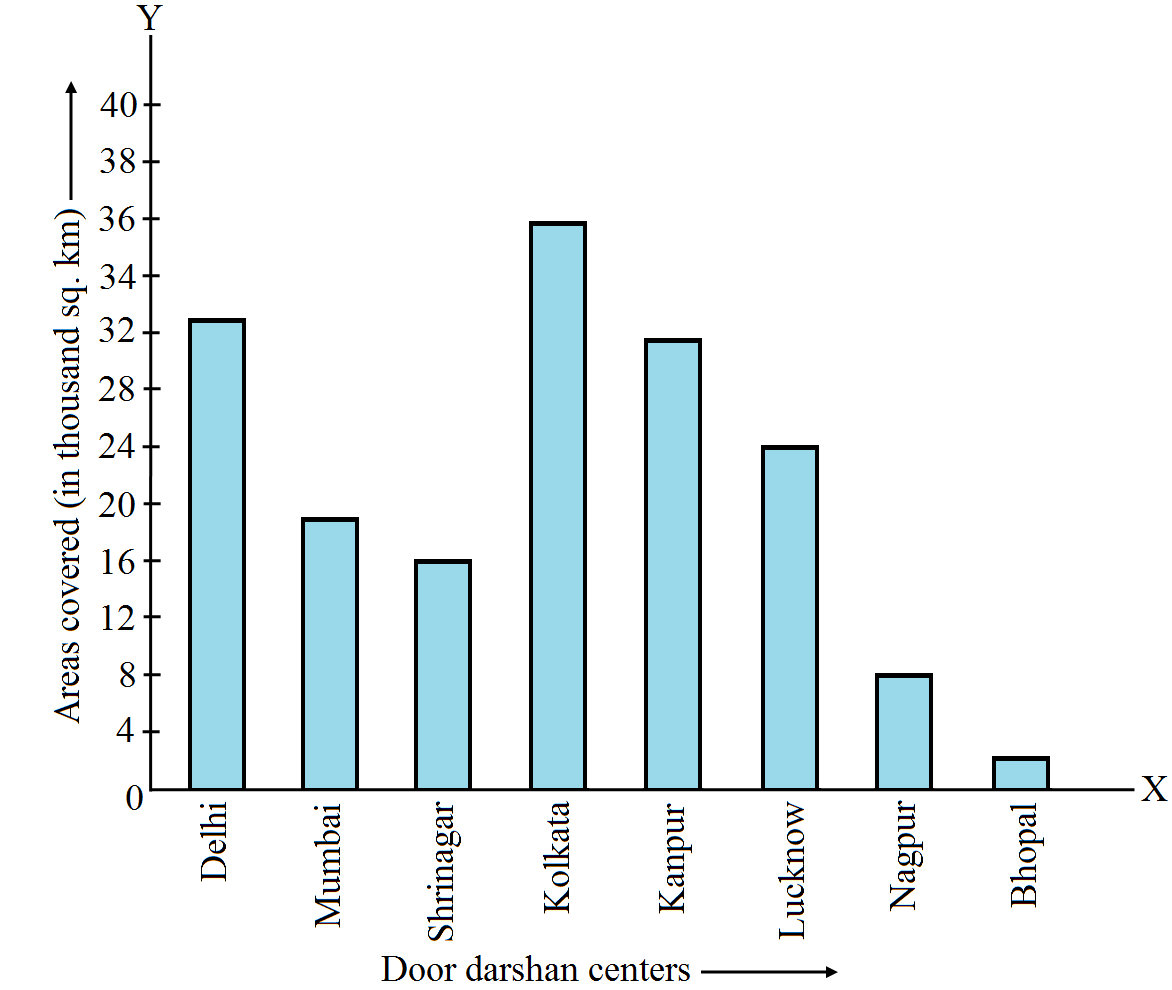
Read the bar graph given in Fig. and answer the following questions:

$i.$ What information is given by the bar graph?
$ii.$ Which Door darshan center covers maximum area? Also, tell the covered area.
$iii.$ What is the difference between the areas covered by the centers at Delhi and Bombay?
$iv.$ Which Door darshan centers are in $U.P.$ State? What are the areas covered by them?
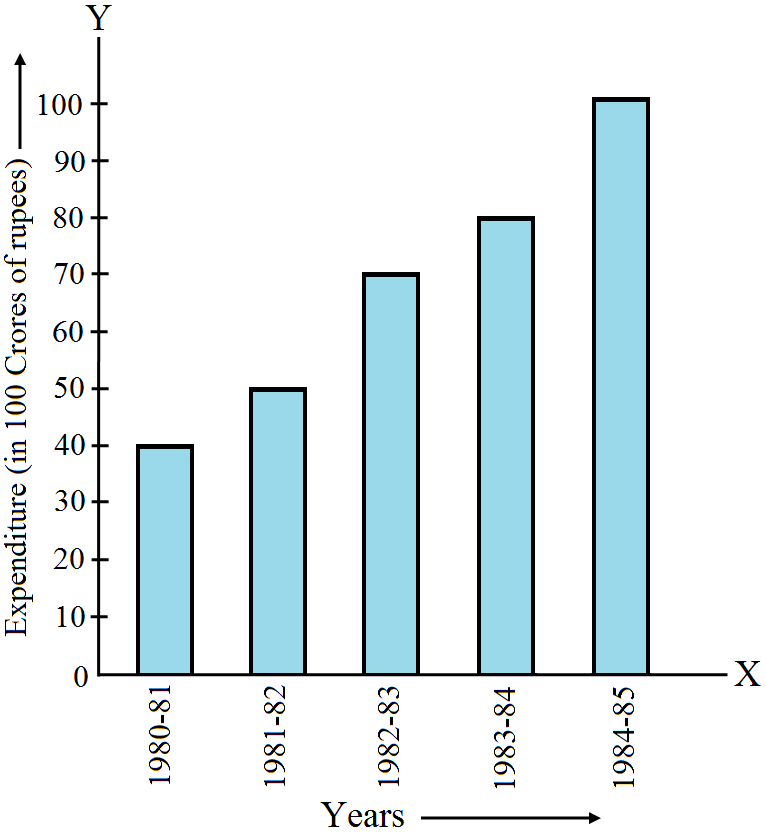
Read the bar graph given in figure and answer the following questions:

$i.$ What information is given by the bar graph?
$ii.$ What was the expenditure on health and family planning in the year $1982-83?$
$iii.$ In which year is the increase in expenditure maximum over the expenditure in the previous year? What is the maximum increase?
Prove that the angle in a segment greater than a semi-circle is less than a right angle.
Write the linear equation such that each point on its graph has an ordinate $3$ times its abscissa.
Prove that angle bisector of any angle of a triangle and perpendicular bisector of the opposite side if intersect, they will intersect on the circumcircle of the triangle.
An equilateral triangle of side $9\ cm$ is inscribed in a circle. Find the radius of the circle.
Locate $\sqrt{3}$ on the number line.
Show that the quadrilateral formed by joining the mid-points of the consecutive sides of a square is also a square.
$AB$ and $AC$ are two equal chords of a circle. Prove that the bisector of the angle $BAC$ passes through the centre of the circle.
If $PQRS$ is a square, then write the measure of $\angle\text{SRP.}$