Question
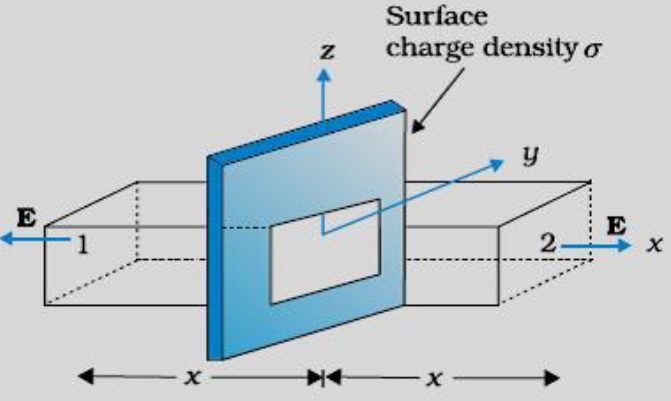
Using Gauss’s law in electrostatics, deduce an expression for electric field intensity due to a uniformly charged infinite plane sheet. If another identical sheet is placed parallel to it, show that there is no electric field in the region between the two sheets.
Answer


By Gauss’s law $ \oint \overrightarrow{E}.\overrightarrow{ds}=\frac{q}{\in_0}$
$\therefore{2{\text{EA}}}=\frac{\sigma{\text{A}}}{{\in_0}}$
$\therefore\text{E}=\frac{\sigma}{2\in_0}\text{ }\text{or}\frac{\sigma}{2\in_0}\text{A}$
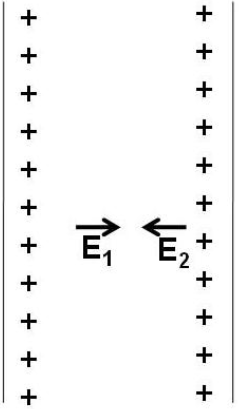
Electric field between two identical charged sheets

$\because$ Both the sheets have same charge density, their electric fields will be equal and opposite in the region between the two sheets.
Hence the net field is zero.Alternate Answer
$\text{E}_1=\frac{\sigma}{2\in_0}$
$\text{E}_2=-\frac{\sigma}{2\in_0}$
Resultant electric field between the plates $= E_1 + E_2\frac{\sigma}{2\in_0}-\frac{\sigma}{2\in_0}=0$]

Need a full question paper?

Generate a complete, print-ready paper with questions like this in minutes — across 16+ boards, with answer keys.

Start Generating Free

Similar questions

A convex lens of focal length 20 cm is placed coaxially with a concave mirror of focal length 10 cm at a distance of 50 cm apart from each other. A beam of light coming parallel to the principal axis is incident on the convex lens. Find the position of the final image formed by this combination. Draw the ray diagram showing the formation of the image.
A pole of length 1.00m stands half dipped in a swimming pool with water level 50.0 cm higher than the bed. The refractive index of water is 1.33 and sunlight is coming at an angle of 45° with the vertical. Find the length of the shadow of the pole on the bed.
Suppose the spheres A and B in Exercise 1.12 have identical sizes. A third sphere of the same size but uncharged is brought in contact with the first, then brought in contact with the second, and finally removed from both. What is the new force of repulsion between A and B?
Find the binding energy per nucleon of $\text{ }^{197}_{79}\text{Au}$ if its atomic mass is 196.96u.
  1. Depict the equipotential surfaces for a system of two identical positive point charges placed a distance ‘d’ apart.
  2. Deduce the expression for the potential energy of a system of two point charges $q_1$ and $q_2$ brought from infinity to the points$\overrightarrow{\text{r}_{1}}$ and $\overrightarrow{\text{r}_{2}}$ respectively in the presence of external electric field $\overrightarrow{\text{E}}.$
Estimate the proportion of boron impurity whieh will increase the conductivity of a pure silicon sample by a factor of 100. Assume that each boron atom creates a hole and the concentration of holes in pure silicon at the same temperature is $7 \times 10^{15}$ holes per cubic metre. Density of silicon is $5 \times 10^{21}$ atoms per cubic metre.
A 100W light bulb is placed at the centre of a spherical chamber of radius 20cm. Assume that 60% of the energy supplied to the bulb is converted into light and that the surface of the chamber is perfectly absorbing. Find the pressure exerted by the light on the surface of the chamber.
Write Einstein's photoelectric equation in terms of the stopping potential and the threshold frequency for a given photosensitive material. Draw a plot showing the variation of stopping potential vs. the frequency of incident radiation.
What is magnetic flux density? Obtain a relation between magnetic flux and magnetic induction.
The ground state energy of hydrogen atom is –13.6 eV.
  1. What is the kinetic energy of an electron in the $2^{nd}$ excited state?
  2. If the electron jumps to the ground state from the $2^{nd}$ excited state, calculate the wavelength of the spectral line emitted.