Question
Using integration, Find the area bounded by the the triangle whose vartices are $(2, 1), (3, 4)$ and $(5, 2).$

Answer


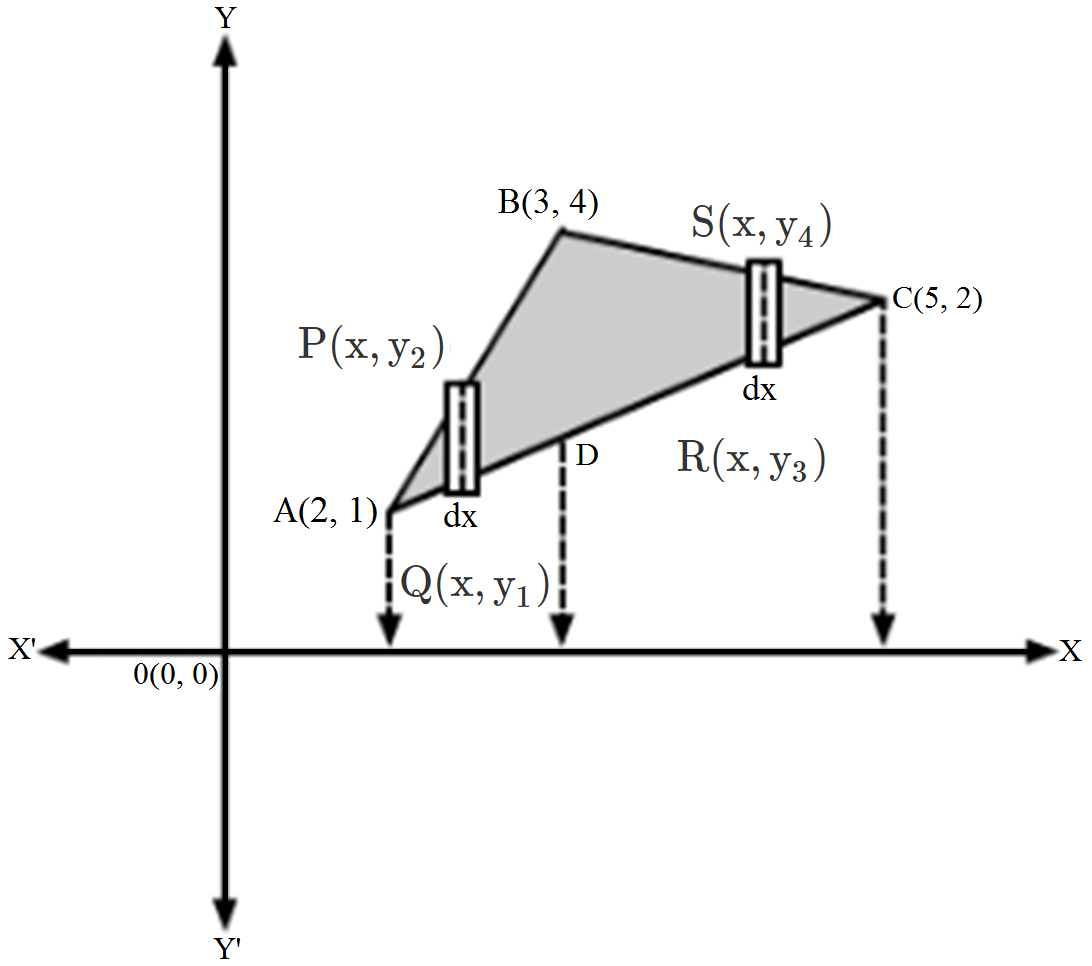
Consider the points $A(2, 1), B(3, 4)$ and $C(5, 2)$
We need to find area of shaded triangle $ABC$
Equation of $AB$ is 
$\text{y}-1=\Big(\frac{4-3}{3-2}\Big)(\text{x}-2)$
$\Rightarrow\text{x}-3\text{y}-5=0\ ...(\text{i})$
Equation of $BC$ is 
 $\text{y}-4=\Big(\frac{2-4}{5-3}\Big)(\text{x}-3)$
$\Rightarrow\text{x}=\text{y}-7=0\ ...(\text{ii})$
Equation of $CA$ is
$\text{y}-2=\Big(\frac{2-1}{5-2}\Big)(\text{x}-5)$
$\Rightarrow\text{x}-3\text{y}+2=0\ ...(\text{iii})$
Area of $\triangle\text{ABC}= \text{Area of}\ \triangle\text{ABC}+ \text{Area of }\triangle\text{ABC}$ in the,
Consided point $P(x_1, y_2)$ on $AB$ and $Q(x_1, y_1)$ on $AD$
Thus, the area of appoximating with length $= |y_2 - y_1|$ from $x = 2,$ to $x = 3$
$\therefore$ Area of $\triangle\text{ABC}=\int\limits_{2}^{3}|\text{y}_{2}-\text{y}_{1}|\text{dx} $
$\Rightarrow\text{A}=\int\limits_{2}^{3}(\text{y}_{2}-\text{y}_{1})\text{dx} $
$\Rightarrow\text{A}=\int\limits_{2}^{3}(3\text{x}-5)-\Big(\frac{\text{x}-1}{3}\Big)\text{dx}$
$\Rightarrow\text{A}=\int\limits_{2}^{3}\frac{(9\text{x}-15-\text{x}-1)}{3}\text{dx}$
$\Rightarrow\text{A}=\int\limits_{2}^{3}\frac{(8\text{x}-16)}{3}\text{dx}$
$\Rightarrow\text{A}=\frac{1}{3}\Big[8\text{x}^{2}-16\text{x}\Big]\text{dx}$
$\Rightarrow\text{A}=\frac{1}{3}(68-64)$
$\Rightarrow\text{A}=\frac{4}{3}\ \text{sq.}\ \text{units}$

Need a full question paper?

Generate a complete, print-ready paper with questions like this in minutes — across 16+ boards, with answer keys.
Start Generating Free

Similar questions

Find the area of the region between the circles $x^2 + y^2 = 4$ and $(x - 2)^2 + y^2 = 4.$
If the area bounded by the parabola $\text{y}^{2} = 16\text{ax}$ and the line $\text{y = 4 mx}$ is  $\frac{\text{a}^{2}}{12}$ sq. units, then using integration, find the value of m.
Find the distance of the point (3, 3, 3) from the plane $\vec{\text{r}}\cdot(5\hat{\text{i}}+2\hat{\text{j}}-7\hat{\text{k}})+9=0$
If $\vec{\text{a}}=2\hat{\text{i}}-3\hat{\text{j}}+\hat{\text{k}},\vec{\text{b}}=-\hat{\text{i}}+\hat{\text{k}},\vec{\text{c}}=2\hat{\text{j}}-\hat{\text{k}}$are three vectors, find the aera of the parallelogram having diagonals $\big(\vec{\text{a}}+\vec{\text{b}}\big)$ and $\big(\vec{\text{b}}+\vec{\text{c}}\big).$
Amit's mathematics teacher has given him three very long lists of problems with the instruction to submit not more than 100 of them (correctly solved) for credit. The problem in the first set are worth 5 points each, those in the second set are worth 4 points each, and those in the third set are worth 6 points each. Amit knows from experience that he requires on the average 3 minutes to solve a 5 point problem, 2 minutes to solve a 4 point problem, and 4 minutes to solve a 6 point problem. Because he has other subjects to worry about, he can not afford to devote more than $3\frac{1}{2}$ hours altogether to his mathematics assignment. Moreover, the first two sets of problems involve numerical calculations and he knows that he cannot stand more than $2\frac{1}{2}$ hours work on this type of problem. Under these circumstances, how many problems in each of these categories shall he do in order to get maximum possible credit for his efforts? Formulate this as a LPP.
A card is drawn and replaced in an ordinary pack of 52 cards. How many times must a card be drawn so that.
  1. there is at least an even chance of drawing a heart.
  2. the probability of drawing a heart is greater than $\frac{3}{4}$?
Solve the following differential equation:
$(1+\text{x}^2)\frac{\text{dy}}{\text{dx}}+\text{y}=\tan^{-1}\text{x}$
Find the area, lying above $x-$axis and included between the circle $x^2 + y^2 = 8x$ and the parabola $y^2 = 4x.$
Evaluvate the following intregals
$\int\frac{1}{4+3\tan\text{x}}\ \text{dx}$
If $\text{y}=\sin^{-1}\Big(\frac{2\text{x}}{1+\text{x}^2}\Big)+\sec^{-1}\Big(\frac{1+\text{x}^2}{1-\text{x}^2}\Big), 0<\text{x}<1$ prove that $\frac{\text{dy}}{\text{dx}}=\frac{4}{1+\text{x}^2}$