Question
Using integration, Find the area bounded by the the triangle whose vartices are $(2, 1), (3, 4)$ and $(5, 2)$.

Answer


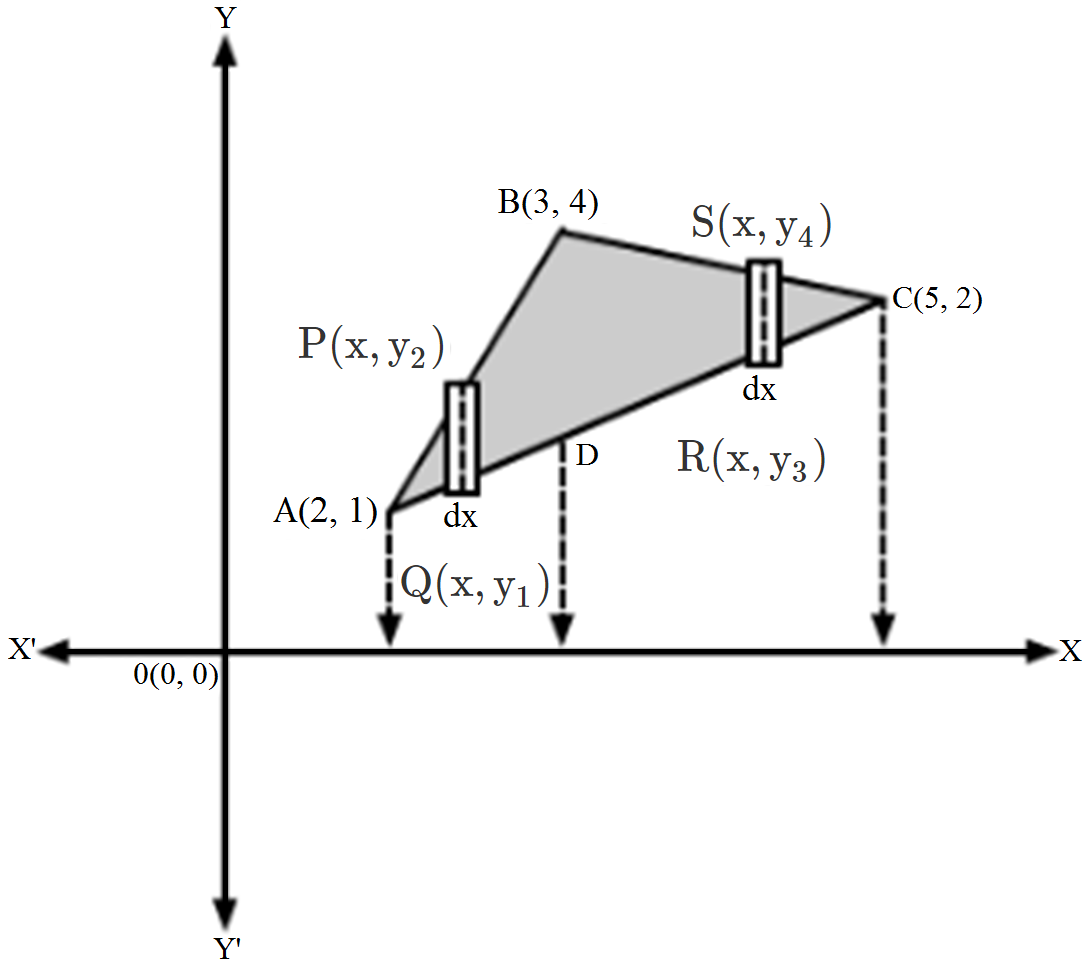
Consider the points A(2, 1), B(3, 4) and C(5, 2)
We need to find area of shaded triangle ABC
Equation of AB is
$\text{y}-1=\Big(\frac{4-3}{3-2}\Big)(\text{x}-2)$
$\Rightarrow\text{x}-3\text{y}-5=0\ ...(\text{i})$
Equation of BC is
$\text{y}-4=\Big(\frac{2-4}{5-3}\Big)(\text{x}-3)$
$\Rightarrow\text{x}=\text{y}-7=0\ ...(\text{ii})$
Equation of CA is
$\text{y}-2=\Big(\frac{2-1}{5-2}\Big)(\text{x}-5)$
$\Rightarrow\text{x}-3\text{y}+2=0\ ...(\text{iii})$
Area of $\triangle\text{ABC}= \text{Area of}\ \triangle\text{ABC}+ \text{Area of }\triangle\text{ABC}$ in the,
Consided point $P(x_1, y_2)$ on $AB$ and $Q(x_1, y_1)$ on $AD$
Thus, the area of appoximating with length $= |y_2 - y_1|$ from $x = 2$, to $x = 3$
$\therefore$ Area of $\triangle\text{ABC}=\int\limits_{2}^{3}|\text{y}_{2}-\text{y}_{1}|\text{dx} $
$\Rightarrow\text{A}=\int\limits_{2}^{3}(\text{y}_{2}-\text{y}_{1})\text{dx} $
$\Rightarrow\text{A}=\int\limits_{2}^{3}(3\text{x}-5)-\Big(\frac{\text{x}-1}{3}\Big)\text{dx}$
$\Rightarrow\text{A}=\int\limits_{2}^{3}\frac{(9\text{x}-15-\text{x}-1)}{3}\text{dx}$
$\Rightarrow\text{A}=\int\limits_{2}^{3}\frac{(8\text{x}-16)}{3}\text{dx}$
$\Rightarrow\text{A}=\frac{1}{3}\Big[8\text{x}^{2}-16\text{x}\Big]\text{dx}$
$\Rightarrow\text{A}=\frac{1}{3}(68-64)$
$\Rightarrow\text{A}=\frac{4}{3}\ \text{sq.}\ \text{units}$

Need a full question paper?

Generate a complete, print-ready paper with questions like this in minutes — across 16+ boards, with answer keys.
Start Generating Free

Similar questions

Using elementary transformations, find the inverse of the following matrix:
$\begin{bmatrix} 0 & 1 & 2 \\ 1 & 2 & 3 \\ 3 & 1 & 0 \end{bmatrix} $
$\text{Evaluate:}\int\frac{\text{x + 2}}{\sqrt{\text{x}^{2}+\text{2x}+}\text{3}}\text{dx}$
Solve the following determinant equations:
$\begin{vmatrix}1&1&\text{x}\\\text{p}+1&\text{p}+1&\text{p}+\text{x}\\3&\text{x}+1&\text{x}+2\end{vmatrix}=0$
Show that the lines $\frac{\text{x}+1}{-3}=\frac{\text{y}-3}{2}=\frac{\text{z}+2}{1}$ and $\frac{\text{x}}{1}=\frac{\text{y}-7}{-3}=\frac{\text{z}+7}{2}$ are coplanar. Also, find the equation of the plane containing them.
Prove that:
$\begin{vmatrix} 1&\text{a}&\text{bc}\\1&\text{b}&\text{ca}\\1&\text{c}&\text{ab}\end{vmatrix}=\begin{vmatrix} 1&\text{a}&\text{a}^2\\1&\text{b}&\text{b}^2\\1&\text{c}&\text{c}^2\end{vmatrix}$
Prove that:
$\cos^{-1}\frac{12}{13}=\sin^{-1}\frac{3}{5}=\sin^{-1}\frac{3}{5}=\sin^{-1}\frac{56}{65}$
Find the equation of the curve which passes through the point $(1, \frac{\pi}{4})$ and tangent at any point 0f which makes an angle $\tan^{-1}\Big(\frac{\text{y}}{\text{x}}-\cos^{2}\frac{\text{y}}{\text{x}}\Big)$ with x-axis.
Experiments show that radium disintegrates at a rate proportional to the amount of radium present at the moment. Its half - life is 1590 years. What percentage will disappear in one year?
A bag contains $4$ white and $5$ black balls. Another bag contains $9$ white and $7$ black balls. A ball is transferred from the first bag to the second and then a ball is drawn at random from the second bag. Find the probability that the ball drawn is white.
David wants to invest at most $Rs. 12,000$ in Bonds $A$ and $B$. According to the rule, he has to invest at least $Rs. 2,000$ in Bond A and at least $Rs. 4,000$ in Bond $B.$ If the rates of interest on Bonds $A$ and $B$ respectively are $8\%$ and $10\%$ per annum, formulate the problem as L.P.P. and solve it graphically for maximum interest. Also determine the maximum interest received in a year.