Question
Using integration, find the area of the region bounded by the triangle whose vertices are (–1, 2), (1, 5) and (3, 4).
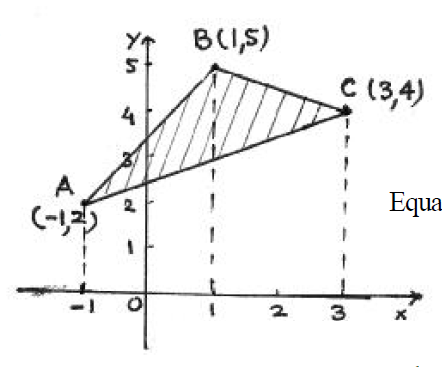
Answer

Correct fiqure

Equation of
$\text{AB is}:\text{y} =\frac{1}{2}(3 \text{x} + 7 )$
$\text{BC is:}\text{y} = \frac{1}{2}(11 - \text{x})$
$\text{AC is}:\text{y} =\frac{1}{2}(\text{x} + 5 )$
Required area $ =\frac{1}{2}\int\limits_{-1}^{1}(3 \text{x} + 7 )\text{dx} + \frac{1}{2}\int\limits_{1}^{3}(11 - \text{x})\text{dx} - \frac{1}{2}\int\limits_{-1}^{3}(\text{x} + 5 )\text{dx}$
$ = \bigg[\frac{1}{12}(3 \text{x} + 7 )^{2}\bigg]_{-1}^{1} - \frac{1}{4}\bigg[(11-\text{x})^{2}\bigg]_{1}^{3} - \frac{1}{4}\bigg[(\text{x} + 5)^{2}\bigg]_{-1}^{3}$
= 7 + 9 – 12 = 4 sq. units.

Need a full question paper?

Generate a complete, print-ready paper with questions like this in minutes — across 16+ boards, with answer keys.

Start Generating Free

Similar questions

Find the angle between the lines whose direction ratios are proportional to a, b, c and b - c, c - a, a - b.
Find the area of the region enclosed by the parabola $x^2=y$ the line $y=x+2$ and $x-$ axis.
For the following matrices verify the distributivity of matrix, multiplication over matrix addtion i.e., A(B + C) = AB + AC.
$\text{A}=\begin{bmatrix}2&-1\\1&1\\-1&2\end{bmatrix},\text{B}=\begin{bmatrix}0&1\\1&1\end{bmatrix}$ and $\text{C}=\begin{bmatrix}1&-1\\0&1\end{bmatrix}$
Evaluate the following integrals:
$\int\frac{\text{x}^2}{\text{x}^4+\text{x}^2-2}\ \text{dx}$
Evaluate the following integrals:
$\int\limits_{0}^{{2\pi}}\sqrt{1-\sin\frac{\text{x}}{2}}\text{ dx}$
Let $\text{A}=\{\text{x}\in\text{Z}:0\leq\text{x}\leq12\}.$ Show that, $\text{R}=\{(\text{a, b}):\text{a, b}\in\text{A},\ |\text{a}-\text{b}|$ is divisible by 4} is an equivalence relation. Find the set of all elements related to 1. Also write the equivalence class [2].
Solve the following differential equation:
$\frac{\text{dy}}{\text{dx}}=\text{y}\tan\text{x}-2\sin\text{x}$
If $\text{y}=\text{a}\{\text{x}+\sqrt{\text{x}^2+1}\}^\text{n}+\text{b}\{\text{x}-\sqrt{\text{x}^2+1}\}^{-\text{n},}$ prove that $(\text{x}^2-1)\frac{\text{d}^2\text{y}}{\text{dx}^2}+\text{x}\frac{\text{dy}}{\text{dx}}-\text{n}^2\text{y}=0.$
If the value of c prescribed in Roll's theorem for the function$\text{f}(\text{x})=2\text{x}(\text{x}-3)^{\text{n}}$ on the interval $\big[0,2\sqrt3\big]$ is $\frac{3}{4},$ write the value of n (a positive integers).
Two schools $A$ and $B$ want to award their selected students on the values of sincerity, truthfulness and helpfulness. The school A wants to award $₹\ x$ each, $₹\ y$ each and $₹\ z$ each for the three respective values to $3, 2$ and $1$ students respectively with a total award money of $₹\ 1,600$. School $B$ wants to spend $₹\ 2,300$ to award its $4, 1$ and $3$ students on the respective values $($by giving the same award money to the three values as before$).$ If the total amount of award for one prize on each value is $₹\ 900,$ using matrices, find the award money for each value. Apart from these three values, suggest one more value which should be considered for award.