Question
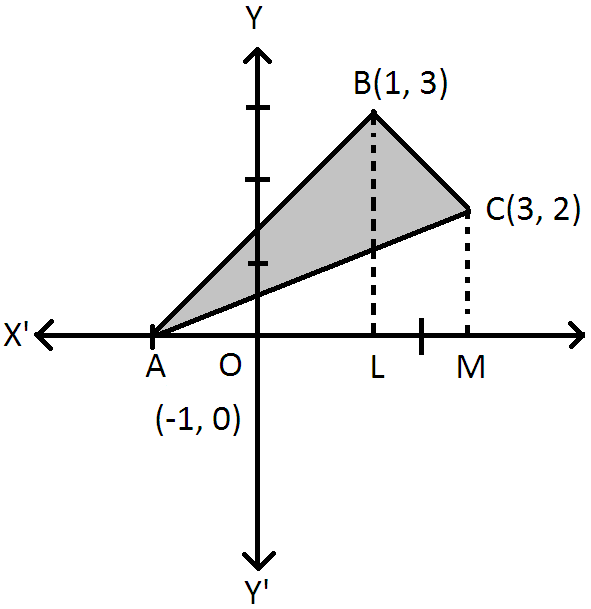
Using integration, find the area of the region bounded by the triangle whose vertices are (-1, 0), (1, 3) and (3, 2).
Answer

Here, Vertices of triangle are A(-1, 0), B(1, 3) and C(3, 2).
$\therefore$ Equation of the line is $\text{y}-0=\frac{3-0}{1-(-1)}(\text{x}-(-1))$ $\bigg[\therefore\text{y}-\text{y}_1=\frac{\text{y}_2-\text{y}_1}{\text{x}_2-\text{x}_1}(\text{x}-\text{x}_1)\bigg]$ $\Rightarrow\text{y}=\frac32(\text{x}+1)$ $\therefore\text{Area of }\Delta\text{ABL}$ = Area bounded by line AB and x-axis $=\begin{vmatrix}\int\limits^1_{-1}\text{y dx} \end{vmatrix}\Big[\therefore\text{At A, x}=-1\text{ and at B},\text{ x}=1\Big]$ $=\begin{vmatrix}\int\limits^1_{-1}\frac32(\text{x}+1)\text{dx} \end{vmatrix}$ $=\frac32\begin{vmatrix}\int\limits^1_{-1}(\text{x}+1)\text{dx} \end{vmatrix}=\frac32\begin{vmatrix}\bigg(\frac{\text{x}^2}{2}+\text{x}\bigg)^1_{-1} \end{vmatrix}$ $=\frac32\begin{vmatrix}\bigg(\frac{1}{2}+\text{1}\bigg)-\bigg(\frac{1}{2}-\text{1}\bigg)\end{vmatrix}$ $=\frac32\bigg(\frac32+\frac12\bigg)=\frac32.\frac42=3\dots(\text{i})$ Again equation of line BC is $\text{y}-3=\frac{2-3}{3-1}(\text{x}-1)\Rightarrow\text{y}=\frac12(7-\text{x})$ $\therefore$ Area of trapezium BLMC = Area bounded by line BC and x-axis $=\begin{vmatrix}\int\limits^3_{1}\text{y dx} \end{vmatrix}=\begin{vmatrix}\int\limits^3_{1}\frac12(7-\text{x})\text{dx} \end{vmatrix}$ $=\frac12\begin{vmatrix}\bigg(7\text{x}-\frac{\text{x}^2}{2}\bigg)^3_1 \end{vmatrix}$ $=\frac12\begin{vmatrix}\bigg(21-\frac{\text{9}}{2}\bigg)-\bigg(7-\frac{\text{1}}{2}\bigg)\end{vmatrix}$ $=\frac12\bigg(21-\frac{\text{9}}{2}-7+\frac12\bigg)=\frac12\Big(\frac{42-9-14+1}{2}\Big)$ $=\frac14\times20=5\dots(\text{ii})$ Again equation of line AC is $\text{y}-0=\frac{2-0}{3-(-1)}(\text{x}-(-1))\Rightarrow\text{y}=\frac12(\text{x}+1)$ $\therefore$ Area of triangle ACM = Area bounded by line AC and x-axis $=\begin{vmatrix}\int\limits^3_{-1}\text{y dx} \end{vmatrix}=\begin{vmatrix}\int\limits^3_{-1}\frac12(\text{x}+1)\text{dx} \end{vmatrix}=\frac12\begin{vmatrix}\Big(\frac{\text{x}^2}{2}+\text{x}\Big)^3_{-1} \end{vmatrix}$ $=\frac12\begin{vmatrix}\Big(\frac92+3\Big)-\Big(\frac12-1\Big)\end{vmatrix}$ $=\frac12\Big(\frac92+3-\frac12+1\Big)$ $=\frac12\Big(\frac{9+6-1+2}{2}\Big)$ $=\frac14\times16=4\dots(\text{iii})$ $\therefore$ Required area = Area of $\Delta\text{ABL}$ + Area of Trapezium BLMC - Area of $\Delta\text{ACM}$ = 3 + 5 - 4 = 4 sq. units

Need a full question paper?

Generate a complete, print-ready paper with questions like this in minutes — across 16+ boards, with answer keys.

Start Generating Free

Similar questions

If$ y = P e^{ax}+ Q e^{bx},$ show that
$\frac{\text{d}^2\text{y}}{\text{dx}^2}-(\text{a}+\text{b})\frac{\text{dy}}{\text{dx}}+\text{aby}=0$
Find $\frac{\text{dy}}{\text{dx}} y = e^x + 10^x + x^x$
A company produces two types of leather belts, say type $A$ and $B.$ Belt $A$ is a superior quality and belt $B$ is of a lower quality. Profits on each type of belt are $Rs. 2$ and $Rs. 1.50$ per belt, respectively. Each belt of type $A$ requires twice as much time as required by a belt of type $B.$ If all belts were of type $B,$ the company could produce $1000$ belts per day. But the supply of leather is sufficient only for $800$ belts per day $($both $A$ and $B$ combined$).$ Belt $A$ requires a fancy buckle and only $400$ fancy buckles are available for this per day. For belt of type $B,$ only $700$ buckles are available per day.
How should the company manufacture the two types of belts in order to have a maximum overall profit?
A manufacturer makes two types of toys A and B. Three machines are needed for this purpose and the time (in minutes) required for each toy on the machines is given below:
Type of Toys
Machine
 
I
II
III
A
12
18
6
B
6
0
9
Each machine is available for a maximum of 6 hours per day. If the profit on each toy of type A is Rs. 7.50 and that on each toy of type B is Rs. 5, show that 15 toys of type A and 30 toys of type B should be manufactured in a day to get maximum profit.
Show that the following system of linear equation is inconsistent:
$2x + 3y = 5$
$6x + 9y = 10$
For the following matrices verify the associativity of multiplication i.e., (AB) C = A(BC):
$\text{A}=\begin{bmatrix}4&2&3\\1&1&2\\3&0&1\end{bmatrix},\text{B}=\begin{bmatrix}1&-1&1\\0&1&2\\2&-1&1\end{bmatrix}$ and $\text{C}=\begin{bmatrix}1&2&-1\\3&0&1\\0&0&1\end{bmatrix}$
If $\text{x}=2\cos\text{t}-\cos2\text{t},\text{y}=2\sin\text{t}-\sin2\text{t},$ find $\frac{\text{d}^2\text{y}}{\text{dx}^2}\ \text{at}\ \text{t}=\frac{\pi}{2}.$
Differentiate the following functions with respect to x:
$\text{x}\sin2\text{x}+5^{\text{x}}+\text{k}^\text{k}+(\tan^2\text{x})^3$
If $y=x \cos (\log x)$ then prove that :$
x^2 y_2-x y_1+2 y=0
$
A large window has the shape of a rectangle surmounted by an equilateral triangle. If the perimeter of the window is 12 metres find the dimensions of the rectangle will produce the largest area of the window.