Question
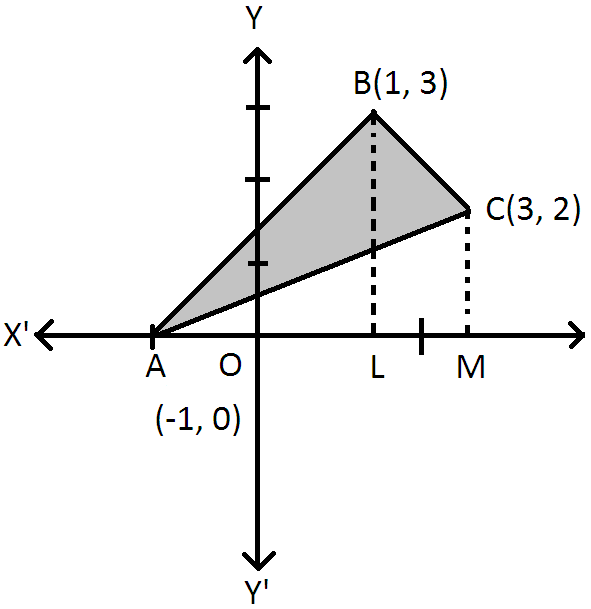
Using integration, find the area of the region bounded by the triangle whose vertices are (-1, 0), (1, 3) and (3, 2).
Answer

Here, Vertices of triangle are A(-1, 0), B(1, 3) and C(3, 2).

$\therefore$ Equation of the line is

$\text{y}-0=\frac{3-0}{1-(-1)}(\text{x}-(-1))$

$\bigg[\therefore\text{y}-\text{y}_1=\frac{\text{y}_2-\text{y}_1}{\text{x}_2-\text{x}_1}(\text{x}-\text{x}_1)\bigg]$

$\Rightarrow\text{y}=\frac32(\text{x}+1)$

$\therefore\text{Area of }\Delta\text{ABL}$ = Area bounded by line AB and x-axis

$=\begin{vmatrix}\int\limits^1_{-1}\text{y dx} \end{vmatrix}\Big[\therefore\text{At A, x}=-1\text{ and at B},\text{ x}=1\Big]$

$=\begin{vmatrix}\int\limits^1_{-1}\frac32(\text{x}+1)\text{dx} \end{vmatrix}$

$=\frac32\begin{vmatrix}\int\limits^1_{-1}(\text{x}+1)\text{dx} \end{vmatrix}=\frac32\begin{vmatrix}\bigg(\frac{\text{x}^2}{2}+\text{x}\bigg)^1_{-1} \end{vmatrix}$

$=\frac32\begin{vmatrix}\bigg(\frac{1}{2}+\text{1}\bigg)-\bigg(\frac{1}{2}-\text{1}\bigg)\end{vmatrix}$

$=\frac32\bigg(\frac32+\frac12\bigg)=\frac32.\frac42=3\dots(\text{i})$

Again equation of line BC is $\text{y}-3=\frac{2-3}{3-1}(\text{x}-1)\Rightarrow\text{y}=\frac12(7-\text{x})$

$\therefore$ Area of trapezium BLMC = Area bounded by line BC and x-axis

$=\begin{vmatrix}\int\limits^3_{1}\text{y dx} \end{vmatrix}=\begin{vmatrix}\int\limits^3_{1}\frac12(7-\text{x})\text{dx} \end{vmatrix}$

$=\frac12\begin{vmatrix}\bigg(7\text{x}-\frac{\text{x}^2}{2}\bigg)^3_1 \end{vmatrix}$

$=\frac12\begin{vmatrix}\bigg(21-\frac{\text{9}}{2}\bigg)-\bigg(7-\frac{\text{1}}{2}\bigg)\end{vmatrix}$

$=\frac12\bigg(21-\frac{\text{9}}{2}-7+\frac12\bigg)=\frac12\Big(\frac{42-9-14+1}{2}\Big)$

$=\frac14\times20=5\dots(\text{ii})$

Again equation of line AC is $\text{y}-0=\frac{2-0}{3-(-1)}(\text{x}-(-1))\Rightarrow\text{y}=\frac12(\text{x}+1)$

$\therefore$ Area of triangle ACM = Area bounded by line AC and x-axis

$=\begin{vmatrix}\int\limits^3_{-1}\text{y dx} \end{vmatrix}=\begin{vmatrix}\int\limits^3_{-1}\frac12(\text{x}+1)\text{dx} \end{vmatrix}=\frac12\begin{vmatrix}\Big(\frac{\text{x}^2}{2}+\text{x}\Big)^3_{-1} \end{vmatrix}$

$=\frac12\begin{vmatrix}\Big(\frac92+3\Big)-\Big(\frac12-1\Big)\end{vmatrix}$

$=\frac12\Big(\frac92+3-\frac12+1\Big)$

$=\frac12\Big(\frac{9+6-1+2}{2}\Big)$

$=\frac14\times16=4\dots(\text{iii})$

$\therefore$ Required area = Area of $\Delta\text{ABL}$ + Area of Trapezium BLMC - Area of $\Delta\text{ACM}$

= 3 + 5 - 4 = 4 sq. units

Need a full question paper?

Generate a complete, print-ready paper with questions like this in minutes — across 16+ boards, with answer keys.

Start Generating Free

Similar questions

Differentiate $\sin^{-1}\sqrt{1-\text{x}^2}$ with respect to $\cos^{-1}\text{x},$ if
$\text{x}\in(0, 1)$
If $\vec{\text{a}} \times \vec{\text{b}} = \vec{\text{c}} \times \vec{\text{d}}$ and $\vec{\text{a}} \times \vec{\text{c}} = \vec{\text{b}} \times \vec{\text{d}},$ show that $\vec{\text{a}} - \vec{\text{d}}$ is parallel to $\vec{\text{b}} - \vec{\text{c}},$ where $\vec{\text{a}} \neq \vec{\text{d}}$ and $\vec{\text{b}} \neq \vec{\text{c}}.$
Differentiate the function $x^{x \cos x}+\frac{x^{2}+1}{x^{2}-1}$ w.r.t. x.
If $y=x \cos (\log x)$ then prove that :$
x^2 y_2-x y_1+2 y=0
$
Consider $\text{f}:\text{R}_+\rightarrow[-5,\infty)$ given by f(x) = 9x2 + 6x - 5. Show that f is invertible with $\text{f}^{-1}(\text{x})=\frac{\sqrt{\text{x}+6}-1}{3}.$
Without expanding, show that the values of the following determinant are zero:
$\begin{vmatrix}1&\text{a}&\text{a}^2-\text{bc}\\1&\text{b}&\text{b}^2-\text{ac}\\1&\text{c}&\text{c}^2-\text{ab} \end{vmatrix}$
Find the inverse of the following matrices by using elementry row transformation:

$\begin{bmatrix} 0 & 1 & 2 \\ 1 & 2 & 3 \\ 3 & 1 & 1 \end{bmatrix}$

Find the area under the curve $\text{y}=\sqrt{6\text{x}+4}$ above x-axis from x = 0 to x = 2. Draw a sketch of curve also.
Let n be a fixed positive integer. Define a relation R on Z as follows:
$(\text{a, b})\in\text{R}\Leftrightarrow\ \text{a}-\text{b}$ is divisible by n. Show that R is an equivalence relation on Z.
For the matrix $A=\left[\begin{array}{ccc}1 & 1 & 1 \\ 1 & 2 & -3 \\ 2 & -1 & 3\end{array}\right]$, show that $A^3-6 A^2+5 A+11 I=0$. Hence find $A^{-1}$.