Question
Using integration, find the area of the region bounded by the triangle whose vertices are (2, –2), (4, 5) and (6, 2).
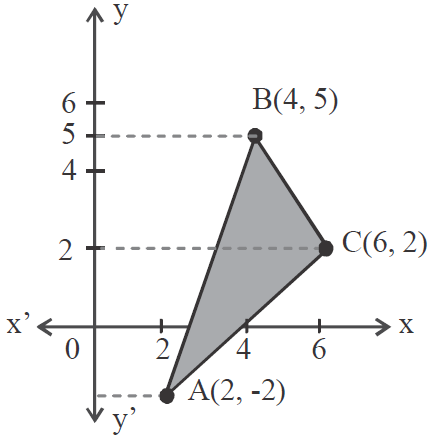
Answer

yet A = (2 - 2)
B = (4, 5)
C = (6, 2)
We have to find the area of $\triangle\text{ABC}$ 
Equation of line AB $\text{y}-5=\Big(\frac{-2-5}{2-4}\Big)(\text{x}-4)$
$\text{y}-5=\frac72(\text{x}-4)$
$2\text{y}-10=7\text{x}-28$
$\text{7x}-2\text{y}=-10+28$
$\text{7x}-2\text{y}=18\dots(\text{i})$
Equation of line BC $\text{y}-2=\Big(\frac{5-2}{4-6}\Big)(\text{x}-6)$
$-2\text{y}+4=3\text{x}-18$
$4+18=3\text{x}+\text{2y}$
$\text{3x}+\text{2y}=22\dots{\text{(ii)}}$
Equation of line AC $\text{y}-2=\frac{-2-2}{2-6}(\text{x}-6)$
$\text{y}-2=\frac{-4}{-4}(\text{x}-6)$
$\text{y}-2=\text{x}-6$
$\text{x}-\text{y}=-2+6$
$\text{x}-\text{y}=4\dots(\text{iii})$
So the required are:

$\text{ar}(\triangle\text{ABC})=\int_\limits{2}^{2} (\text{y}+4)\text{dy}+\Big(\frac{-2}{3}\Big)\\\int_\limits{2}^{5}(\text{y}-11)\text{dy}-\int_\limits{-2}^{5}\frac27(\text{y}+9)\text{dy}$
$=\frac12\Big[(\text{y}+4)^2\Big]^2_{-2}-\frac13\Big[(\text{y}-11)^2\Big]^5_{2}-\frac17\Big[(\text{y}+9)^2\Big]^5_{-2}$
$=16+15-21=10.$

Need a full question paper?

Generate a complete, print-ready paper with questions like this in minutes — across 16+ boards, with answer keys.

Start Generating Free

Similar questions

Show that $\text{A}=\begin{bmatrix} 5 & 3 \\-1 & -2 \end{bmatrix}$ satisfies the equation x2 - 3x - 7 = 0. Thus, find A-1.
If A = diag(a, b, c), show that An = diag(an, bn, cn) for all positive integer n.
Find the vector and cartesian equations of the line passing through (1, 2, 3) and parallel to the planes $\vec{\text{r}}\cdot(\hat{\text{i}}-\hat{\text{j}}+2\hat{\text{k}})=5$ and $\vec{\text{r}}\cdot(3\hat{\text{i}}+\hat{\text{j}}+2\hat{\text{k}})=6$
A card is drawn and replaced in an ordinary pack of 52 cards. How many times must a card be drawn so that.
  1. there is at least an even chance of drawing a heart.
  2. the probability of drawing a heart is greater than $\frac{3}{4}$?
Form the differential equation of the family of curves represented by the equation (a being the perimeter):

$(\text{x}-\text{a})^2+2\text{y}^2=\text{a}^2$

If $\vec{\text{a}},\ \vec{\text{b}},\ \vec{\text{c}}$ are non-coplanar vectors, prove that the point having the following position vectors is collinear:

$\vec{\text{a}}+\vec{\text{b}}+\vec{\text{c}},\ 4\vec{\text{a}}+3\vec{\text{b}},\ 10\vec{\text{a}}+7\vec{\text{b}}-2\vec{\text{c}}$

Find the area under the curve $\text{y}=\sqrt{6\text{x}+4}$ above x-axis from x = 0 to x = 2. Draw a sketch of curve also.
If the tangent to the curve y = x3 + ax + b at (1, − 6) is parallel to the line x − y + 5 = 0, find a and b.
Using integration, find the area of the triangle ABC coordinatrs of whise vertices A(4, 1), B(6, 6) and C(8, 4).
Differentiate the following functions with respect to x:
$\log\Big(\frac{\text{x}^2+\text{x}+1}{\text{x}^3-\text{x}+1}\Big)$