Question
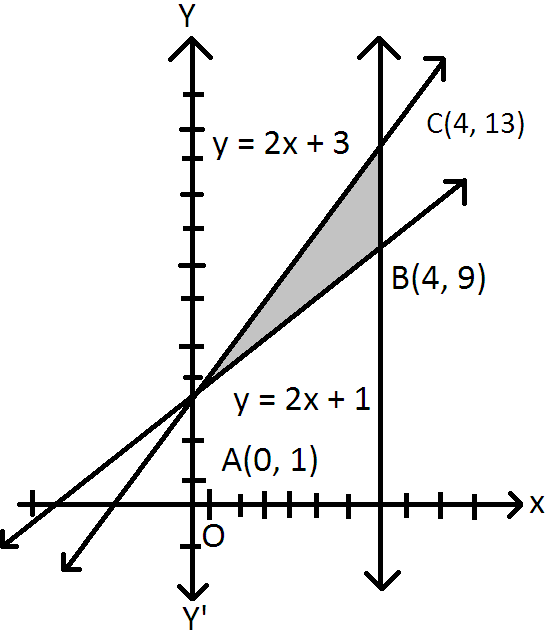
Using integration, find the area of the triangular region whose sides have the equations y = 2x + 1, y = 3x + 1 and x = 4.

Answer

Equations of one side of triangle is
y = 2x + 1 ...(i) second line of triangle is y = 3x + 1 ...(ii) third line of triangle is x = 4 ...(iii) Solving eq. (i) and (ii), we get x = 0 and y = 1 $\therefore$ Point of intersection of lines (i) and (ii) is A(0, 1) Putting x = 4 in eq. (i), we get y = 9 $\therefore$ Point of intersection of lines (i) and (iii) is B(4, 9) Putting x = 4 in eq. (i), we get y = 13 $\therefore$ Point of intersection of lines (ii) and (iii) is C(4, 13) $\therefore$ Area between line (ii) i.e., AC and x-axis $=\begin{vmatrix}\int\limits^4_{0}\text{y dx} \end{vmatrix}=\begin{vmatrix}\int\limits^4_{0}(3\text{x}+1)\text{dx} \end{vmatrix}=\bigg(\frac{3\text{x}^2}{2}+\text{x}\bigg)^4_0$ = 24 + 4 = 28 sq. units ...(iv) Again Area between line (i) i.e., AB and x-axis $=\begin{vmatrix}\int\limits^4_{0}\text{y dx} \end{vmatrix}=\begin{vmatrix}\int\limits^4_{0}(2\text{x}+1)\text{dx} \end{vmatrix}=\bigg(\text{x}^2+\text{x}\bigg)^4_0$ = 16 + 4 = 20 sq. units …(v) Therefore, Required area of $\Delta\text{ABC}$ = Area given by (iv) - Area given by (v) = 28 - 20 = 8 sq. units

Need a full question paper?

Generate a complete, print-ready paper with questions like this in minutes — across 16+ boards, with answer keys.
Start Generating Free

Similar questions

Without expanding, show that the values of the following determinant are zero:
$\begin{vmatrix}\sin\alpha&\cos\alpha&\cos(\alpha+\delta)\\\sin\beta&\cos\beta&\cos(\beta+\delta)\\\sin\gamma&\cos\gamma&\cos(\gamma+\delta)\end{vmatrix}$
A die is tossed twice. A 'success' is getting an odd number on a toss. Find the variance of the number of successes.
If $e^x + x^y = e^{x+y}$, prove that $\frac{\text{dy}}{\text{dx}}+\text{e}^{\text{y}-\text{x}}=0$
Form the differential equation corresponding to $\text{y}=\text{e}^{\text{mx}}$ by eliminating m.
Let $E_1$ and $E_2$ be two independent events such that $P(E_1) = P_1$ and $P(E_2) = P_2$. Describe in words of the events whose probabilities are:
i. $P_1 P_2$
ii. $\left(1-P_1\right) P_2$
iii. $1-\left(1-P_1\right)\left(1-P_2\right)$
iv. $P_1+P_2-2 P_1 P_2$
$\begin{vmatrix}\text{b}+\text{c}&\text{a}&\text{a}\\\text{b}&\text{c}+\text{a}&\text{b}\\\text{c}&\text{c}&\text{a}+\text{b}\end{vmatrix}=4\text{abc}$
A company sells two different products, $A$ and $B$. The two products are produced in a common production process, which has a total capacity of $500$ man-hours. It takes 5 hours to produce a unit of A and $3$ hours to produce a unit of B. The market has been surveyed and company officials feel that the maximum number of unit of A that can be sold is $70$ and that for B is $125$. If the profit is Rs. $20$ per unit for the product A and Rs. $15$ per unit for the product B, how many units of each product should be sold to maximize profit?
Find the value of k if f(x) is continuous at $\text{x}=\frac{\pi}{2},$ where
$\text{f}\text{(x)}=\begin{cases}\frac{\text{k}\cos\text{x}}{\pi-2\text{x}}, &\text{ x}\neq\frac{\pi}{2}\\3, &\text{ x}=\frac{\pi}{2}\end{cases}$
Evaluate the following integrals:
$\int(\text{e}^{\log\text{x}}+\sin\text{x})\cos\text{x dx}$
A small firm manufactures necklaces and bracelets. The total number of necklaces and bracelets that it can handle per day is at most 24. It takes one hour to make a bracelet and half an hour to make a necklace. The maximum number of hours available per day is 16. If the profit on a necklace is Rs. 100 and that on a bracelet is Rs. 300. Formulate on L.P.P. for finding how many of each should be produced daily to maximize the profit?
It is being given that at least one of each must be produced.