Question
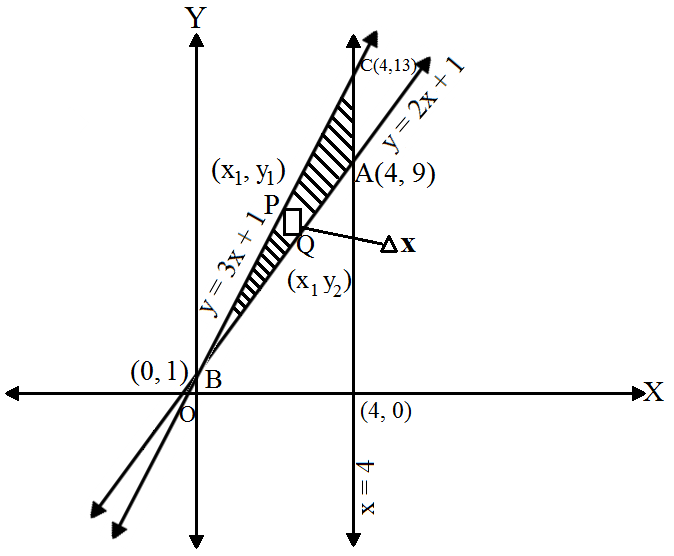
using interation, find the area of the region bounded by the triangle ragion, the euations of whose sides are y = 2x + 1, y = 3x + 1 and x = 4.
Answer

To find area of triangular region bounded by 
y = 2x + 1 ...(i)
y = 3x + 1 ...(ii)
y = 4 ...(iii)
Equation (i) represents a parabola with vertex points(0, 1) and $\Big(-\frac{1}{2}, 0\Big)$ at origin and axis as x-axis and equation (ii) represents points (0, 1) and $\Big(\frac{1}{3}, 0\Big)$ a line parallel to y-axis.
Solving quation (i) and (ii) gives points B(0, 1)
Solving quation (ii) and (iii) gives points C(4, 13)
Solving quation (i) and (iii) gives points B(4, 9)

Area of rectargle = (y1 - y2)x
This apprectximating from x = 0, x = 4
Required area = Redion ABCA
$=\int\limits_{0}^{4}(\text{y}_{1}-\text{y}_{2})\text{dx} $
$=\int\limits_{0}^{4}\Big[3(\text{x}+1)-(2\text{x}+1)\Big]\text{dx} $
$=\int\limits_{0}^{4}\text{x}\text{dx}$
$=\Big[\frac{\text{x}^{2}}{2}\Big]^{4}_{0}$
$=8\ \text{sq.}\ \text{units}$

Need a full question paper?

Generate a complete, print-ready paper with questions like this in minutes — across 16+ boards, with answer keys.

Start Generating Free

Similar questions

Solve the following equation for x:
$\tan^{-1}\Big(\frac{\text{x}-2}{\text{x}-1}\Big)+\tan^{-1}\Big(\frac{\text{x}+2}{\text{x}+1}\Big)=\frac{\pi}{4}$
Find the value of 'a' for which the function f defined by
 $\text{f}\text{(x)}=\begin{cases}\text{a}\sin\frac{\pi}{2}(\text{x}+1),& \text{x}\leq0 \\\frac{\tan\text{x-sin}\text{x}}{\text{x}^3} &\text{x} > 0\end{cases}$ is discontinuous at x = 0.
Find one-parameter families of solution curves of the following differential equation: (or solve the following differential equation)

$\frac{\text{dy}}{\text{dx}}-\frac{2\text{xy}}{1+\text{x}^2}=\text{x}^2+2$

If $\text{y}=(\sin\text{x})^{(\sin\text{x})^{(\sin\text{x})^{....\infty}}},$ prove that $\frac{\text{y}^2\cot\text{x}}{(1-\text{y}\log\sin\text{x})}$
The radius of a sphere shrinks from 10 to 9.8cm. Find approximately the decrease in its volume.
Let f = {(3, 1), (9, 3), (12, 4)} and g = {(1, 3), (3, 3) (4, 9) (5, 9)}. Show that gof and fog are both defined. Also, find fog and gof.
Integrate the function in Exercise:

$\frac{1}{\sqrt{\sin^{3}\text{x}\sin(\text{x}+\text{a)}}}$

Show that the following system of linear equations is consistent and also find solutions:
5x +3y + 7z = 4
3x + 26y + 2z = 9
7x + 2y + 10z = 5
Find $\frac{\text{dy}}{\text{dx}}$
$\text{y}=\text{x}^{\cos\text{x}}+(\sin\text{x})^{\tan\text{x}}$
How many of circuits of Type A and of Type B, should be produced by the manufacturer so as to maximise his profit? Determine the maximum profit.