Question
Using lens maker’s formula, derive the thin lens formula $\frac{1}{\text{f}}=\frac{1}{\text{v}}-\frac{1}{\text{u}}$ for a biconvex lens.

Answer

Ace to lens maker's formula,
$\frac{1}{\text{v}}-\frac{1}{\text{u}}=(\text{n}_{21}-1)\Big(\frac{1}{\text{R}_1}-\frac{1}{\text{R}_2}\Big)\ ...(1)$
When object is at placed at infinity,
$\text{u}=\infty$
Image is obtained at focus,
$\text{v}=\text{f}$
Using these values in Eq (1),
$\frac{1}{\text{f}}-\frac{1}{\infty}={(\text{n}_{21}-1)}\Big(\frac{1}{\text{R}_1}-\frac{1}{\text{R}_2}\Big)$
$\Rightarrow\frac{1}{\text{f}}=(\text{n}_{21}-1)\Big(\frac{1}{\text{R}_1}-\frac{1}{\text{R}_2}\Big)\ ...(2)$
$\therefore$ By Eq (1) and (2),
$\Rightarrow\frac{1}{\text{f}}=\frac{1}{\text{v}}-\frac{1}{\text{u}}$

Need a full question paper?

Generate a complete, print-ready paper with questions like this in minutes — across 16+ boards, with answer keys.

Start Generating Free

Similar questions

A filter transmits only the radiation of wavelength greater than 440nm. Radiation from a hydrogen-discharge tube goes through such a filter and is incident on a metal of work function 2.0eV. Find the stopping potential which can stop the photoelectrons.
(a) When monochromatic light is incident on a surface separating two media, the reflected and refracted light both have the same frequency as the incident frequency. Explain why?
(b) When light travels from a rarer to a denser medium, the speed decreases. Does the reduction in speed imply a reduction in the energy carried by the light wave?
(c) In the wave picture of light, intensity of light is determined by the square of the amplitude of the wave. What determines the intensity of light in the photon picture of light.
State the research done by scientists on electromagnetism after Oersted's observation.
Each side of a square is 90 cm long. At its corners $-2,+3,-4$ and +5 micro coulomb charges are placed respectively. Find the electric potential at the centre of the square.
On the basis of electric field lines, in space, how does the intensity ( $\vec{E}$ ) of electric field of a point charge depend on distance $r$ ? - explain.
###
How do electric field lines depend on area or the solid angle subtended by area element?
An electron, an alpha particle and a proton have the same kinetic energy. Which one of these particles has (i) the shortest and (ii) the largest, de Broglie wavelength?
Explain current flow in N- and P-type semiconductors.
Define the term ‘linearly polarised light’.
When’ does the intensity of transmitted light become maximum, when a polaroid sheet is rotated between two crossed polaroids?
The radius of a spherical conductor shell is $R$ and the charge on it is $Q$. Compare the potential at a distance 2 R from the centre of the sphere with the potential at a distance $R / 2$.
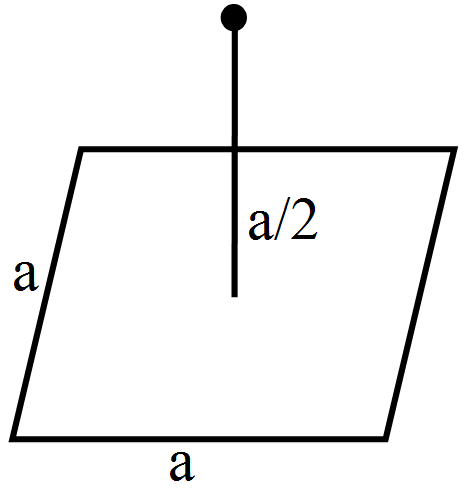
A charge Q is placed at a distance $\frac{\text{a}}{2}$ above the centre of a horizontal, square surface of edge a as shown in figure. Find the flux of the electric field through the square surface.