Question
Using lens maker’s formula, derive the thin lens formula $\frac{1}{\text{f}}=\frac{1}{\text{v}}-\frac{1}{\text{u}}$ for a biconvex lens.

Answer

Ace to lens maker's formula,
$\frac{1}{\text{v}}-\frac{1}{\text{u}}=(\text{n}_{21}-1)\Big(\frac{1}{\text{R}_1}-\frac{1}{\text{R}_2}\Big)\ ...(1)$
When object is at placed at infinity,
$\text{u}=\infty$
Image is obtained at focus,
$\text{v}=\text{f}$
Using these values in Eq (1),
$\frac{1}{\text{f}}-\frac{1}{\infty}={(\text{n}_{21}-1)}\Big(\frac{1}{\text{R}_1}-\frac{1}{\text{R}_2}\Big)$
$\Rightarrow\frac{1}{\text{f}}=(\text{n}_{21}-1)\Big(\frac{1}{\text{R}_1}-\frac{1}{\text{R}_2}\Big)\ ...(2)$
$\therefore$ By Eq (1) and (2),
$\Rightarrow\frac{1}{\text{f}}=\frac{1}{\text{v}}-\frac{1}{\text{u}}$

Need a full question paper?

Generate a complete, print-ready paper with questions like this in minutes — across 16+ boards, with answer keys.
Start Generating Free

Similar questions

State the research done by scientists on electromagnetism after Oersted's observation.
A circular wire-loop of radius a carries a total charge Q distributed uniformly over its length. A small length dL of the wire is cut off. Find the electric field at the centre due to the remaining wire.
The luminous flux of a monochromatic source of 1W is 450 lumen/ watt. Find the relative luminosity at the wavelength emitted.
Derive the equation of P.E. (Potential Energy) of an electric dipole in uniform electric field.
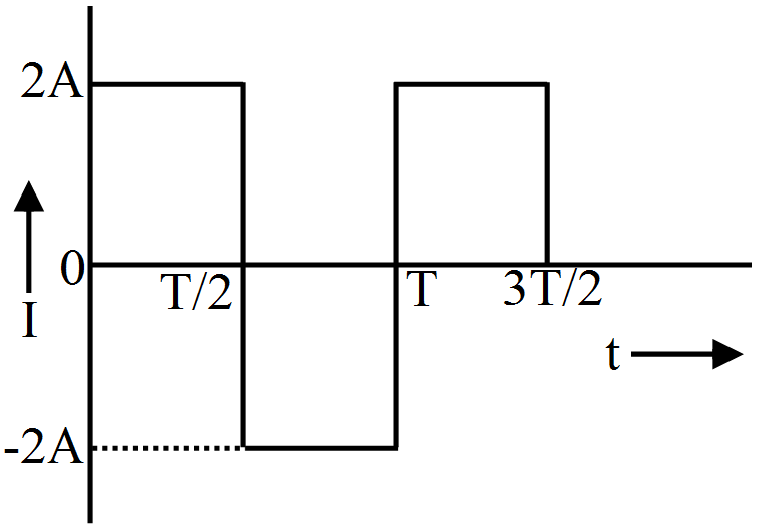
What is the rms value of alternating current shown in figure?
"The total energy of the electron in the hydrogen atom is negative." What does this fact indicate? If the total energy of the electron was positive than what result will have been achieved?
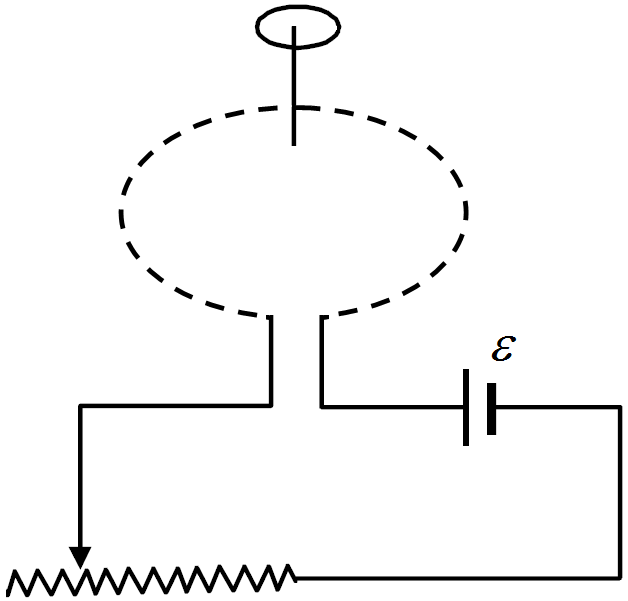
Find the mutual inductance between the circular coil and the loop shown in figure.
A Rowland ring of mean radius 15 cm has 3500 turns of wire wound on a ferromagnetic core of relative permeability 800. What is the magnetic field B in the core for a magnetising current of 1.2 A?
A conducting loop of face-area A and resistance R is placed perpendicular to a magnetic field B. The loop is withdrawn completely from the field. Find the charge which flows through any cross-section of the wire in the process. Note that it is independent of the shape of the loop as well as the way it is withdrawn.
Answer the following:
A man fixes outside his house one evening a two metre high insulating slab carrying on its top a large aluminium sheet of area $1m^2.$ Will he get an electric shock if he touches the metal sheet next morning?