Question
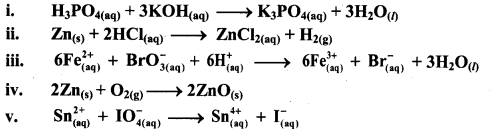
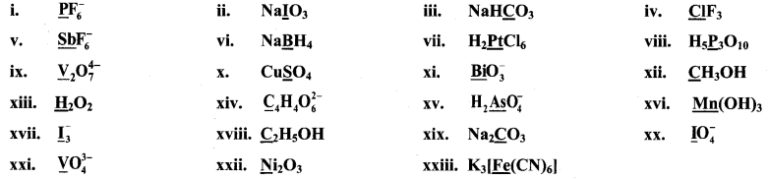
Using oxidation number concept, identify the redox reactions, identify oxidizing and reducing agents in case of redox reactions.
Image

Answer

$i. \ H_3PO_{4(aq)} + 3KOH_{(aq)} \rightarrow K_3PO_{4(aq)} + 3H_2O_{(l)}$
$a.$ Write oxidation number of all the atoms of reactants and products
Image
$b.$ Since, the oxidation numbers of all the species remain same, this is $\text{NOT}$ a redox reaction.
Result:
The given reaction is $\text{NOT}$ a redox reaction.
$ii. \ Zn _{( s )}+2 HCl _{( aq )} \rightarrow ZnCl _2(( aq ))+ H _{2( g )}$
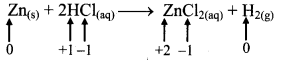
$a.$ Write oxidation number of all the atoms of reactants and products.
Image
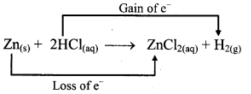
$b.$ Identify the species that undergoes change in oxidation number.
Image
$c.$ The oxidation number of $Zn$ increases from $0 \ to \ +2$ and that of $H$ decreases from $+1 \ to \ 0.$ Because oxidation number of one species increases and that of other decreases, the reaction is redox reaction.
$d.$ The oxidation number of $Zn$ increases by loss of electrons and therefore, $Zn$ is a reducing agent and itself is oxidized. On the other hand, the oxidation number of $H$ decreases by gain of electrons and therefore, $H$ is oxidising an agent and itself is reduced by gain of electrons.
Result:
$1.$The given reaction is a redox reaction.
$2.$Oxidant/oxidising agent $: HCl$
$3.$Reductant/reducing agent $: Zn$
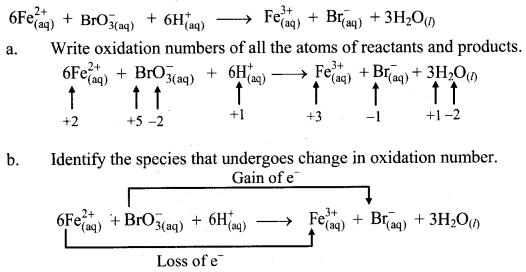
$iii.$Image
$c.$ The oxidation number of $Fe$ increases from $+2 \ to \ +3$ and that of $Br$ decreases from $+5 \ to \ -1.$ Because oxidation number of one species increases and that of the other decreases, the reaction is a redox reaction.
$d.$ The oxidation number of $Fe$ increases by loss of electrons and therefore, $Fe$ is a reducing agent and itself is oxidized. On the other hand, the oxidation number of $Br$ decreases by gain of electrons and therefore, $Br$ is an oxidising an agent and itself is reduced.
Result:
$1.$ The given reaction is a redox reaction.
$2.$ Oxidant/oxidising agent$: BrO _3^{-}$
$3.$ Reductant/reducing agent$: Fe ^{2+}$
$iv. \ 2 Zn _{( s )}+ O _{2( g )} \rightarrow 2 ZnO _{( s )}$
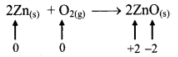
$a.$ Write oxidation number of all the atoms of reactants and products.
Image
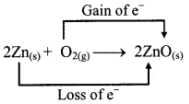
$b.$ Identify the species that undergoes change in oxidation number.
Image
$c.$ The oxidation number of $Zn$ increases from $0 \ to \ +2$ and that of $O$ decreases from $0 \ to \ -2.$ Because oxidation number of one species increases and that of the other decreases, the reaction is a redox reaction.
$d.$ The oxidation number of $Zn$ increases by loss of electrons and therefore, $Zn$ is a reducing agent and itself is oxidized. On the other hand, the oxidation number of $O$ decreases by gain of electrons and therefore, $O$ is an oxidising agent and itself is reduced.
Result:
$1.$The given reaction is a redox reaction.
$2.$Oxidant/oxidising agent $: O_2$
$3.$Reductant/reducing agent $: Zn
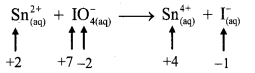
\text { v. } Sn _{(a q)}^{2+}+ IO _{4(2 q)}^{-} \longrightarrow Sn _{(a q)}^{4+}+ I _{(a q)}^{-}$
$a.$ Write oxidation number of all the atoms of reactants and products.
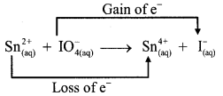
Image$b.$ Identify the species that undergoes change in oxidation number.
Image
$c.$ The oxidation number of $Sn$ increases from $+2 \ to \ +4$ and that of $I$ decreases from $+7$ to $-1.$ Because oxidation number of one species increases and that of the other decreases, the reaction is a redox reaction.
$d.$ The oxidation number of $Sn$ increases by loss of electrons and therefore, $Sn$ is a reducing agent and itself is oxidized. On the other hand, the oxidation number of $I$ decreases by gain of electrons and therefore, $I$ is an oxidising agent and itself is reduced.
Result:
$1.$ The given reaction is a redox reaction.
$2.$ Oxidant/oxidising agent$: Sn ^{2+}$
$3.$ Reductant/reducing agent$: IO _4^{-}$

Need a full question paper?

Generate a complete, print-ready paper with questions like this in minutes — across 16+ boards, with answer keys.
Start Generating Free