Question
Using properties of determinant, show that :
$\left|\begin{array}{ccc}a+b & a & b \\ a & a+c & c \\ b & c & b+c\end{array}\right|=4 a b c$
$\left|\begin{array}{ccc}a+b & a & b \\ a & a+c & c \\ b & c & b+c\end{array}\right|=4 a b c$
Applying $C_1 \rightarrow C_1-\left(C_2+C_3\right)$, we get
L.H.S $=\left|\begin{array}{ccc}0 & a & b \\ -2 c & a+c & c \\ -2 c & c & b+c\end{array}\right|$
Taking $(-2)$ common from $C_1$, we get
L.H.S. $=-2\left|\begin{array}{ccc}0 & a & b \\ c & a+c & c \\ c & c & b+c\end{array}\right|$
Applying $C_2 \rightarrow C_2-C_1$ and $C_3 \rightarrow C_3-C_1$, we get
L.H.S. $=-2\left|\begin{array}{lll}0 & a & b \\ c & a & 0 \\ c & 0 & b\end{array}\right|$
= -2[0(ab – 0) – a(bc – 0) + b(0 – ac)] = -2(0 – abc – abc) = -2(-2abc) = 4abc = R.H.S.
Generate a complete, print-ready paper with questions like this in minutes — across 16+ boards, with answer keys.
$\frac{(15-n) !}{(13-n) !}=12$
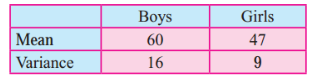
Which of the two is more variable?