Question
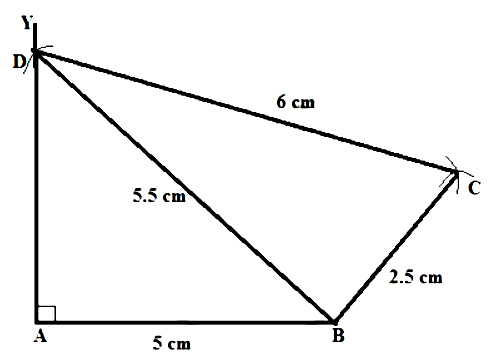
Using ruler and compasses only, construct the quadrilateral $\text{ABCD}$, having given $AB = 5 \ cm, BC = 2.5 \ cm CD = 6 \ cm, \angle BAD = 90^o$ and diagonal $BD = 5.5 \ cm.$
Answer


Steps:
$1.$ Draw $A B=5 \ cm$.
$2.$ From A draw a line $A Y$ such that $\angle A=90^{\circ}$.
$3.$ Taking $B$ as a center with radius $5.5 \ cm$ draw an arc at $D$ on $A Y$.
$4.$ With $D$ and $B$ as center and radii, $6 \ cm$ and $2.5 \ cm$ draw arcs cutting each other at $C$.
$5.$ Join $DC$ and $BC$.
$\text{ABCD}$ is the required quadrilateral.

Need a full question paper?

Generate a complete, print-ready paper with questions like this in minutes — across 16+ boards, with answer keys.
Start Generating Free

Similar questions

Prove that the bisectors of the interior angles of a rectangle form a square.
If $\left(a+\frac{1}{a}\right)^2=3$; then show that $a^3+\frac{1}{a^3}=0$
The area of a rectangle gets reduced by $9$ square units, if its length is reduced by $5$ units and breadth is increased by $3$ units. However, if the length of this rectangle increases by $3$ units and the breadth by $2$ units, the area increases by $67$ square units. Find the dimensions of the rectangle.
Without using tables, evaluate the following: $4(\sin^430^\circ + \cos^460^\circ ) - 3(\cos^245^\circ - \sin^290^\circ )$.
In the following, the coordinates of the three vertices of a rectangle $\text{ABCD}$ are given. By plotting the given points; find, in case, the coordinates of the fourth vertex:$A (4, 2),B(-2, 2)$ and $D(4, -2).$
In isosceles $\triangle ABC, AB = AC.$ The side $BA$ is produced to $D$ such that $BA = AD.$Prove that$: \angle BCD = 90^\circ $
Show that:$\frac{1}{3-2 \sqrt{ } 2}-\frac{1}{2 \sqrt{ } 2-\sqrt{ } 7}+\frac{1}{\sqrt{ } 7-\sqrt{ } 6}-\frac{1}{\sqrt{ } 6-\sqrt{ } 5}+\frac{1}{\sqrt{ } 5-2}=5$
$\text{ABCD}$ is a kite in which $BC = CD, AB = AD. E, F$ and $G$ are the mid$-$points of $CD, BC$ and $AB$ respectively. Prove that: The line drawn through $G$ and parallel to $FE$ and bisects $DA.$
In the given figure, ABCD is a rhombus in which $\angle A =72^{\circ}$. If $\angle CBD =x^{\circ}$, find the value of $x$.
Image
A man borrows $Rs.10,000$ at $10\%$ compound interest compounded yearly. At the end of each year, he pays back $20\%$ of the amount for that year. How much money is left unpaid just after the second year ?