Question
Using second law of motion, derive the relation between force and acceleration. A bullet of $10g$ strikes a sand$-$bag at a speed of $103m\ s^{-1}$ and gets embedded after travelling $5\ cm.$ Calculate
  1. The resistive force exerted by the sand on the bullet.
  2. The time taken by the bullet to come to rest.
Answer

If a body of mass $(m),$ moving at velocity $(u)$ accelerates uniformly at $(a)$ for time $T, $
so that its velocity changes to $v,$ then initial momentum $p_1 =$ mu and final momentum $p_2 = mv $
$\therefore$ Change in momentum $= p_2- p_1= mv - mu = m (v - u)$ According to the second law of mation, force $\text{F}\propto\frac{\text{Change in momentum}}{\text{Time}}$
$\Rightarrow\text{F}\propto\frac{\text{p}_2-\text{p}_1}{\text{t}}$
$\Rightarrow\text{F}\propto\frac{\text{m(v}-\text{u})}{\text{t}}$
$\Rightarrow\text{F}\propto\text{ma}$ $\Big[\text{where},\frac{\text{v}-\text{u}}{\text{t}}=\text{a}\Big]$
$\Rightarrow\text{F}=\text{kma}$ Here, $\text{k}=1$
$\therefore \text{F}=\text{ma}$ Given, $\text{m}=10\text{g}=\frac{10}{1000}\text{kg}=0.01\text{kg},\text{u}=10^3\text{m/s},\text{v}=0$ [$\because 1\ kg = 1000g]$ and $\text{s}=5\text{cm}=\frac{5}{100}\text{m}=0.05\text{m}$ [$\because 1m = 100\ cm]$
  1. From thrid equation of motion, $\text{v}^2=\text{u}^2+2 \text {as}$
$\Rightarrow\text{v}^2-\text{u}^2+2\text{as}$
$\Rightarrow\text{a}=\frac{\text{v}^2-\text{u}^2}{2\text{s}}=\frac{(0)^2-(10^3)^2}{2\times0.05}$
$\text{a}=\frac{-10^6}{0.1}=-10^7\text{m/s}^2$
Now, force applied by the bullet,
$F = ma$
$= 0.01 \times 10^7 = -10^5 N [$ negative sing show against the direction of motion$]$
The resistive force exerted by the sand on the bullet $= 10^5 N$
  1. From first equation of motion, $\text{v = u + at}$
$\Rightarrow\text{at = v}-\text{u}$
Now, time taken by bullet to come to rest, $\text{t}=\frac{\text{v}-\text{u}}{\text{a}}$
$\Rightarrow\text{t}=\frac{0-10^3}{-10^7}$
$\Rightarrow\text{t}=\frac{-10^3}{-10^7}=10^3\times10^{-7}$
$\Rightarrow\text{t}=10^{-4}\text{s}$
Hence, force $(F) = 10^5 N$ and time $(t) = 10^{-4} s$.

Need a full question paper?

Generate a complete, print-ready paper with questions like this in minutes — across 16+ boards, with answer keys.

Start Generating Free

Similar questions

Write the formulae of the following compounds. Also name the elements present in them.
  1. Water.
  2. Ammonia.
  3. Methane.
  4. Sulphur dioxide.
  5. Ethanol.
Write an activity to show that water can be made to boil even at a temperate below its normal boiling point $(100^\circ C)$.
You are provided with a mixture of naphthalene and ammonium chloride by your teacher. Suggest an activity to separate them with well labelled diagram.
  1.  
  1.  
  1. Identify figures A and B.
  2. Which is called tesselated and payement epitheliurn?
  3. Which one lines the gastrointestinal tract and epiglottis?
  4. Which one allows diffusion of substances?
How will you separate a mixture of mercury, oil and water?
Give a brief account of cartilage.
What is a soundboard? Explain the working of a soundboard with the help of a labelled diagram.
A boy of mass $50\ kg$ running at $5\ m/s$ jumps on to a $20\ kg$ trolley travelling in the same direction at $1.5\ m/s.$ What is their common velocity?
There is a water reservoir (river) near a village. Due to insufficient rain, farmers are worried about their crops. Suggest and explain the irrigation practice that can be adopted to supply water to the entire agricultural land in the village.

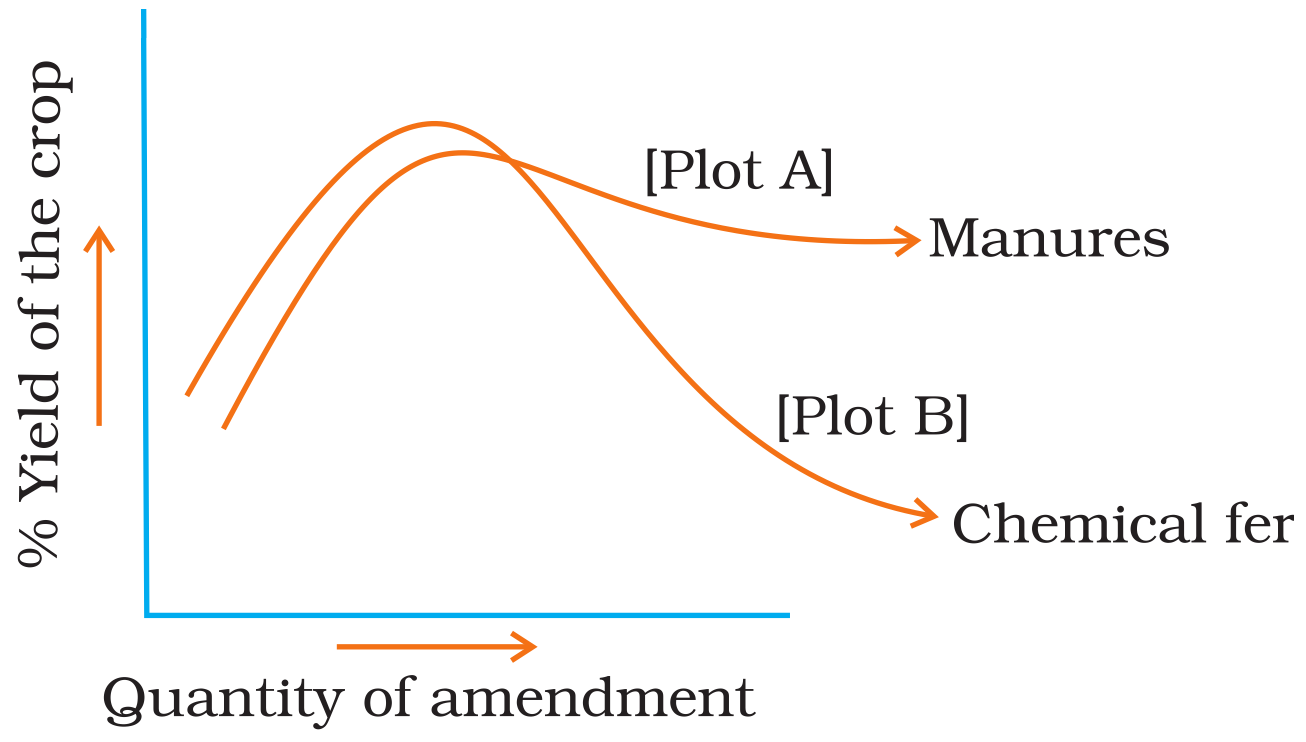
Figure shows the two crop fields [Plots A and B] have been treated by manures and chemical fertilizers respectively, keeping other environmental factors same. Observe the graph and answer the following questions.
  1. Why does plot B show sudden increase and then gradual decrease in yield?
  2. Why is the highest peak in plot A graph slightly delayed?
  3. What is the reason for the different pattern of the two graphs?