Question
Using the Ellingham diagram,(A) Predict the conditions under which
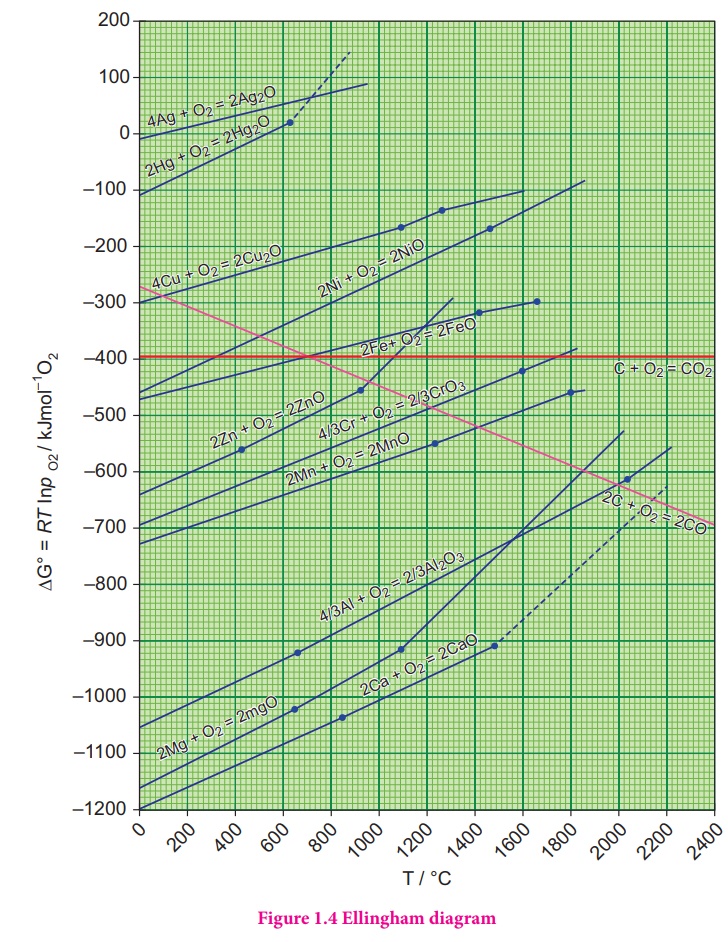
  1. Aluminium might be expected to reduce magnesia.
  2. Magnesium could reduce alumina.
(B) it is possible to reduce $Fe_2O_3$ by coke at a temperature around 1200 K

Answer

(A)
i. Ellingham diagram for the formation of $Al_2O_3$ and MgO intersects around 1600 K. Above this temperature, aluminium line lies below the magnesium line. Hence we can use aluminium to reduce magnesia above 1600 K.
ii. In the Ellingham diagram below 1600 K magnesium line lies below the aluminium line. Hence below 1600 K magnesium can reduce alumina.
Image
(B) In the Ellingham diagram above 1000 K carbon line lies below the iron line. Hence it is possible to reduce $Fe _2 O _3$ by coke at a temperature around 1200 K .

Need a full question paper?

Generate a complete, print-ready paper with questions like this in minutes — across 16+ boards, with answer keys.

Start Generating Free

Similar questions

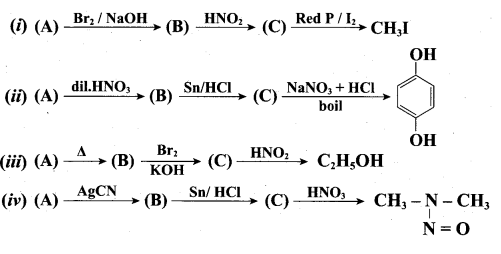
Identify compounds A, B and C in the following reactions.
Image
 An organic compound $(A)$ of molecular formula $C _7 H _8 O$ on oxidation with alkaline $KMnO _4$ gives $(B)$ of formula $C _7 H _6 O$. (B) on reaction with $Cl _2$ in the presence of catalyst $FeCl _3$ gives (C) of formula $C _7 HOCl$. (B) on reaction with $Cl _2$ in the absence of catalyst gives $C _7 H _5 OCl$. Identify $A , B , C , D$ and explain the reaction involved.
An organic compound (A) of molecular formula $C _3 H _6$ on reaction with Conc. $H _2 SO _4$ and $H _2 O$ gives $Cl _5 O$ as (B) as a MarkownikoWs product. (B) on oxidation with Cu at 573 K gives (C) of formula $C _3 H _6 O$. (C) on reaction with $CH _3 MgBr$ followed by acid hydrolysis yields ( D ) as $C _4 H _{10} O$ which will not give any colour in Victor Meyer's test. Identify A, B, C, D and explain the reactions involved.
Explain the hybridisation, geometry, magnetic property and magnetic moment $\left[ CO F _6\right]^{3-}$
Explain the observations from the Ellingham diagram.
An organic compound $(A)$ of molecular formula $C _2 H _4 O$ reduces tollen's reagent to silver mirror. (A) on treatment with $C _2 H _5 MgBr$ followed by acid hydrolysis gives (B) of formula $C _4 H _{10} O$. (B) on reaction with Cu at 573 K gives $\left( C\right.$ ) of formula $C _4 H _8 O$ which does not reduce tollen's reagent but answers iodoform test. Identify $A, B, C, D$ and explain the reaction involved.
Illustrate with examples.
  1. Lyophilic and Lyophobic sols
  2. Homogeneous and Heterogeneous catalysis.
An organic compound (A) of molecular formula $C _6 HN _2 Cl$ on boiling with hot water gives (B) of molecular formula $C _6 H _6 O$. (B) on reaction with Zinc dust gives $(C)$ a simplest aromatic hydrocarbon. (C) on reaction with methyl chloride in the presence of anhydrous $AlCl _2$ gives (D) of molecular formula $C _7 H _8$. Identify A, B, C, D and explain the reaction.
What happens when nitrous acid react with
(i) Ethyl amine
(ii) Aniline
(iii) N – methyl aniline
(iv) Trimethyl amine
(v) N, N – dimethyl aniline
An organic compound (A) of molecular formula $C _2 H _4 O _2$ gives brisk effervescence with $Na _2 CO _3$. Acetyl chloride reacts with sodium acetate to give $C _4 H _6 O _3$ as (B). (B) on reaction with $PCl _5$ gives (C) of formula $C _2 H _{10} Cl$. (C) on reaction with ammonia gives (D) of molecular formula $C _2 H _5 NO$. Identify $A , B , C , D$ and explain the reactions involved.