Maharashtra BoardEnglish MediumSTD 12 SciencePhysicsMARCH 20244 Marks
Question
Using the geometry of the double slit experiment, derive the expression for fringe width of interference bands.
✓
Answer
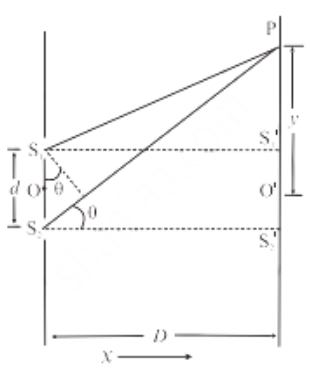
Consider, a point $P$ on the screen at a distance $y$ from $O \ ' (y << 0).$ The two light waves from $S_1$ and $S_2$ reach $P$ along paths $S_1P$ and $S_2P,$ respectively. If the path difference $(\Delta l )$ between $S_1P$ and $S_2P$ is an integral multiple of $\lambda$, the two waves arriving there will interfere constructively producing a bright fringe at $P$ . On the contrary, if the path difference between $S _1 P$ and $S _2 P$ is a half$-$integral multiple of $\lambda$, there will be destructive interference and a dark fringe will be produced at $P$.
From the above figure,
$\left(S_2 P\right)^2=\left(S_2 S_2^ \ {\prime}\right)^2+\left(P S_2{ }^ \ {\prime}\right)^2$
$=\left(S_2 S_2^ \ {\prime}\right)^2+\left(P O^ \ {\prime}+O^ \ {\prime} S_2^ \ {\prime}\right)^2$
$=D^2+\left(y+\frac{d}{2}\right)^2 ....(1)$
and $\left(S_1 P\right)^2=\left(S_1 S_1^ \ {\prime}\right)^2+\left(P S_1^ \ {\prime}\right)^2$
$=\left(S_1 S_1^ \ {\prime}\right)^2+\left(P Q^ \ {\prime}-Q^ \ {\prime} S_1\right)^2$
$=D^2+\left(y-\frac{d}{2}\right)^2 .....(2)$
$\left(S_2 P\right)^2-\left(S_1 P\right)^2=\left\{D^2+\left(y+\frac{d}{2}\right)^2\right\}-\left\{D^2+\left(y-\frac{d}{2}\right)^2\right\}$
$\therefore\left(S_2 P+S_1 P\right)\left(S_2 P-S_1 P\right)$
$=\left[D^2+y^2+\frac{d^2}{4}+y d\right]-\left[D^2+y^2+\frac{d^2}{4}-y d\right]=2 y d$
$\therefore S_2 P+S_1 P=\Delta I=2 y d / S_2 P+S_1 P$
In practice, $D \gg y$ and $D \gg d$,
$\therefore S_2 P+S_1 P \cong 2 D$
$\therefore$ Path difference,
$\Delta I=S_2 P+S_1 P \cong 2 \frac{y d}{2 D}=y \frac{d}{D} ....(3)$ The expression for the fringe width (or band width):
The distance between consecutive bright $($or dark$)$ fringes is called the fringe width$ ($or bandwidth$) \ W.$ Point $P$ will be bright $($maximum intensity$)$, if the
path difference, $\Delta I = y _{ n } \frac{ d }{ D }= n \lambda$ where $n =0,1,2,3, \ldots .$. Point $P$ will be dark $($minimum intensity equal to zero$)$, if $y _{ m } \frac{ d }{ D }=(2 m-1) \frac{\lambda}{2}$, where, $m =1,2,3 \ldots$,
Thus, for bright fringes $($or bands$),$
$y_{n}=0, \lambda \frac{D}{d}, \frac{2 \lambda D}{d} \ldots$
and for dark fringes $($or bands$),$
$y_{n}=\frac{\lambda}{2} \frac{D}{d}, 3 \frac{\lambda}{2} \frac{D}{d}, 5 \frac{\lambda}{2} \frac{D}{d} \ldots$
The bright and dark fringes $($or bands$)$ alternate and are evenly spaced in these situations. For Point $O \ ',$ the path difference $(S_2O \ ' - S_1O \ ') = 0.$ Hence, point $O \ '$ will be bright. It corresponds to the centre of the central bright fringe $($or band$).$ On both sides of $O',$ the interference pattern consists of alternate dark and bright fringes $($or band$)$ parallel to the slit.
Let $y_n$ and $y_{n+1}$, be the distances of the $n$th and $(m+1)^{\text {th }}$ bright fringes from the central bright fringe.
$\therefore \frac{ y _{ n } d }{ D }= n \lambda$
$\therefore y_n=\frac{n \lambda D}{d} .....(4)$
and $\frac{y_{n+1} d}{D}=(n+1) \lambda$
$\therefore\left(y_{n+1}\right)=\frac{(n+1) \lambda D}{d} .....(5)$
The distance between consecutive bright fringes
$=y_{n+1}-y_n=\frac{\lambda D}{d}[(n+1)-n]=\frac{\lambda D}{d} ....(6)$
Hence, the fringe width,
$\therefore W=\Delta y=y_{n+1}-y_n=\frac{\lambda D}{d} ($for bright fringes$) ... (7)$
Alternately, let $y_m$ and $y_{m+1}$ be the distances of the $m$ th and $( m$
$+1)^{\text {th }}$ dark fringes respectively from the central bright fringe.
$\therefore \frac{ y _{ m } d }{ D }=(2 m-1) \frac{\lambda}{2}$ and
$\frac{ y _{ m +1} d}{ D }=[2(m+1)-1] \frac{\lambda}{2}=(2 m+1) \frac{\lambda}{2} ....(8)$
$\therefore y_m=(2 m-1) \frac{\lambda D}{2 d}$ and
$y_{m+1}=(2 m+1) \frac{\lambda D}{2 d} .....(9)$
$\therefore$ The distance between consecutive dark fringes,
$y_{m+1}-y_m=\frac{\lambda D}{2 d}[(2 m+1)-(2 m-1)]=\frac{\lambda D}{d} ....(10)$
$\therefore W=y_{m+1} \quad-y_m$
$=\frac{\lambda D}{d} ($ for dark fringes $) .....(11)$
Eqs. $(7)$ and $(11)$ show that the fringe width is the same for bright and dark fringes.
Need a full question paper?
Generate a complete, print-ready paper with questions like this in minutes — across 16+ boards, with answer keys.