Question
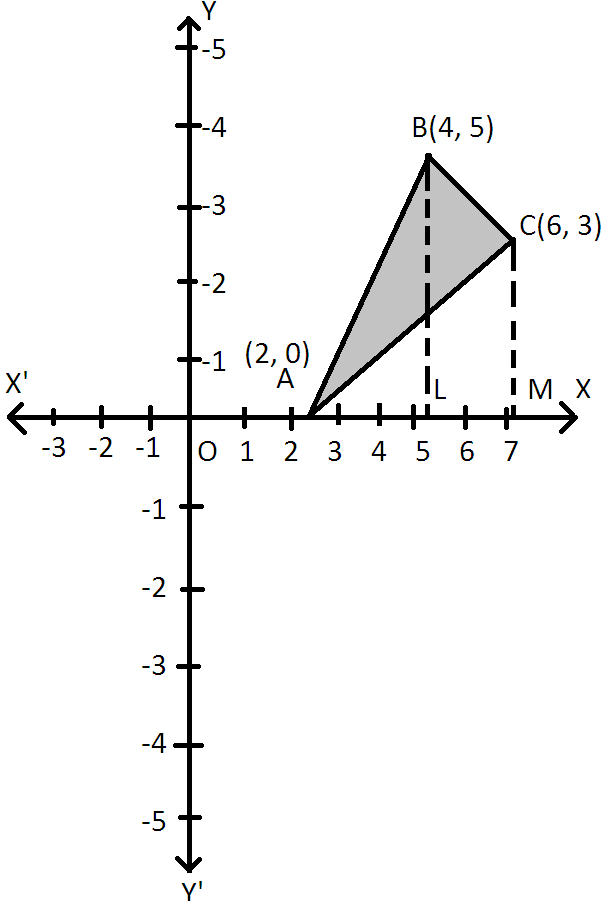
Using the method of integration find the area of the triangle ABC, coordinates of whose vertices are A(2, 0), B(4, 5) and C(6, 3).
Answer

The vertices of $\Delta\text{ ABC}$ are A(2, 0), B(4, 5), and C(6, 3).

Equation of line segment AB is
$\text{y}-0=\frac{5-0}{4-2}(\text{x}-2)$
$2\text{y}=5\text{x}-10$
$\text{y}=\frac52(\text{x}-2)...(1)$
Equation of line segment BC is
$\text{y}-5=\frac{3-5}{6-4}(\text{x}-4)$
$2\text{y}-10=-2\text{x}+8$
$2\text{y}=-2\text{x}+18$
$\text{y}=-\text{x}+9\dots(2)$
Equation of line segment CA is
$\text{y}-3=\frac{0-3}{2-6}(\text{x}-6)$
$-4\text{y}+12=-3\text{x}+18$
$4\text{y}=3\text{x}-6$
$\text{y}=\frac34(\text{x}-2)\dots(3)$
Area $(\Delta\text{ ABC})$ = Area (ABLA) + Area (BLMCB) - (ACMA)
$=\int\limits^4_2\frac52(\text{x}-2)\text{ dx}+\int\limits^6_4(-\text{x}+9)\text{dx}-\int\limits^6_2\frac34(\text{x}-2)\text{ dx}$
$=\frac52\Big[\frac{\text{x}^2}{2}-2\text{x}\Big]^4_2+\Big[\frac{-\text{x}^2}{2}+9\text{x}\Big]^6_2-\frac34\Big[\frac{\text{x}^2}{2}-2\text{x}\Big]^6_2$
$=\frac52[8-8-2+4]+[-18+54+8-36]$ $-\frac34[18-12-2+4]$
$=5+8-\frac34(8)$
$=13-6\\=7\text{ units}$

Need a full question paper?

Generate a complete, print-ready paper with questions like this in minutes — across 16+ boards, with answer keys.

Start Generating Free

Similar questions

Differentiate $\sin^{-1}\Big(4\text{x}\sqrt{1-4\text{x}^2}\Big)$ with respect to $\sqrt{1-4\text{x}^2},$ if:
$\text{x}\in\Big(-\frac{1}{2\sqrt{2}},\frac{1}{2}\Big)$
Using differentials, find the approximate values of the following:
$\log_\text{e}10.01$ it being given that $\log_{10}=0.4343$
Show that the differential equation of $(x-y) d y-(x+y) d x=0$ is homogeneous and solve it.
Prove that $ \tan^{-1}\bigg[\frac{\sqrt{1 + \text{x}} - \sqrt{1 - \text{x}}}{\sqrt{1 + \text{x}} + \sqrt{1 - \text{x}}}\bigg] = \frac{\pi}{4} - \frac{1}{2}\cos^{-1}\text{x} , \frac{1}{\sqrt{2}}\leq\text{x}\leq1$
cards are drawn successively with replacement from a well shuffled pack of 52 cards. Find the mean and variance of red cards.
A company makes 3 model of calculators: A, B and C at factory I and factory II. The company has orders for at least 6400 calculators of model A, 4000 calculator of model B and 4800 calculator of model C. At factory I, 50 calculators of model A, 50 of model B and 30 of model C are made every day; at factory II, 40 calculators of model A, 20 of model B and 40 of model C are made everyday. It costs Rs. 12000 and Rs. 15000 each day to operate factory I and II, respectively. Find the number of days each factory should operate to minimise the operating costs and still meet the demand.
Find the slopes of the tangent and the normal to the following curves at the indicated points:
$\text{x}=\text{a}(\theta-\sin\theta),\text{y}=\text{a}(1-\cos\theta)\ \text{at}\ \theta=\frac{-\pi}{2}$
If $\sqrt{1-\text{x}^2}+\sqrt{1-\text{y}^2}=\text{a}(\text{x}-\text{y}),$ prove that $\frac{\text{dy}}{\text{dx}}=\sqrt{\frac{1-\text{y}^2}{1-\text{x}^2}}.$
There are three coins. One is two headed coin, another is a biased coin that comes up heads 75% of the time and third is an unbiased coin. One of the three coins is chosen at random and tossed, it shows heads, what is the probability that it was the two headed coin?
A class has 15 students whose ages are 14, 17, 15, 14, 21, 17, 19, 20, 16, 18, 20, 17, 16, 19 and 20 years. One student is selected in such a manner that each has the same chance of being chosen and the age X of the selected student is recorded. What is the probability distribution of the random variable X? Find mean, variance and standard deviation of X.